

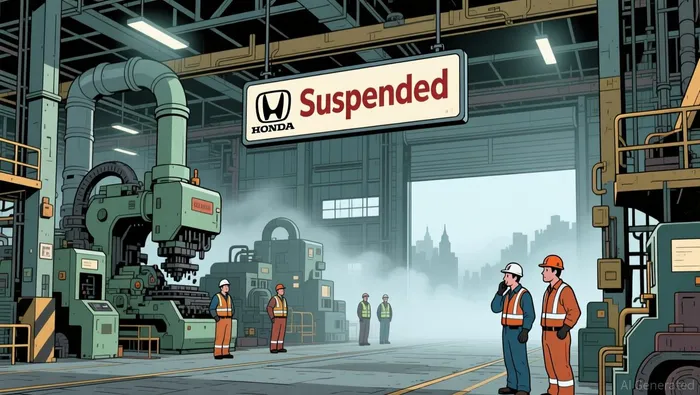
Honda is pulling the plug. The company is indefinitely suspending plans for its massive $11 billion EV and battery plant in Ontario, Canada. This isn't a simple delay. After a two-year pause last year, the move to "shelve" the project signals a clear retreat from its electrification ambitions. It follows a $15.7 billion writedown and the cancellation of three key US EV models, marking a complete pivot away from the electric future it once promised.
The smart money is watching the filings, not the press releases. And here's the critical signal: despite this major strategic retreat, there's no evidence of significant insider selling. Form 4 filings show only minor, routine transactions. This is a key alignment of interest. Management isn't betting against the stock's current price by selling their own shares. They are retreating from a costly bet, but they are not fleeing the ship.
This sets up a classic trap for the unwary. The company is pulling back from a capital-intensive, failing EV project, yet its leadership isn't cashing out. That suggests they believe the core business-likely its hybrid and internal combustion engine vehicles-can still support the stock price. The risk is that the "shelve" is a temporary cover for deeper problems, and the smart money is waiting to see if the company's realignment can generate enough cash flow to offset the writedowns and keep the stock afloat. For now, the insiders are staying put.
The Smart Money's View: Institutional Accumulation
The smart money is fleeing. The numbers tell a stark story of institutional exodus. Between the third quarter of 2024 and the first quarter of 2026, the number of institutional holders plummeted from 361 to 150. More telling is the collapse in reported value, which fell from $2.23 billion to $518 million. This isn't just a minor portfolio rebalancing; it's a massive withdrawal of capital from Honda's story.
This mass sell-off is the dominant signal. It indicates that the large, sophisticated funds that typically drive market momentum have lost confidence in the company's current trajectory. Their exit suggests they see the writedowns, the shelved EV project, and the strategic retreat as fundamental threats to value, not temporary setbacks. For the smart money, the risk/reward has clearly shifted.
Yet, within this tide of selling, a few selective bets stand out. Some major funds have maintained or slightly increased their stakes. For instance, Mondrian Investment Partners held a significant position of over 4.4 million shares, representing a 2.3% stake, with no reported change in its quarterly filing. Other names like Bank of America and American Century also showed modest, positive quarterly changes. This selective accumulation points to a small group of investors who see value in the current price, perhaps betting on a turnaround or a deep value play.
The bottom line is clear. The overwhelming trend is a flight of capital, a verdict from the institutional whale wallets. While a few funds are accumulating, their actions are the exception that proves the rule of widespread skepticism. When the smart money collectively pulls its money out, it's a stronger signal than any single insider trade. It means the narrative of a successful pivot or hidden value is failing to convince the professionals who have skin in the game at scale.
Catalysts and Risks: What to Watch
The smart money is waiting for a definitive signal. The key catalyst to watch is any formal announcement from Honda to scrap the Ontario project entirely. The company has said it has not ruled out scrapping the project entirely, depending on evolving EV policies. A final, public decision would be a clean end to the EV bet, removing a major overhang and allowing the market to price the company on its revised, hybrid-focused strategy. Until then, the indefinite suspension remains a tactical pause, not a strategic conclusion.
The primary drivers to monitor are the very forces that forced this retreat: US EV sales data and policy changes. The pivot was driven by a 36% plunge in EV sales last quarter and the elimination of tax incentives. Any stabilization in those numbers, or a reversal in policy, could reignite the debate over Honda's strategic direction. Conversely, continued weakness would validate the company's retreat and pressure its core business.
The biggest risk is that the stock's low valuation is a value trap. Honda is selling off a costly, failing EV project, but it has not yet presented a clear, alternative growth strategy. The smart money's institutional exodus suggests they see this as a value trap-a cheap stock built on deteriorating fundamentals. The company's core business is still strong in North America, but global sales are down, and its China strategy is in disarray. Without a credible plan to grow beyond hybrids, the stock could remain stagnant while the writedowns and strategic uncertainty weigh on sentiment.
The bottom line is that the next few weeks are critical. Honda is set to detail its revised plans later this month. The smart money will be looking for concrete steps to stabilize operations and generate cash, not just a retreat. If the company can show a clear path to profitability from its hybrid focus, the stock may find a floor. If the plan is vague, the institutional selling could resume, turning a strategic retreat into a deeper decline. Watch the policy headlines, the sales data, and the company's own roadmap for the next move.