

Summary
- NVIDIA has effectively lost its entire AI chip market in China to Huawei - but that does not make Hong Kong-listed Chinese semiconductor stocks a buy.
- The two names driving the rally, SMIC and Hua Hong Semiconductor, trade at extreme valuations that have no connection to their actual earnings power or shareholder returns.
- SMIC - Huawei's primary manufacturing partner - just dumped its dividend to fund massive capital spending, while reporting Q1 profits that missed forecasts.
- Hua Hong Semiconductor, the other visible beneficiary in the rally, generated $54.9 million of net profit on $2.4 billion of revenue all of last year - and trades at multiples that suggest it earns more than it does.
- The false narrative here is that Huawei's self-sufficiency success flows through to Hong Kong-listed chip companies. It doesn't. It flows to Huawei - which is not publicly traded.
I always keep an eye out for irrational false narratives that frequently take the stock market by storm and lead to some terrific bargains - but also to some terrific duds. The current rally in Hong Kong-listed Chinese semiconductor stocks is the latter.
The narrative is simple and seductive: Huawei is winning the AI chip war in China, so buy the Chinese chip stocks trading in Hong Kong. NVIDIA CEO Jensen Huang confirmed in late May that the company has "largely conceded" China's advanced AI chip market to Huawei. China once accounted for 13% of NVIDIA's revenue. Today, its market share in China's AI chip sector has reportedly fallen from 95% to effectively zero. Huawei expects AI processor revenue to reach approximately $12 billion in 2026, up from $7.5 billion last year.
Those are real numbers. The problem is that Huawei is not a publicly traded company. You cannot buy it.
That being the case, the market has turned to Hong Kong-listed semiconductor names - primarily SMIC (0981.HK) and Hua Hong Semiconductor (1347.HK) - as the investable proxy for Huawei's rise. This is where the narrative breaks down against the fundamentals.
SMIC is genuinely the most important link in China's semiconductor supply chain. The company manufactures Huawei's Ascend 910C AI chips and is reportedly ramping toward production of approximately 600,000 units in 2026 - more than double its 2025 volume. SMIC's Q1 2026 revenue of $2.5 billion grew 11.5% year-over-year, and gross margin ticked up to 20.1%.
However, the first-quarter profit of $197.4 million missed analyst forecasts of $215.2 million. More importantly for an income-focused investor, SMIC has abandoned its dividend - refocusing capital on investment rather than shareholder returns. The company is pouring cash back into capital expenditures to maintain its fabrication cadence. That is a legitimate strategic choice for a company trying to advance process nodes under sanctions pressure. But it means the stock offers nothing to investors in the way of yield or free cash flow distribution. And yet it trades at a trailing P/E of approximately 113 to 122 - with a forward P/E near 256x.
At those multiples, you are paying for a level of future earnings that may never materialize. The stock is pricing in a flawless execution of Huawei's roadmap, flawless margin recovery, and an eventual return of the dividend - all simultaneously. In my opinion, that is not structural conviction. That is hope.
Hua Hong Semiconductor presents an even starker disconnect. China's second-largest chipmaker behind SMIC, Hua Hong reported Q1 2026 revenue of $660.9 million, up 22.2% year-over-year, with gross margin improving to 13%. That growth rate sounds strong - until you look at what happens below the gross margin line. Full-year 2025 net profit attributable to shareholders was $54.9 million on $2.4 billion of revenue. That is a net margin of 2.3%. The stock trades at trailing P/E multiples exceeding 500x, with some data sources showing figures near 975x.
Comparisons with global semiconductor peers at those valuations are not only unjustifiable and irrational; in my opinion, they are irresponsible. A company that turns $2.4 billion of revenue into $54.9 million of net profit does not deserve a 500x P/E - even if the market believes tomorrow's margins will look like a completely different business.
The stock's own trading behavior confirms the fragility of the thesis. On May 8, Hua Hong plunged 7% in a sharp reversal of the prior day's surge. SMIC dropped 4% in the same session. These are not fundamentally driven moves. They are sentiment whipsaws - the kind of volatility that characterizes a market fueled by narrative rather than earnings power.
Now, I understand the structural logic investors are trying to trade. China's push for semiconductor self-sufficiency is real. The 14th Five-Year Plan has delivered measurable progress in domestic chip production. If Chinese companies capture 50% domestic market share by 2030, the projected revenue expansion is enormous. I do not dispute the trend.
But trends are not investments until fundamentals catch up. The question is not whether Huawei is succeeding. The question is whether you can profit from it through Hong Kong-listed names that trade at 100x to 900x earnings, pay no dividends, and burn cash on capital expenditures to keep the production lines running.
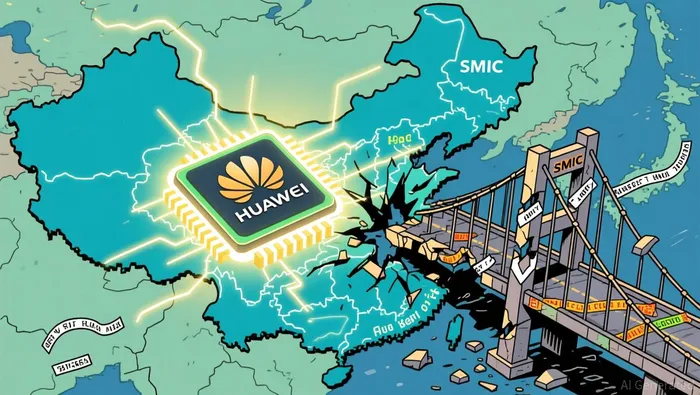
Of the Hong Kong-listed Chinese semiconductor names, neither SMIC nor Hua Hong passes the dividend and free cash flow test. SMIC generates revenue growth but no shareholder returns; Hua Hong generates neither in any meaningful sense. Both are capital-intensive operations running at thin margins, and both are priced as if they are high-margin, high-return compounders.
The Global X China Semiconductor ETF (3191.HK) bundles these names together, but that does not solve the underlying problem. An ETF does not fix broken fundamentals - it just spreads them across a basket.
That being the case, I rate both SMIC and Hua Hong Semiconductor as "Sells" at current levels. The Huawei semiconductor self-sufficiency story is real, but its investment value flows to a company you cannot buy. The Hong Kong-listed proxies are trading at valuations that assume a perfect future while delivering nothing to shareholders today - no yield, no free cash flow distribution, and in SMIC's case, earnings that already miss expectations.
For investors who want exposure to the structural shift in China's semiconductor independence, the current entry point in Hong Kong-listed names offers no margin of safety. Patience - and a willingness to look beyond the narrative - will serve you better than buying the hope trade.