

The $1 billion grant changed the story
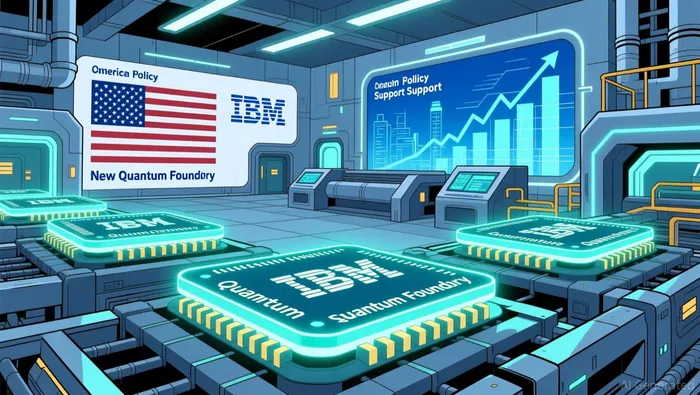
This is what a strategic re-rating can look like. IBM did not need a near-term earnings inflection to move the market; it needed a signal that it may be building part of the infrastructure layer of the next compute cycle. Earlier this week, the Commerce Department announced a $1 billion CHIPS incentive to support a new quantum chip foundry, and IBM said it would contribute $1 billion in cash plus IP, assets, and workforce to Anderon, a standalone 300-millimeter quantum wafer foundry based in Albany, New York. The market read that as more than a policy win: a claim on future quantum manufacturing rails.
The market's first verdict
The reaction was sharp. IBM shares jumped 12.4% on Thursday and added another 4.6% in overnight trading after the proposed government support became clear, while Stocktwits sentiment shifted from bearish to extremely bullish. Investors were not pricing foundry revenue next quarter. They were pricing optionality on a broader question: can IBM become a foundry model for quantum the way some semiconductor names became essential before their biggest revenue waves?
Bulls see IBM positioning itself before proof exists. Bears will argue that a foundry announcement is not the same as technical validation or customer demand. That is a fair split. But in frontier tech, the first re-rating often comes from infrastructure ambition rather than current earnings. The timing matters because the government has already signaled strategic interest through a proposed $1 billion semiconductor funding package.
Why Anderon matters more than another quantum system
The key re-rating here is not that IBM built another quantum system. It is that IBM may be claiming the manufacturing node. Anderon is described as America's first pure-play quantum foundry, and its stated purpose is to make advanced quantum wafer production available for multiple quantum technology vendors. That shifts the strategic question from who can build the most impressive quantum computer to who controls the fabrication platform others may need.
Foundry ambition versus system ambition
A standard quantum announcement sells compute ambition. A foundry announcement sells standardization. If Anderon becomes a place where quantum wafers are developed and scaled, it could influence design rules, process standards, and quality benchmarks across the ecosystem. That is more valuable than a standalone system sale because it turns IBM's know-how into a platform other companies can consume.
The policy backdrop strengthens that reading. Washington is reportedly assembling a roughly $2 billion funding package for nine companies developing quantum technologies, and IBM is expected to receive about $1 billion. IBM is also putting in $1 billion cash investment of its own, on top of significant IP, assets, and workforce support. That looks more like strategic manufacturing infrastructure than a side project.
Why investors may be paying for scarcity
Bears will argue that foundry demand remains hypothetical until qubit architectures stabilize and the market standardizes around a process. That is reasonable. But it is also why the timing matters now. If quantum hardware begins to follow a specialization curve more like classical semiconductors, the first credible foundry could become a standards node. Investors are not paying only for near-term wafer revenue. They are paying for the chance that IBM occupies a scarce position before the ecosystem fragments or consolidates.
The real debate: infrastructure hub or real option?
The real debate is not whether IBM has a quantum story. It does. The debate is whether federal backing is helping IBM become a standard-setting manufacturing hub, or whether a large incumbent is simply buying a more valuable real option in a still-fragmenting paradigm.
Why the bullish case still has force
The bullish case is about ecosystem positioning, not near-term foundry revenue. Washington is reportedly building a roughly $2 billion funding package that could support nine companies developing quantum technologies, with IBM expected to receive about $1 billion. If that money helps anchor a U.S.-based wafer fabrication hub, IBM is not just pitching better machines. It is trying to sit closer to the infrastructure layer, where process rules and development practices can begin to standardize.
Why the bear case is still credible
Bears are right to focus on competition inside that same federal plan. Reported support also extends to other players in the ecosystem, and recent reporting confirmed grants to names including Rigetti Computing and D-Wave Quantum. That cuts both ways. Government participation can de-risk the buildout, but it also suggests policymakers are supporting multiple architectures and business models rather than crowning one winner immediately. If the field stays fragmented, IBM risks owning the factory without owning the standard.
July 22, 2026 is the next evidence point
The next hard test is July 22, 2026, IBM's second-quarter earnings date. That session matters because management will also be expected to address topics analysts already flag around the Confluent opportunity, z17 sales cycle updates, and AI-related issues. Investors do not need quantum revenue to move earnings now, but they do need evidence that the foundry effort is being executed with discipline rather than treated as an open-ended strategic bet.
Watch three things:
What would make the re-rating stick
First, external demand. For the re-rating to hold, IBM has to move Anderon from announcement to operating platform. The company says Anderon will enable advanced quantum wafer production for a broad range of companies, and IBM has said additional investors are expected as Anderon grows. If outside customer interest and third-party capital start showing up, the infrastructure thesis gets stronger. If not, the bear case becomes easier to defend.
Second, execution discipline. With a further $1 billion cash investment from IBM and major federal backing expected, the burden is not raising the money. It is deploying it without fracturing the broader business. That is why July 22, 2026 remains the next hard checkpoint. Management does not need quantum revenue to hit a target. It does need to show that this capital-intensive build is being integrated with operating control.
Third, ecosystem capture. Washington's broader quantum push is reportedly spread across nine companies developing quantum technologies, which could either validate the platform or dilute it. The re-rating holds if Anderon becomes a common manufacturing node across architectures. It weakens if the ecosystem fragments and IBM ends up owning the factory without owning the standards.