

The latest World Economic Outlook from the IMF and World Bank paints a picture of a global economy that was stabilizing—but is now being tested again by the Iran conflict, with energy markets acting as the central transmission mechanism for both growth and inflation shocks.
The most immediate and visible impact is on commodity prices, particularly oil. The IMF now expects energy prices to rise 19% in 2026, with oil prices increasing more than 21% due to disruptions in production and transportation across the Middle East. This is a sharp reversal from prior expectations for declining prices and reflects the direct impact of constrained supply, damaged infrastructure, and disruptions in key shipping routes like the Strait of Hormuz. The knock-on effects extend beyond oil, with natural gas, food, and fertilizer prices also expected to rise, amplifying inflationary pressures globally.
From a growth perspective , the IMF highlights that the global economy remains resilient but is now clearly slowing. Global GDP is projected to grow 3.1% in 2026, down from 3.4% in 2025 and roughly 0.2 percentage points below pre-conflict expectations. While this headline downgrade appears modest, it masks significant divergence beneath the surface, with the conflict acting as a negative supply shock that disproportionately impacts certain regions and economies.
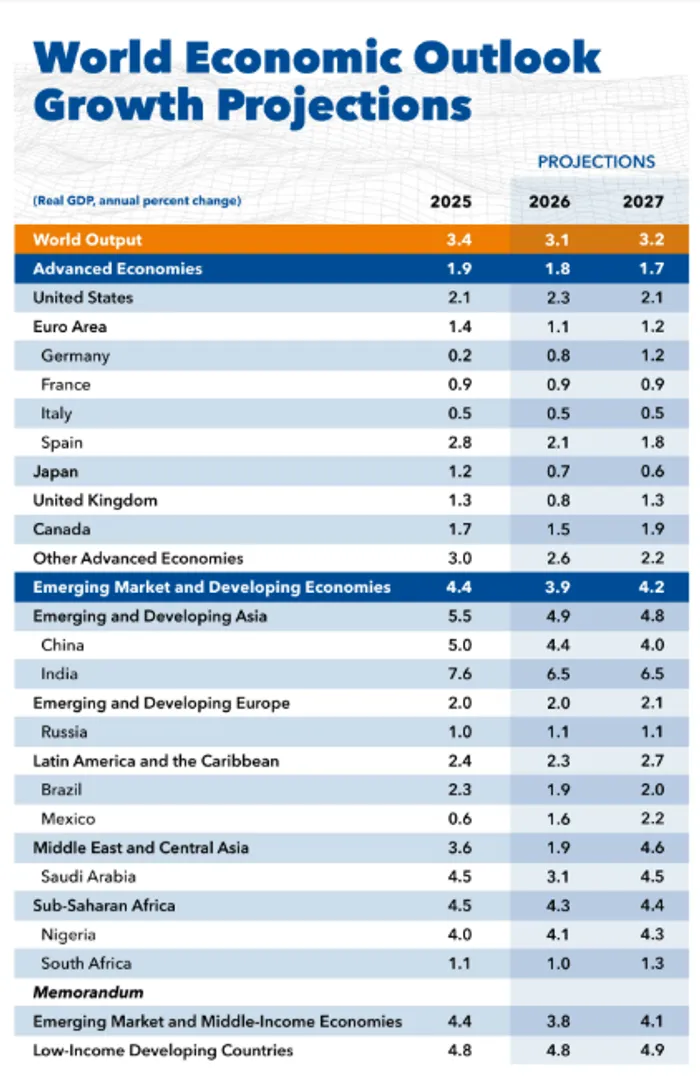
The most severe growth downgrades are concentrated in the Middle East and Central Asia, where the conflict is directly affecting production, exports, and infrastructure. Regional growth is expected to collapse from 3.6% in 2025 to just 1.9% in 2026. Within that, Iran stands out as the most extreme case, with growth revised down sharply to -6.1% for 2026, reflecting direct war-related disruptions. Other oil producers such as Iraq, Kuwait, and Qatar also face meaningful downgrades due to reduced output and logistical constraints.
Outside the conflict zone, the euro area and United Kingdom are among the hardest-hit advanced economies, primarily due to their status as net energy importers. Euro area growth is projected to slow to 1.1% in 2026, with a 0.2 percentage point downgrade tied to higher energy costs and weaker manufacturing activity. The UK sees an even steeper revision, with growth dropping to 0.8% amid rising inflation and slower policy easing.
Emerging markets, particularly commodity-importing economies, are also under pressure. The IMF notes that low-income, energy-importing countries face the largest cumulative growth downgrades, with a 0.5 percentage point hit over 2026–2027. Currency depreciation in these economies further amplifies the inflation shock, making energy and food imports more expensive and tightening financial conditions.
In contrast, energy-exporting economies are among the relative winners in this environment. Countries like the United States and Brazil benefit from positive terms-of-trade effects, with higher energy prices supporting income and growth. The U.S., for example, is still expected to grow 2.3% in 2026, with only a modest downgrade, reflecting its status as a net energy exporter and continued support from fiscal policy and prior monetary easing.
There are also selective upside revisions to growth, particularly in parts of Asia. India stands out, with growth expectations revised higher to 6.5% for 2026, supported by strong domestic momentum and reduced tariff pressures. China also sees a modest upward revision relative to earlier forecasts, as stimulus and trade adjustments help offset the negative effects of the conflict. These pockets of resilience highlight the uneven nature of the current global cycle.
Inflation is where the impact of the conflict is most pronounced. Global inflation is now expected to rise to 4.4% in 2026, reversing the prior disinflation trend. The increase reflects higher energy and food prices, along with second-order effects on inflation expectations. Emerging markets are expected to see larger inflation increases than advanced economies, driven by currency weakness and higher import costs.
The report also outlines downside scenarios that underscore the fragility of the outlook. In a more adverse scenario, oil prices could rise as much as 80%, pushing global growth down to 2.5% and raising inflation significantly. In a severe scenario, oil prices could double, bringing global growth dangerously close to recession levels below 2%, while inflation surges above 5%. These scenarios highlight how sensitive the global economy is to energy market disruptions.
Debt dynamics are another area of concern. The combination of higher energy prices, weaker growth, and rising borrowing costs is expected to put additional pressure on public finances. U.S. debt is projected to rise from 124% of GDP in 2025 to 142% by 2031, while emerging market debt is expected to climb to 86% of GDP. Governments may also face pressure to increase spending to offset the impact of higher energy costs on households, further widening deficits.
Central bank policy is becoming more complex in this environment. The conflict has introduced a new global supply shock, forcing policymakers to balance inflation control with growth risks. The IMF expects divergence across regions, with the Federal Reserve gradually cutting rates over time, while the European Central Bank may still need to tighten policy in 2026 due to persistent inflation pressures. In downside scenarios, central banks may be forced to prioritize inflation, even at the cost of weaker growth.
Ultimately, the IMF’s outlook underscores a key shift in the global macro narrative. What was shaping up to be a steady, if unspectacular, growth environment has now become one defined by geopolitical risk, energy volatility, and policy uncertainty. The Iran conflict has reintroduced stagflationary pressures into the system, with higher inflation and slower growth occurring simultaneously.
The big picture is one of resilience—but increasingly fragile resilience. While the baseline scenario assumes a relatively short-lived conflict and only modest economic disruption, the risks are clearly skewed to the downside. For investors and policymakers alike, the path forward will depend heavily on the trajectory of the conflict, the behavior of oil prices, and the ability of central banks to navigate a much more complex and uncertain macro landscape.