

The numbers from Infinity Natural Resources' first quarter paint a classic picture of a company in hyper-growth mode. The headline production figures are eye-popping. The company delivered 88% growth in total net daily production to 299.3 MMcfe/d compared to the same period last year. That's a massive ramp-up, driven by a transformative acquisition and new well completions. On the revenue side, that production surge translated into a strong beat, with sales hitting $154.9 million, surging 81.9% year-over-year.
But here's where the common-sense lens is needed. For all that growth, the bottom line tells a different story. The company reported a net loss of $6.3 million for the quarter, which is a significant widening from prior periods. This is the core tension: explosive production and revenue growth are being funded by heavy investment, and the company is still burning cash to get there.
To break it down simply: 1. Revenue: $154.9 million, up 82% YoY. The top line is clearly expanding. 2. Production: 299.3 MMcfe/d, up 88% YoY. The operational engine is firing on all cylinders. 3. Profitability: Net loss of $6.3 million. The bills are piling up faster than the new revenue can cover them.
The story isn't just about the loss, but about the scale of the investment required to achieve this growth. The company spent $111.5 million on development capital expenditures last quarter alone. That's a huge outlay to build the production machine. The result is a company that is scaling fast, but not yet profitable. The real-world question for investors is whether this growth is sustainable and if the company can eventually turn that production into real cash flow that covers the costs. For now, it's a classic "growth vs. profitability" setup that needs watching.
The Earnings Quality Smell Test: Cash Flow vs. Net Income
The numbers from the first quarter tell a story that looks good on paper but raises a red flag when you check the cash register. The company reported a net loss of $6.3 million, but that figure is a product of accounting rules, not the real-world cash burn. The true test of earnings quality is what happens to the actual dollars in the bank.
Here's the disconnect: cash from operating activities totaled $58.4 million, down 21.3% year-over-year. That's a significant drop in the cash engine. Meanwhile, the company spent $111.5 million on development capital last quarter alone. In other words, it's spending more than it's bringing in from operations, even as production and revenue soar. This is the classic setup for a growth story that's burning through cash to fund its expansion.
The funding for this growth came from the balance sheet, not from operations. To close its transformative $1.2 billion acquisition of assets from Antero Resources, Infinity raised $350 million in equity and issued $550 million in senior notes. This dramatically increased leverage, with total liabilities surging 342% year-over-year. The company now has a major debt load to service, which will pressure future cash flow.
So what's the buffer? Cash and cash equivalents rose to $73.0 million, up 1,402.0% year-over-year. That's a massive short-term war chest built from the equity and debt raised. It's a lifeline, but it's not a business model. This cash provides a runway, but it doesn't solve the core problem: the company is using borrowed money and new equity to fund growth, while its core operations are generating less cash than before.
The bottom line is a smell test for earnings quality. High capital spending and debt are funding the production ramp, but cash flow is declining. For the story to work, that operating cash flow needs to turn around and start covering the costs of growth and debt service. Until then, the reported profits are a shadow of the real financial picture.
The Real-World Utility: What's the Production Actually Worth?
The headline production numbers are impressive, but the real test is what that new output is actually worth in the real world. The company's realized prices tell a clear story about its strategy and the economics of its growth.
First, look at the oil. The company's realized oil price was $58.40 per barrel. That's well below the current market price for West Texas Intermediate crude. This isn't a pricing problem; it's a deliberate hedging strategy. Management is prioritizing the "volatile oil window" for near-term returns, which means they are focusing on wells that produce oil and are currently unhedged. The low realized price indicates they are taking on more price risk to capture stronger returns now, betting that oil prices will hold or rise. It's a high-stakes, high-reward play that could lead to higher but riskier earnings.
Then there's natural gas. Production here grew 169% year-over-year, a staggering increase. Yet the realized price was just $3.54 per Mcf. That's a low point for the commodity, reflecting the current oversupply in the Appalachian Basin. The company's own midstream system, which handles 75% of its gas volumes, is operating at less than a quarter of its capacity. This underutilization is a direct contributor to the weak pricing, as the company is competing with other producers for limited takeaway options. The strategy to ramp third-party throughput is a long-term fix, but it doesn't help the low prices today.
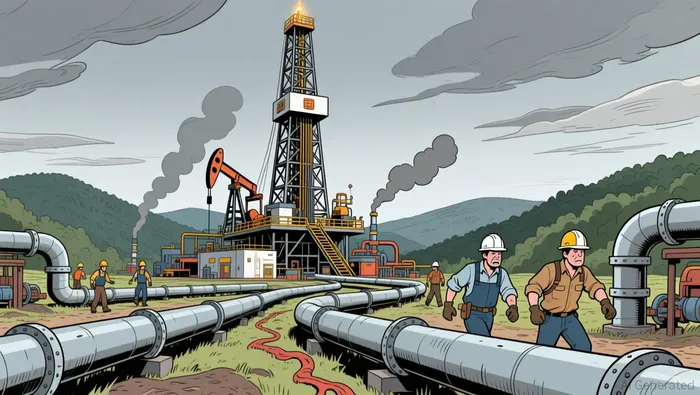
Put simply, the company is scaling up a business where the core product-natural gas-is selling at a discount, while betting heavily on oil prices to hold. The operational execution is solid, with a second frac crew and rig driving the growth. But the real-world utility of this production is being weighed down by commodity prices and the company's own hedging decisions. The cash flow from this new output is being squeezed from both ends. For the growth story to pay the bills, management needs to either see gas prices firm up or successfully monetize that idle midstream capacity to improve its pricing power. Until then, the utility of all that new production is compromised.
Catalysts and Risks: What to Watch Next
The investment thesis for Infinity Natural Resources now hinges on a few clear, near-term tests. The company has built a powerful production machine, but the real-world question is whether it can convert that volume into consistent cash flow and eventually net income. Three critical points will determine if the story holds or breaks.
First, the primary catalyst is execution on that production ramp. Management expects production to increase sequentially each quarter throughout 2026, with the fourth quarter as the peak. The company is running two rigs-one on legacy assets and one on the newly acquired Antero acreage-to drive this growth. The key will be whether the cash from operations, which fell last quarter, can start to catch up with the heavy development spending. The company's controllable cash operating costs declined 18% year-over-year due to scale, which is a positive sign. But for the story to work, this cost advantage needs to translate into a rising cash flow that can fund growth without relying on the balance sheet.
Second, a major risk is the high level of debt from the acquisition. The company raised $550 million in senior notes and $350 million in preferred equity to close the $1.2 billion Antero deal. While this strengthened the balance sheet, it also created a significant interest burden. If commodity prices soften, as they have for natural gas, the pressure on returns will increase. The company's guidance assumes net production between 345 and 375 MMcfe/d for the year, representing about 70% growth. That ambitious target must be achieved while servicing this new debt, making the path to profitability more precarious.
Third, watch for progress in filling the underutilized midstream system. This is a potential game-changer. The acquired infrastructure is viewed as a 'turnkey system' with significant underutilized capacity, currently operating at less than a quarter of its 600 million cubic feet per day limit. Management is highly incentivized to fill this pipe and sees it as a source of third-party revenue. Successfully ramping this throughput would improve gas pricing by reducing local oversupply and provide a new cash flow stream. It's a direct lever to improve the economics of the company's massive natural gas production.
The bottom line is that Infinity is now in the execution phase. The catalysts are clear: ramp production, control costs, and monetize the midstream. The risks are tangible: high debt and commodity price volatility. Investors should watch the next few quarters for signs that the company is turning its impressive production volume into the real-world cash flow needed to pay the bills.