

Innodata's fundamentals are undeniably strong. The company delivered 48% annual revenue growth to $251.7 million and 68% EBITDA growth to $57.9 million for fiscal 2025. Yet the stock's price action tells a different story-one driven less by rational valuation than by behavioral overreaction. This is irrational exuberance meeting real growth, creating a classic momentum trap.
The numbers are extreme by any measure. INOD has racked up a 192.5% rolling annual return, but the acceleration is what signals behavioral fever. The stock surged 127.1% in just five trading days and 166.2% over twenty days. These aren't gradual revaluations; they're explosive moves that suggest investors are chasing recent wins rather than discounting future cash flows. The 36.27% turnover rate confirms frenzied trading activity-people buying and selling with unusual intensity, likely driven by fear of missing out rather than fundamental analysis.
The valuation metrics reveal the extent of the overreach. At 86.29 trailing P/E and 112.97 forward P/E, the market is pricing in years of perfection. The 51.77 PEG ratio-price relative to growth-suggests investors are paying 51 dollars for every dollar of expected earnings growth. Even relative to sales, at 11.59 times revenue, the stock commands a premium that would be hard to justify in any other sector.
Here's the behavioral tension: Innodata's fundamentals deserve a premium. The company is growing faster than most AI-adjacent businesses, with 35%+ revenue growth projected for 2026 and expanding margins. But the price has run far ahead of the fundamentals. The 5-day and 20-day gains are not responses to new information-they are momentum chasing, the market equivalent of a feedback loop where rising prices attract buyers who push prices higher, regardless of value.
This is the beat-and-raise trap in action. Innodata beat expectations, raised guidance, and the market responded with exponential rather than linear pricing. The result is a stock that may have real merit but is now vulnerable to the same behavioral reversal that follows every momentum rally: when the music stops, the dancers who arrived late get hurt.
Anchoring on Explosive Early Growth
The most powerful anchor in this rally is the 127% revenue growth Innodata posted in Q4 2024. That number-$59.2 million in revenue, up from $26.1 million a year earlier-became the mental reference point for investors chasing the stock. But the company's growth trajectory tells a different story: 127% in Q4 2024, 48% for full-year 2025, and now guidance pointing to roughly 35% in 2026. This is not a company maintaining explosive momentum. It is a company whose growth rate is normalizing-and investors anchored on the early number are mispricing that reality.
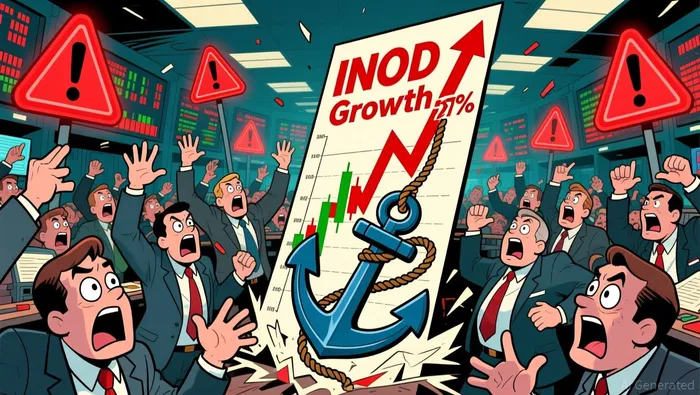
Anchoring is one of the most persistent cognitive biases in investing. Once people latch onto a number-especially an extreme one like 127%-they adjust insufficiently when new information arrives. The 48% growth Innodata delivered in 2025 is objectively strong. But relative to the Q4 2024 peak, it represents a 62-percentage-point deceleration. The 2026 guidance of approximately 35% or more revenue growth signals further normalization. Yet the stock price continues to reflect the earlier, more extreme trajectory.
The earnings surprise pattern reinforces this anchoring trap. Innodata has beaten analyst estimates for four consecutive quarters, with an average surprise of 55.9%. This creates a secondary anchor-investors begin to expect not just growth, but consistent, substantial beats. When a company delivers solid results that still represent meaningful deceleration, the market may treat them as disappointing simply because they don't match the earlier shock-and-awe pattern.
Here's the behavioral tension: the fundamentals are still impressive. A company growing at 35%+ with expanding margins is far from a value trap. But the price has run far ahead of the deceleration story. Investors who bought on the 127% anchor are now facing a company whose growth is clearly moderating-and the market has not yet priced in that transition. When the music stops, those anchored to the wrong number will be the first to stumble.
Valuation Gap and Correction Risk
The numbers tell a stark story: Innodata's PEG ratio of 51.77x means investors are paying $51.77 for every $1 of expected earnings growth. This is not a premium-it is a bet that perfection will be delivered, quarter after quarter, with zero tolerance for deviation. The EV/EBITDA multiple of 58.66x compounds the problem, pricing in years of margin expansion before a single dollar of it has materialized.
Compare this to the IT services universe. Cognizant and Infosys-mature, slower-growth peers-trade at single-digit EV/EBITDA multiples and PEG ratios well below 2.0. The Zacks data shows INOD has outpaced Cognizant Technology Solutions and Infosys dramatically over the past six months, but that outperformance is entirely behavioral. It reflects momentum chasing, not a rational discount to future cash flows. When a stock trades at 112.97x forward P/E, the market is no longer valuing the business-it is valuing the narrative around the business.
This creates a brittle structure. The PEG of 51.8 leaves zero margin for error. Even a single quarter where Innodata delivers solid results but fails to beat expectations by the 55%+ margin it has built over the past four quarters could trigger a violent reassessment. The anchoring on early explosive growth means the market is not pricing in normalization-it is pricing in acceleration. When reality arrives, the gap will close.
Q1 2026 results, expected in May, represent the first major stress test. The company's guidance suggests 25.9% revenue growth for 2026-a meaningful deceleration from 2025's 48%. If Q1 shows the kind of year-over-year growth that matches or exceeds 2025's pace, the rally may have further to run. But if the numbers show the expected normalization-if revenue growth slows toward the low-30% range or margins compress from increased investment-the valuation gap will snap shut with dangerous speed.
The behavioral tension is clear: investors are anchored on the 127% Q4 2024 growth number and the 55.9% average earnings beat. They are not pricing in the possibility that Innodata is a good company growing at a normalizing rate, not a hyper-growth outlier. When the Q1 report arrives, the market will learn whether the fundamentals can support even a fraction of this valuation. The odds are not in the stock's favor. At these multiples, the cost of a single miss is far higher than the reward for another beat.