

A 225% rally changes the question
Intel's about 225% year-to-date gain changes the setup. After a move of that size, the stock is no longer a cheap reset waiting to be discovered. It is now a large, headline-sensitive business that has to back the rally with harder evidence.
The bull case still has real operating support
Bulls are not pointing to hope alone. Intel's data center and AI business grew 22% year over year, while operating margin in that segment rose to roughly 31%. Management said AI demand is lifting the need for CPUs, silicon supply, and advanced packaging, and it pointed to new and deepened relationships with strategic partners. On top of that, reported talks around Apple and Intel's role in the Terafab semiconductor project give the foundry story a more visible external customer base.
The bear case is simpler: proof still lags fundamentals
Shares recently hit a record above $129, while the Wall Street average price target remained just under $85, more than 30% below that close. That gap matters. It suggests the market is still valuing Intel mostly as an AI turnaround with potential, not as a foundry business that has already converted demand into durable profit.
So the real question is no longer whether the narrative is believable. It is whether Apple, cloud, and Terafab headlines can turn into lasting foundry revenue and better margins.
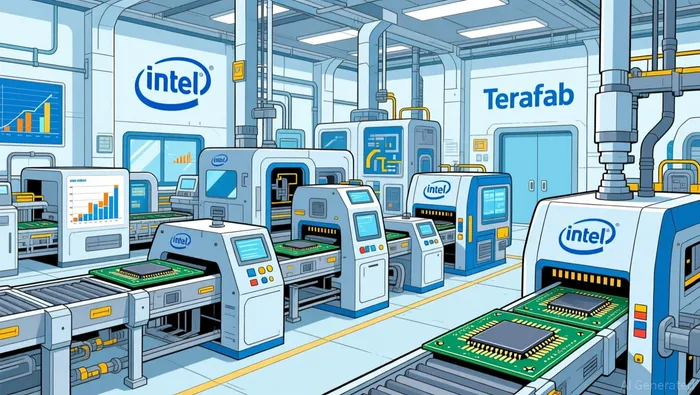
Why the market got excited: Intel may finally have visible foundry demand
The excitement is not random. Terafab gives Intel a visible external customer for its foundry plan, rather than another internal roadmap item.
Terafab gives the foundry story a real customer test
Terafab is targeting one terawatt per year of AI and robotics compute power, and Intel's role is to support that through its foundry, AI chip manufacturing, and advanced packaging capabilities in the U.S. That matters because foundries do not win on ambition alone. They win when outside customers commit capacity, place repeat orders, and help fund the supply chain.
This matters even more because Intel already relies on outside fabrication for part of its own output. Management has said a significant use of third-party foundry capacity is part of the current setup, and outside analysis has suggested advanced packaging technology might be the most underappreciated part of the story. In other words, Intel's own factories need a reason to exist beyond serving internal product groups, and Terafab starts to provide that.
Packaging is part of the value proposition
The business logic here is not limited to wafer fabrication. The broader AI buildout is straining existing high-end compute production, which makes packaging and system-level integration more important. For a customer like Terafab, that can make Intel's mix of process technology and packaging expertise more relevant than a simple node comparison.
The new internal foundry model is about discipline, not just scale
Intel's new internal foundry model is designed to make product groups and manufacturing work together in a more arm's-length way. Management has tied that change to $8 billion to $10 billion in cost savings exiting 2025 and to a longer-term ambition of non-GAAP gross margins of 60%.
If Intel can make its fabs behave more like true suppliers-internal and external-and improve the economics of that manufacturing layer, the foundry story becomes easier to underwrite.
What investors should watch: - concrete Terafab order visibility and capacity commitments - signs the arm's-length internal model is improving foundry economics - whether packaging, not just process nodes, becomes part of customer wins
The operating trend is improving, but the financial safety margin is still thin
Operating progress is real
Intel's business is clearly improving. First-quarter revenue reached $13.6 billion, Data Center and AI grew 22%, and Intel Foundry grew 16%. That is the kind of top-line and mix improvement that can support a higher valuation over time. This is no longer a story with zero operating evidence.
Cash flow and balance-sheet pressure still matter
The pressure point is that the income statement and cash flow have not fully caught up with the stock. Intel still reported a GAAP net loss of $3.728 billion, free cash flow of negative $3.867 billion, and only a Q2 non-GAAP EPS guide of $0.20. Just as important, it now carries a market cap past $470 billion.
After a move this large, investors are no longer paying for a company that is merely getting less bad. They are paying for a company that can eventually fund its own rebuild without constant stress on cash or capital allocation.
Where bulls and bears split
Bulls see a turnaround with real operating momentum and a plausible path to external foundry revenue. Bears see a company whose financial safety margin is still too thin for a stock that has already rerated so aggressively.
What would confirm the rally-and what could break it
The next earnings report gives investors a clean scoreboard. Management is looking for $13.8 billion to $14.8 billion in Q2 revenue and non-GAAP EPS of $0.20.
Signals that would support the rally
- Revenue nearer the high end of guidance, which would suggest demand is broadening.
- EPS at or above $0.20, which would show the business is not weakening sequentially.
- Evidence that the internal foundry model is changing how the business runs, consistent with $8 billion to $10 billion in cost savings exiting 2025.
Signals that could shake confidence
If revenue stays near the low end and EPS falls below $0.20, the market could decide the story has run ahead of the fundamentals. Options pricing already implies swings of about 8.5% in either direction by month-end, which is the kind of setup where proof gets rewarded quickly and delays get punished quickly.