

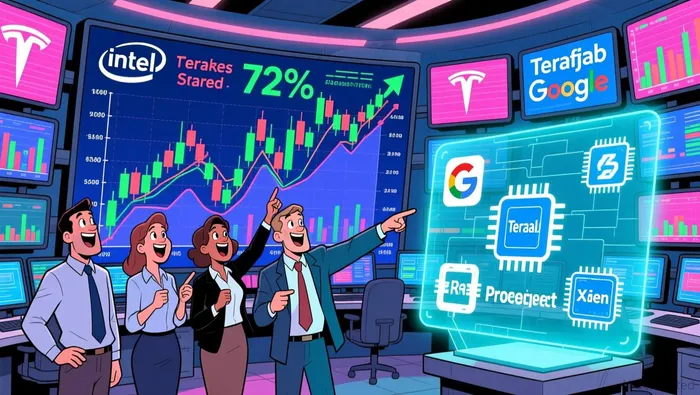
Intel shares have surged 72% year-to-date, marking the company's best performance in over a decade. A record nine-day rally added over $100 billion in market value, driven by strategic partnerships and asset acquisitions. The stock trades at a significant premium to analyst targets, raising questions about whether the rally is sustainable. Key catalysts include the Terafab project with Tesla and a multi-year deal with Google for Xeon processors.
Intel Corporation (NASDAQ: INTC) has officially declared its return to the center of the semiconductor conversation. After years of struggling with manufacturing delays and market share losses, the chip giant has staged a dramatic comeback that has left Wall Street both impressed and wary. The company's stock has exploded higher, fueled by a series of high-stakes strategic moves that suggest a fundamental shift in its business trajectory. But as the price climbs to five-year highs, investors are left asking if the rally is grounded in reality or if it is pricing in a perfect future that may never arrive.
Why Is Intel Stock Surging 72% Year-To-Date?
The most striking feature of Intel's recent performance is the sheer velocity of its recovery. In a single nine-day window, the stock gained nearly 60%, adding more than $100 billion to its market capitalization and marking the best eight-day stretch in the company's history since going public in 1971. This momentum has compounded into a 72% gain for the year, effectively erasing the losses from previous quarters and pushing the stock back into the spotlight of major institutional portfolios.
The primary engine driving this rally is a clear signal that Intel is no longer fighting for survival but is instead in a mode of aggressive expansion. This narrative shift was cemented by a massive $14.2 billion agreement to buy back half of its Fab 34 plant in Ireland from Apollo Global Management. By reclaiming control of the facility, Intel demonstrated the financial confidence to invest heavily in its infrastructure, a move that Thomas Hayes of Great Hill Capital noted proves the company is "in expansion mode, not survival mode."
Complementing the asset buyback is a series of strategic partnerships that validate Intel's role in the next generation of computing. The company joined Elon Musk's Terafab project, a joint initiative to develop advanced semiconductors for Tesla, SpaceX, and xAI. This alliance not only provides Intel with a high-profile client but also signals confidence in its ability to manufacture cutting-edge chips for the most demanding applications in the world. Additionally, a multi-year agreement with Alphabet (Google) ensures that future generations of Intel's Xeon processors will power Google's data centers, securing a critical revenue stream in the cloud computing sector.
Does Intel Stock Have Room To Run Past The Rally?
While the momentum is undeniable, the market is currently grappling with the valuation of the stock. Intel shares are trading at a significant premium, with some metrics suggesting a price-to-earnings ratio of over 90 times estimated earnings for the next 12 months. This valuation implies that the market is pricing in a rapid and flawless execution of the company's turnaround strategy, which includes the successful ramp-up of its 18A and 14A process nodes.
Analysts remain divided on the sustainability of this premium. Of the 52 analysts tracked by Bloomberg, only 10 hold "buy" ratings, with the consensus rating standing at a relatively weak 3.15 out of 5. UBS analyst Timothy Arcuri has cautioned that the stock price already reflects an optimistic 2030 scenario, which could limit further upside in the near term. However, other voices see potential for continued gains. Northland analyst Gus Richard raised his price target to $92, citing Intel's strategic importance as one of the few remaining leading logic chipmakers capable of competing with TSMC.
The potential for further growth hinges on Intel's ability to deliver on its foundry promises. The upcoming release of the process design kit (PDK) for the 14A process node is viewed by Wall Street as a critical milestone that could attract more external customers to the foundry business. If Intel can successfully demonstrate that its advanced nodes are competitive, the company could unlock significant value in the contract manufacturing space. Jefferies analyst Blayne Curtis noted that while AMD may capture more share in the server CPU space, Intel will still benefit from the overall stronger backdrop and healthier pricing conditions.
What Are The Key Risks For Intel Investors Now?
Despite the bullish sentiment, significant risks remain for investors considering the current price levels. The company continues to post GAAP losses, with Q1 2026 guidance suggesting a non-GAAP EPS of $0.00, indicating that profitability has not yet returned to the bottom line. The foundry business, which is central to the turnaround thesis, continues to face massive losses, creating a stark contradiction between the stock's soaring price and its current financial reality.
Furthermore, the near-term outlook includes headwinds that could dampen enthusiasm. Revenue for the Client Computing Group (CCG) is projected to decline year-over-year due to supply constraints and a challenging macroeconomic environment. While the Data Center and AI segment is expected to grow, the company's overall financial health remains fragile until the foundry business achieves profitability. Investors are betting on a future where the 18A process node and the foundry business become major profit centers, but the timeline for this transformation remains uncertain.
In conclusion, Intel's stock rally is a testament to the power of strategic pivots and high-profile partnerships. The company has successfully repositioned itself as a critical player in the AI and foundry markets, earning the attention of tech giants like Tesla and Google. However, the current valuation leaves little room for error, and investors must weigh the potential for long-term growth against the immediate risks of persistent losses and execution challenges. As the company moves forward, the release of the 14A PDK and the results of upcoming earnings reports will be the next critical tests of whether this rally is just the beginning or a prelude to a correction.