

Intel's stock has surged nearly 500% over the trailing twelve months, a move that reflects Wall Street's aggressive pricing in of a corporate turnaround that remains far from complete. The rally has been fueled by a combination of strong Q1 2026 earnings, preliminary talks with Apple regarding foundry services, and a broader structural shift in artificial intelligence infrastructure that has revitalized demand for server CPUs. However, beneath the parabolic price action lies a company grappling with significant internal execution gaps, widening foundry losses, and a valuation that demands near-flawless delivery to justify current multiples. While the bull case rests on the promise of CPU-to-GPU parity in AI workloads and major external foundry wins, skeptics argue that the stock is running well ahead of its fundamental reality.
Is Intel's Stock Price Rally Sustainable Amid Foundry Risks?
The most striking aspect of Intel's recent performance is the sheer velocity of its recovery. Shares have climbed approximately 490% over the past year, a bet by investors that CEO Lip-Bu Tan can successfully reposition the chipmaker as a dual engine of design and manufacturing. Tan, who took over in March of last year, has focused heavily on external relationships, securing a government deal that made the U.S. Intel's third-largest shareholder, partnering with Elon Musk on factory initiatives, and landing preliminary manufacturing agreements with Apple and Tesla. These strategic moves have provided a narrative of structural change that has captivated the market, driving the stock to all-time highs and pushing it to trade at a forward P/E of 119 times.
However, this optimistic pricing contrasts sharply with the company's internal operational reality. Reports indicate that chip yields at Intel's advanced nodes still lag behind industry leader TSMC, and employees have noted that Tan has been light on specific restructuring details, with some teams adjusting missed deadlines rather than recovering from them. The financial data underscores these challenges: while non-GAAP earnings beat expectations, Intel reported a $3.7 billion GAAP net loss in Q1 2026, primarily driven by a $4.07 billion goodwill impairment from its Mobileye stake. Furthermore, Intel Foundry posted a staggering $2.4 billion operating loss in the first quarter, highlighting the capital intensity required to compete in the advanced manufacturing space.
The stock's valuation implies that the market is pricing in a scenario where Intel successfully wins major external foundry customers and achieves its 18A process node targets without significant hiccups. Yet, analysts warn that any delay in the 14A node development or a widening of foundry losses could trigger a sharp correction. The company's balance sheet holds $17.25 billion in cash, which provides a buffer, but sustained execution is critical. If federal subsidies slow or external customer commitments fail to materialize, Intel could face a liquidity crunch or be forced into dilutive common stock sales to fund its operations.
What Drives Intel's Q1 2026 Earnings Beat and AI Revenue Growth?
Despite the valuation headwinds, Intel's operational fundamentals have shown signs of improvement, particularly in the data center and AI segments. The company reported Q1 2026 revenue of $13.58 billion, beating analyst estimates by 9.22% and exceeding guidance by $1.4 billion. A key driver of this beat was the 22% year-over-year growth in Data Center and AI revenue, which jumped to $5.05 billion. This growth aligns with a broader industry trend where CPU demand is recovering alongside AI accelerators, as workloads shift from training to inference and agentic AI applications.
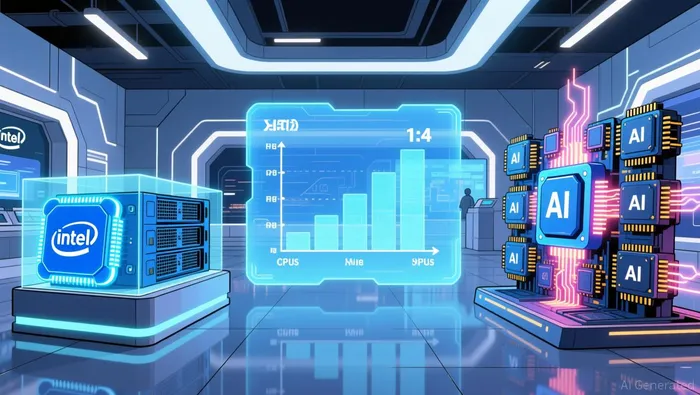
CEO Lip-Bu Tan highlighted that the CPU-to-GPU deployment ratio is shifting from 1:8 toward 1:4 or parity, revitalizing demand for Xeon server CPUs which are becoming the orchestration layer for AI stacks. This structural shift has allowed Intel to raise CPU prices by 10% to 15% due to tight supply and surging demand. The company has also secured multiple long-term agreements, including a significant deal with Google for Xeon processors and custom ASICs, as well as the selection of Xeon 6 as the host CPU for NVIDIA's DGX Rubin NVL8. These partnerships validate Intel's role in balanced AI systems and provide a foundation for sustained momentum in the server market.
On the foundry side, Intel Foundry revenue rose 20% sequentially to $5.4 billion, aided by better yields on Intel 18A and a surge in advanced packaging demand. Management described the advanced packaging backlog as reaching "billions of dollars per year," signaling strong interest in Intel's manufacturing capabilities. However, this growth comes at a cost. Capital expenditures for 2026 are expected to be flat year-over-year, but tool spending will rise approximately 25% to support wafer output, and operating expenses are projected to exceed the prior $16 billion target due to inflation and targeted investments in AI capabilities. The company's free cash flow remains negative at -$3.87 billion, reflecting the heavy reinvestment required to compete in the advanced manufacturing space.
Why Analysts Warn of a Sharp Correction in Intel's Valuation
While the operational improvements are notable, the stock's valuation presents significant downside risk for investors. The 466% trailing twelve-month rally has priced in highly optimistic scenarios, including CPU-to-GPU ratio parity and major foundry customer wins, leaving little margin for error. The average Wall Street analyst price target is $80.93, implying a 36% downside from current levels near $125. Technical indicators further suggest caution, with the stock's 14-day Relative Strength Index (RSI) hitting 80.5, entering overbought territory that historically precedes pullbacks.
Analysts emphasize that the current valuation requires near-flawless execution to justify. If foundry losses continue to widen or PC demand weakens as guided, the stock could face a sharp correction. The company's gross margins are expected to slip to 39% in Q2 2026 from 41% in Q1 due to rising input costs and 18A node ramp expenses. While Intel has secured foundry deals with tech giants like Google and Apple, social media analysts note that these wins will not generate significant recognized revenue until 2027 or 2028. Any delays in the 14A node development could trigger a valuation reset, as the market remains skeptical of the company's ability to execute at the pace required.
Ultimately, Intel's stock performance hinges on its ability to translate strategic partnerships and AI-driven CPU demand into sustainable profitability. While the company benefits from a broad product portfolio and significant R&D investment, it faces intense competition from AMD and NVIDIA, as well as the dominant position of TSMC in advanced manufacturing. Investors must weigh the potential upside of a successful turnaround against the risks of a valuation that is stretched beyond historical norms. The coming quarters will be critical in determining whether Intel's operational improvements can sustain its elevated multiples or if the stock will face a reality check.