

BANA Protocol announced on Friday that it has partnered with AI6 to build "intelligent Web3 infrastructure". If you read the headline and pictured a structural convergence between artificial intelligence and blockchain, you're not alone. That's exactly what the announcement is designed to make you see.
Except this is the second partnership BANA has announced in three days. Just before the AI6 deal, it struck a nearly identical arrangement with AegisX - this time for "secure and scalable" infrastructure. Read the press materials for either deal and you'll notice they use the same template: strategic partnership, joint initiative, enhanced reliability.
The AI6 side of the equation is revealing in its own way. A quick look at their social feed shows they're simultaneously announcing partnerships with multiple other projects, including YellowLabs - a team building an AI-powered "Sleep-to-Earn" product, which is a mechanism that rewards users with tokens simply for sleeping, tracked through a phone app.
I'm not mocking the idea. I'm pointing out what the pattern tells us about how the AI-crypto narrative is being deployed in 2026.
The velocity of announcements
The structural question here isn't whether AI and blockchain will eventually intersect. They will. The question is what happens in the interim, when the narrative is real but the products are announcements.
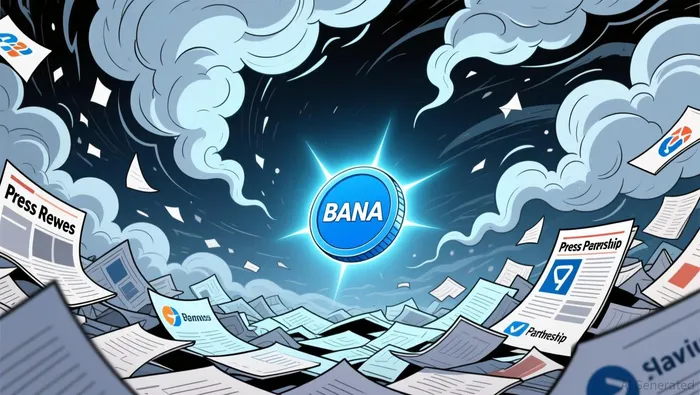
BANA is a relatively small Solana-based project - you won't find deep technical documentation or a public roadmap. It doesn't have the traction or name recognition to capture attention through fundamentals. What it has is velocity: the ability to generate a string of partnership announcements that keep it visible in crypto feeds and exchange-hosted news sections.
AI6 appears to be playing the same game from the other side. Each partnership lends the other party borrowed credibility. The AI label adds legitimacy to BANA's infrastructure claims; BANA adds a blockchain reference to AI6's project stack. Neither party necessarily needs to ship anything for the cycle to be valuable.
Narrative as infrastructure
This isn't random. Major institutions have already flagged AI-crypto convergence as one of the dominant narratives of 2026. SVB's year-end report listed AI's impact on crypto alongside stablecoin growth and tokenization as a key prediction. CoinGecko's narrative guide for 2026 included AI-crypto among the top themes to watch.
When the market's attention economy is actively rewarding a specific label, it becomes rational for small projects to attach themselves to it. The partnership announcement is the cheapest way to do that.
The problem - and I think this is worth sitting with - is that the narrative is now doing infrastructure's job. A project doesn't need to ship a working system to participate in the AI-crypto story; it needs to ship a press release. The announcement is the product, at least until something breaks the pattern.
What would change the read?
Two things would convince me this is more than narrative harvesting.
First: a technical specification. What does "intelligent infrastructure" actually mean in engineering terms? Is BANA building AI-driven smart contract verification, automated governance, or onchain data pipelines that use machine learning? Without that, the label is marketing, not architecture.
Second: a single shipping product from either party that isn't described primarily through its partnerships. If AI6 has a working tool that developers use independently, the partnership announcements are secondary to real product traction. Right now, I couldn't find one.
The broader signal
What BANA and AI6 are doing is extreme but not unusual. It's the tail end of a market structure where announcement velocity can substitute for product maturity, at least for a while. As long as the AI-crypto narrative continues to attract institutional attention, small projects will keep trading in it.
The structural risk isn't to any single token. It's to the signal-to-noise ratio of the narrative itself. When enough projects use the same labels for the same empty gesture, the label starts losing its meaning - and the genuinely interesting work happening at the real intersection of AI and crypto becomes harder to spot in the noise.
I'm more interested in what comes next than in where BANA's token ends up. Watch whether either party publishes technical details that go beyond press language. If they do, the story changes. If the next announcement is just another partnership with another vaguely described counterparty, the pattern confirms itself: this isn't infrastructure. It's attention management.