

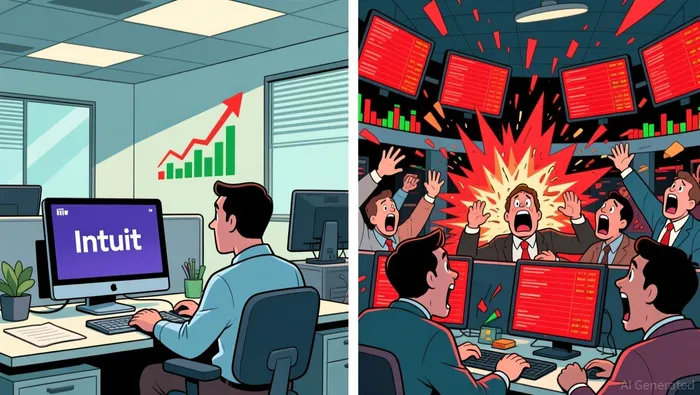
Intuit's stock dropped approximately 15% after reporting Q3 fiscal 2026 earnings - not because the business broke, but because the company announced a 17% workforce reduction. Wall Street treated the layoffs as a demand-warning siren instead of what management clearly framed: a deliberate cost restructuring to unlock margin expansion. The irony is that Intuit raised its full-year adjusted earnings per share guidance to $23.80 to $23.85. The stock punished the very move that makes that guidance achievable.
Here's what the market missed.
1. Guidance went up, not down. Intuit reported fiscal Q3 2026 revenue of about US$8.56b and adjusted EPS of US$12.80, beating analyst estimates. Then management raised full-year revenue guidance to $21.341–$21.374 billion, above the prior range of $21.0–$21.2 billion, and lifted adjusted EPS to ~$23.80, implying approximately 18% growth. The revenue miss was narrow and already absorbed into a higher full-year outlook. The headline should be "Intuit raises guidance." Instead, it was "Intuit cuts 17% of staff."
2. The workforce cut is a margin play, not a distress signal. Intuit is trimming roughly 3000+ jobs across the organization. For a software company with $7.51B in operating cash flow and a 17.8% return on assets, this isn't panic. It's operating leverage. The company has been investing heavily in AI capabilities across TurboTax, Credit Karma, and QuickBooks, and that investment is now reaching a point where automation replaces manual labor. TurboTax already automates data entry for 90% of the most commonly used tax forms through its AI integration with Credit Karma. QuickBooks Intelligence - the AI layer inside QuickBooks Online - is rolling out continuous performance monitoring and proactive task automation. The workforce reduction is the natural result of software doing the work humans used to do. That's margin expansion, not contraction.
3. Global Business Solutions is the engine, and it's accelerating. Intuit raised its full-year Global Business Solutions revenue target to $3.3 billion, up 15 percent. This segment - QuickBooks, Mailchimp, and small-business products - is the recurring-revenue backbone of the company. It grows faster than the fiscal-year average, it's less cyclical than tax products, and the AI features rolling into it every month are increasing stickiness. The Q3 Investor Day in September 2025 guided for 14 to 15 percent GBS growth - the raised target confirms management is tracking above that.
4. The dividend and buyback are a signal, not filler. Intuit approved a 15% higher $1.20 dividend and announced a $300M–$340M share repurchase program alongside the earnings. That's not a company hedging against uncertainty. That's management committing capital while simultaneously cutting costs. The dividend yield sits at roughly 1.5%, which doesn't move the needle for yield seekers, but combined with the buyback it signals that management sees the current earnings trajectory as sustainable, not temporary.
The valuation disconnect
Intuit closed around 319.94 after the post-earnings selloff. On raised FY2026 adjusted EPS of ~$23.80, that's approximately 13.4x forward earnings. Before earnings, the stock was above $400, trading closer to 17x. The 15% drop didn't come from a fundamental revision - it came from the emotional reflex to job cuts. At 13.4x on 18% EPS growth, the stock is trading below its growth rate. That's the definition of the gap the market created.
The forward P/E has been averaging near 17x historically, and the current 13.4x sits below where the stock traded before this quarter's panic. The gap between 13.4x and the company's 18% earnings growth rate is the mathematical expression of the overreaction.
The risk
ProTax revenue was flat at $278 million year-over-year. The tax segment is seasonal, so Q3 flatness isn't alarming - TurboTax drives the majority of ProTax revenue in the Q4 filing season. But if the broader macro environment softens and small-business demand for QuickBooks products decelerates, the GBS growth rate could compress. The thesis requires that QuickBooks continues to win share in the small-business software market, and that AI integration drives the revenue per user higher rather than cannibalizing pricing.
The catalyst
The break condition is straightforward: the next quarterly print where revenue in-line or slightly above estimate combines with the workforce cost savings flowing through to the margin line. That's the moment the market reclassifies the layoffs from "demand fear" to "margin expansion." Until then, the stock may still need to stabilize, but the forward math is already set - 13.4x on targets that management just raised.
At only 13.4x raised FY2026 EPS, Intuit trades below the growth rate it just committed to. The market sold the workforce cut instead of buying the margin raise. That disconnect sets up the re-rate.