

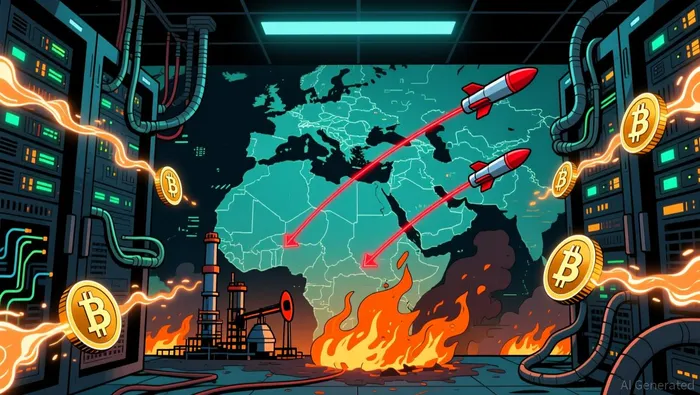
The headline cycle is about missiles, and for good reason. Since late February, Iran has struck roughly 20 US military sites across the Gulf - Kuwait, Bahrain, Qatar, Saudi Arabia, the UAE - causing what the Pentagon has estimated at $800 million in damage to buildings, runways, and infrastructure. On June 7, a Hezbollah rocket attack on northern Israel threatened to unravel the fragile ceasefire that has held, fitfully, since April.
But the missile strikes are the visible force. The slower, more structural contest is happening in payment rails, and it deserves the attention of anyone who thinks about what happens to money when the system itself becomes a weapon.
The cat-and-mouse is now the main event
As of late May, estimates place Iran's digital asset holdings at roughly $7.7 billion. That is not a speculative number pulled from a forum. It comes from US Treasury analysis and has been reported by multiple outlets. Iran is reportedly settling cargo ship insurance payments in Bitcoin, using cryptocurrency to route around the very sanctions that the US built its pressure campaign on.
Then, on June 2, the US Treasury responded with something that would have sounded absurd only a few years ago. Under what it called "Operation Economic Fury," the Treasury sanctioned Nobitex - Iran's largest domestic cryptocurrency exchange along with three other platforms, accusing them of enabling IRGC terror financing and sanctions evasion. Treasury Secretary Bessent announced the US had seized roughly $1 billion in Iranian crypto assets.
This is the structural development. The US is now conducting sanctions warfare inside the same permissionless payment layer it once dismissed as a lawless fringe. And Iran is using that layer to fund a war it cannot otherwise finance.
What "sanctions evasion" actually means here
I want to slow down for a moment on the language. When people say "sanctions evasion," they often picture a rogue trader in a basement. In this case, the evasion infrastructure has scale. The $7.7 billion figure represents what the Treasury itself has estimated as Tehran's controlled crypto holdings. That is money the regime is moving through exchanges, mixers, and off-ramps in third countries - not a hobbyist operation, but a state-level plumbing project.
For context, sanctioned jurisdictions received $15.8 billion in cryptocurrency in 2024 alone, according to Chainalysis, accounting for roughly 39% of all illicit crypto transactions at the time. The Iran war has not created this pattern. It has accelerated it, forced it into the open, and made it urgent.
The key distinction that most headlines miss: this is not about retail Iranians buying Bitcoin to protect their savings - though that is happening too, and it's the story I find more compelling in its own way. This is about a sanctioned government building parallel payment infrastructure to keep operating when SWIFT, the dominant global messaging system for cross-border payments, is not an option.
Why the Gulf is watching closely
Here is where the geography matters. The Gulf states - Saudi Arabia, the UAE, Qatar, Bahrain, Kuwait - have been forced into an unbearable calculation. Their hosting of US military assets made them targets. Iranian strikes have damaged energy, financial, and technology infrastructure across the region. Three leading Gulf economies are now reviewing their overseas investments just to ease financial strain.
And yet their financial systems remain connected to the very US infrastructure that is now the battlefield. If the US is seizing crypto wallets and sanctioning exchanges, and if the dollar-based clearing system is the primary tool of economic coercion, Gulf finance is sitting inside the crossfire by design.
Gulf states are already expressing growing alarm about whether US security guarantees are worth the collateral damage. The Guardian reported in April that they are seeking additional security partners as they rebuild. What is less visible is how this insecurity extends to their financial architecture. If the dollar system can be weaponized against their neighbors - and against them, by proximity - the incentive to diversify away from dollar-denominated settlement is not theoretical anymore. It is a security question.
The ceasefire is fragile, and the money plumbing won't wait
The current ceasefire, which began as a two-week agreement on April 8 and was extended indefinitely on April 21, is cracking. Hezbollah's June 7 attack and Iran's reported suspension of indirect talks with the US (then quickly re-engaged, then reported as opening "other options") suggest the conflict can reignite on short notice.
The IMF's April outlook cut global growth to 3.1% for 2026, down from January's forecast. The closure of the Strait of Hormuz on March 4 - which carries 20% of the world's daily oil supply and 20% of global LNG - forced Brent crude past $120 per barrel and stranded energy exports for months. By late May, analysts were warning oil could reach $200 if disruption persists. The IMF warned the war could lead to global recession.
In that environment, the crypto dimension is not a sidebar. It is evidence of what happens when states and sanctioned actors are forced to build settlement infrastructure outside the traditional system. The US Treasury's Operation Economic Fury shows that Washington is adapting, too. But the adaptation is reactive, not structural. Seizing $1 billion in crypto is a significant enforcement action. It is not a system.
What this changes
I think the lasting revelation from the Iran war, beyond the energy shock and the geopolitical realignment, is this: cryptocurrency is no longer a question of whether it will be used for sanctioned payments. It already is, at a scale that the US Treasury itself now tracks and targets. The debate has shifted from whether crypto undermines sanctions to how the enforcement apparatus adapts in real time.
For an ordinary investor, the implication is not a trade signal - though Bitcoin did sell off first when the war began in February, then recovered past $71,000 by early March as it became the only liquid market open during the initial strikes. The implication is structural: the global financial system is fragmenting into competing settlement layers, and war is the accelerator.
If the ceasefire holds, the crypto-sanctions cat-and-mouse will remain a background story. If it collapses, the pressure on sanctioned states to maintain parallel payment rails will intensify, and the Gulf states' security and financial anxiety will compound.
The question is not whether Iran or other sanctioned actors will keep building crypto infrastructure under fire. They already are. The question is what happens to the dollar system's legitimacy when the countries it was supposed to protect also become targets - and when the alternative rails, however clunky, are the only option left.