

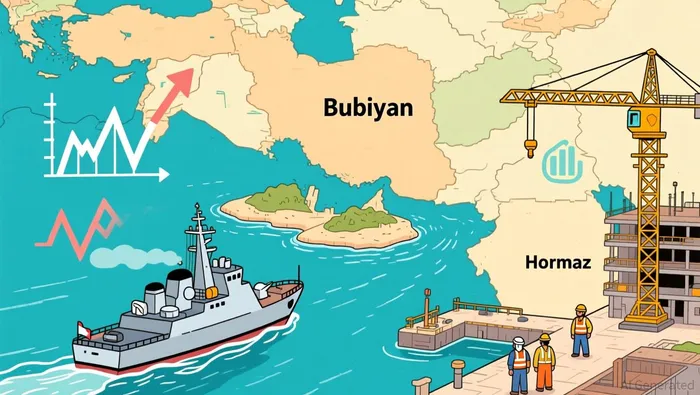
The test came on May 1st, when four operatives affiliated with Iran's Revolutionary Guards attempted to infiltrate Kuwait by sea. Their target was Bubiyan Island, the largest in Kuwait's coastal chain and a strategically significant location in the northwest Gulf. The attempt triggered clashes, resulting in one Kuwaiti armed forces member being injured. Kuwait's interior ministry swiftly arrested the men and later summoned Iran's ambassador to lodge a formal protest, calling the act a hostile incursion and asserting its right to defend sovereignty under the U.N. Charter.
Iran's response was immediate and high-stakes. Foreign Minister Abbas Araqchi labeled the action an unlawful attack and demanded the immediate release of the detained nationals. Tehran reserved the right to respond, framing the incident as a direct challenge to its authority. This confrontation unfolded against a backdrop of fragile regional calm. Just weeks earlier, a devastating war between the U.S., Israel, and Iran had raged for over five weeks, beginning with a massive strike on February 28th that killed Iran's supreme leader and sparked a regional escalation. A two-week cease-fire had been announced on the 39th day of that conflict, but its durability was now in question.
The May 1st raid on Bubiyan Island thus serves as a critical early litmus test for Iran's post-war posture. After a period of intense military pressure and significant leadership losses, the incident forces a choice: will Tehran respond with measured diplomacy to protect its operatives, or will it escalate to demonstrate resolve and deter further encroachments? The demand for their release is a clear signal, but the ultimate test lies in what happens next.
Historical Analogies: Testing Iran's Post-Conflict Behavior
Iran's current posture after the recent war invites comparison with its past behavior following major military setbacks. The pattern suggests a strategic calculus of accepting temporary truces while preparing for future conflict, a dynamic that could shape its response to the Bubiyan Island incident.
The most direct historical parallel is the 1988 end of the Iran-Iraq War. After a grueling eight-year conflict, Iran accepted a ceasefire that ended hostilities. Yet, the truce was not a definitive peace. Tehran used the respite to rebuild its military and reassert its regional influence, eventually resuming hostilities in a different form. This precedent shows a willingness to accept a temporary halt to direct fighting, even under duress, while laying the groundwork for a renewed challenge. The current situation, with a fragile two-week cease-fire announced just weeks ago, echoes that fragile calm before a potential resurgence.
A more recent operational model is Iran's strategy following the 2003 U.S. invasion of Iraq. With direct confrontation avoided, Iran shifted to a proxy warfare approach, supporting groups like Hezbollah and the Iraqi Popular Mobilization Forces. This allowed it to project power and influence without exposing its own forces to direct retaliation. The use of operatives from the Revolutionary Guards in the Bubiyan raid fits this pattern of asymmetric action through non-state or semi-state actors. It is a method of testing the enemy's resolve and probing for vulnerabilities without triggering a full-scale war.
The 2019 attacks on Saudi oil facilities further illustrate this calculus. Iran, through proxies, launched a coordinated assault on key infrastructure, causing significant disruption. The strikes were a clear signal of capability and resolve, designed to send a message without crossing the threshold into a direct military exchange that could invite overwhelming retaliation. The Bubiyan Island attempt shares this asymmetric character-a limited, targeted action meant to challenge sovereignty and test the response, much like the drone and missile attacks on Abqaiq and Khurais.
Viewed through these lenses, Iran's current behavior aligns more with defiance than retreat. The demand for the immediate release of its operatives is a standard diplomatic signal, but the underlying strategy appears consistent with historical patterns: accepting a temporary truce to regroup, using proxies to avoid direct conflict, and employing asymmetric actions to demonstrate resolve. The real test is whether the current cease-fire will hold or fracture under the pressure of such calculated provocations.
Market and Regional Implications
The Bubiyan Island incident introduces a fresh layer of risk to an already volatile region, with clear pathways for escalation that could disrupt global markets. The geopolitical dimension is immediate: Kuwait accused Iran of targeting an island where China is constructing the Mubarak Al Kabeer Port. This infrastructure project, part of Beijing's Belt and Road Initiative, adds a major external stakeholder to the dispute. Any further Iranian action near this site would not only challenge Kuwaiti sovereignty but also directly threaten a significant Chinese investment, potentially drawing a more forceful international response.
Strategically, the incident threatens to reignite control over a critical maritime chokepoint. The narrow Strait of Hormuz remains in Iran's chokehold, a vulnerability that has been a source of tension since the war began. The failed raid on Bubiyan, located just northwest of this strait, is a direct challenge to the maritime order. If Iran perceives the detention of its operatives as a provocation, it could use its control over the strait to impose further pressure, disrupting the flow of oil and raising the specter of a broader energy crisis.
Historical precedent shows how quickly such incidents can trigger market turmoil. The 2019 attacks on Saudi oil facilities, launched by Iran through proxies, caused an immediate spike in oil prices and global market volatility. The current setup bears similarities: a fragile ceasefire, a direct challenge to a Gulf state's sovereignty, and the potential for asymmetric retaliation. The risk is that the Bubiyan incident becomes the spark that fractures the current truce, leading to a renewed cycle of strikes and counter-strikes that would again threaten the stability of oil shipments through the Strait of Hormuz.
The bottom line is one of heightened uncertainty. The combination of a contested territorial claim, a strategic chokepoint under Iranian control, and a history of market-moving provocations creates a setup where escalation is a tangible risk. For markets, this means elevated volatility, particularly in oil and regional equities, until the situation stabilizes. The outcome will depend on whether Iran chooses to escalate to defend its operatives or de-escalate to preserve its fragile post-war position, a choice that will be watched closely by investors and policymakers alike.
Catalysts and Risks to Watch
The immediate catalyst for escalation is clear: Iran's response to Kuwait's demand for the release of the detained operatives. Foreign Minister Abbas Araqchi has framed the detention as an unlawful attack and demanded their immediate release. This is a direct test of Tehran's post-war resolve. A diplomatic push for their return is the expected path, but the real signal will be what happens if Kuwait refuses. Any move to escalate-whether through further asymmetric attacks, threats to the Chinese port project, or actions in the Strait of Hormuz-would be a definitive choice to challenge the fragile truce.
That truce itself is the second major risk. The two-week cease-fire announced after a five-week war is described as "cloudy" and fragile. The Bubiyan Island incident is the first major test of its durability. If Iran perceives the detention as a provocation that goes unanswered, it may fracture the ceasefire entirely. Historical precedent shows that such truces often serve as pauses for regrouping, not permanent peace. The current setup, with Iran's leadership decimated and its military weakened, makes a measured response more likely, but the temptation to demonstrate resolve through action is high.
A complicating layer is the high-level diplomatic uncertainty introduced by the upcoming U.S.-China summit. President Trump is set to depart for Beijing for a visit where Iran is a topic. The U.S. is maintaining a blockade against Iran, and negotiations appear at a standstill. The summit creates a window where U.S. focus may shift, potentially altering the pressure dynamics on Iran. Iran may calculate that a show of force now could strengthen its hand in future talks, or conversely, that a strong U.S.-China alignment could make further escalation too risky.
The likelihood of broader escalation hinges on this calculus. The primary catalyst-the detained operatives-must be resolved without a perceived loss of face. The risk of the ceasefire fracturing is real but not yet certain, as both sides have incentives to avoid a full-scale war. The diplomatic uncertainty from the summit adds a variable that could either ease or intensify pressure. For now, the setup favors a diplomatic resolution, but the historical pattern of post-conflict defiance suggests Iran will test the limits of the new order. The coming days will show whether it chooses to push or retreat.