

The Market Is Bundling the Wrong Stories
S&P 500 and Dow futures slipped this week as Iran resumed missile attacks on Israel for the first time since the April ceasefire. The reflexive market coverage has grouped five tickers together - TMC, PL, ORCL, STI, and KEEL - as if they share a common driver. They don't. The headline creates a false taxonomy. Only two of these five companies have a direct structural mechanism linking them to the Middle East conflict. The other three are AI infrastructure plays being swept into the grouping because they happen to move.
The distinction matters because it determines whether you're looking at a tactical geopolitical trade or a structural capex story. They are not the same market.
The Two-Market Split: Defense Intelligence vs. AI Infrastructure
The five stocks break into two entirely separate categories. The first cluster has a direct defense or intelligence mechanism: Planet Labs and Oracle. The second cluster - Solidion Technology, Keel Infrastructure, and The Metals Company - has zero structural linkage to the Iran-Israel conflict and is moving on AI infrastructure capex, power constraints, and speculative liquidity.
Planet Labs has a clear role. The satellite imaging company has been beaming imagery of Iran and the broader conflict zone throughout the 2026 war that began with U.S. and Israeli strikes on February 28. The company suspended imagery distribution over Iran at the Trump administration's request in April, then resumed coverage as the conflict reignited. On April 5, Planet Labs announced an indefinite blackout on Iran imagery at government direction, creating a situation where commercial satellite data from the region flows through a small set of channels - ones where Planet Labs is a primary supplier to defense and intelligence consumers.
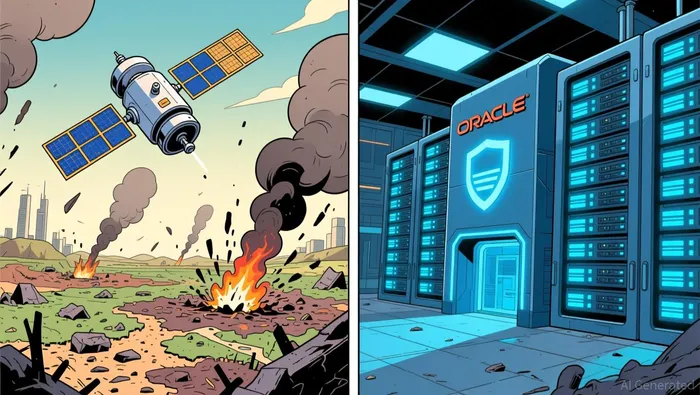
Oracle's connection runs through two vectors. The company holds an expanded $88 million multi-year U.S. Air Force contract for AI-powered defense applications, which directly ties its revenue to military spending escalation. Simultaneously, Oracle is a target: Iran claimed in April to have targeted Oracle data centers in Dubai, and Iranian sources have listed Oracle among U.S. tech firms that could face retaliation for providing cloud services linked to Israeli infrastructure. The stock moves because it sits on both sides of the equation - as a defense supplier benefiting from increased military cloud spend, and as a potential casualty of escalation.
That is the defense-intelligence cluster. The mechanism is clear: more conflict means more defense spending, more intelligence demand, more Oracle contract execution. If the ceasefire holds, the tailwind compresses.
The AI Infrastructure Cluster: No Iran Linkage
The remaining three stocks have no structural mechanism to the Middle East conflict. They are being grouped into the headline because they are volatile tickers that attract speculative capital during market-wide risk-off events. The actual driver for each is AI infrastructure capex - and the constraint migration within it.
Solidion Technology is a silicon-anode battery company targeting AI data center power backup systems. The company reported Q1 2026 revenue of approximately $85,000 against a $1.43 million net loss and $38,000 in cash. On June 4, it unveiled an extreme-climate battery system designed for low-Earth-orbit AI data centers, capable of operating from −80°C to +60°C. The stock surged from $14.67 at the start of 2026 to $35.72 by June 5 - a 144% move - on the combination of the LEO AI data center narrative and the first-ever quarterly revenue print. The mechanism here has nothing to do with Iran. It is whether battery backup becomes a binding constraint for AI data center deployment, and whether Solidion can convert a $85,000 quarterly revenue base into scale.
Keel Infrastructure presents a similar picture, just further along the execution curve. The company pivoted from Bitcoin mining to AI data center hosting, targeting a 2.2 gigawatt pipeline by 2027. It carries roughly $520 million in total liquidity - $359 million in cash and $161 million in unencumbered Bitcoin - as of late March 2026. The stock is up over 50% since the pivot announcement, and it just signed a 40 MW AI colocation agreement in Alabama. The driver is whether power capacity remains the bottleneck for AI infrastructure buildout and whether Keel can convert its existing power-rich sites into hyperscale leases. Again, no Middle East linkage.
The Metals Company is the weakest link in this chain. The company develops deep-sea polymetallic nodule resources - nickel, cobalt, manganese, and copper - from the Clarion-Clipperton Zone in the Pacific Ocean. It applied for a U.S. deep-sea mining license in 2025 and raised $37 million in Q1 2026. The only tenuous connection to the headline is that Iran has pursued rare earth negotiations with Bolivia, suggesting a potential geopolitical competition over critical minerals. But TMC's resources are in the Pacific, not the Middle East, and its timeline to production remains years away. The stock is moving on critical minerals speculation, not on the Iran ceasefire breaking.
The Constraint Migration Is the Real Story
If you strip away the false grouping, what emerges is a constraint migration story that has nothing to do with geopolitics. The AI infrastructure buildout is moving through a sequence of bottlenecks: first compute (GPUs), then packaging (CoWoS), now power and energy storage. Solidion and Keel are both positioned in the power constraint layer. Oracle is positioned in the compute and cloud layer. Planet Labs is positioned in an entirely different value chain. The Metals Company is positioned in a resource extraction play that hasn't produced a single ton of material.
The constraint determines who captures value. If power availability remains the binding constraint for AI data center deployment - and there is evidence it is, given that utilities in multiple regions are already turning down data center interconnection requests - then Keel's power-rich asset base and Solidion's battery backup thesis have structural relevance. If the constraint migrates elsewhere, their pricing power evaporates.
This is not a demand-driven problem. It is a supply discipline question. The question is whether power utilities, battery suppliers, and cloud providers can scale fast enough to keep pace with AI capex that is already priced into every one of these valuations.
Investor Takeaway
The headline grouping of TMC, PL, ORCL, STI, and KEEL under the Iran-Israel framework obscures the actual structural dynamics. Planet Labs and Oracle have a direct defense-intelligence mechanism that tightens with escalation and relaxes with a ceasefire. Solidion, Keel, and The Metals Company are AI infrastructure and critical minerals bets with no Middle East linkage - they move because they're volatile tickers that attract speculative flows during broad market risk-off events.
Looking ahead, the key issue is not whether the Iran ceasefire holds. The more important question is whether power constraints in AI infrastructure buildout remain binding through the rest of 2026, because that is the structural driver for three of these five stocks. If power availability eases - if utilities resolve interconnection backlogs and battery costs fall - then the valuations implied by Solidion's 144% run and Keel's 50% move become unsustainable. If the constraint tightens further, the current pricing may still trail what the market is willing to pay for bottleneck control. The Iran headline is noise. The power bottleneck is the signal.