

The recent diplomatic overture between the United States and Iran has delivered a powerful, if volatile, catalyst for financial markets. The highest-level talks since 1979, held in Islamabad over the weekend, ended without a deal, marking a fundamental blow to nascent hopes of an off-ramp to this crisis. Yet, a single statement from President Trump on Monday reignited optimism. He declared that Iran wants to make a deal and that he would not sanction any agreement allowing Tehran to have a nuclear weapon. This pivot from stalemate to potential negotiation has been the immediate market driver.
The impact was swift and decisive. On Tuesday, the S&P 500 advanced 1.1%, inching closer toward a record. More broadly, the index effectively wiped out losses accumulated since the start of the conflict. This move underscores a clear de-rating of the geopolitical risk premium that had weighed on equities. The relief was not confined to stocks; energy-sensitive sectors benefited as oil prices fell sharply. Benchmark West Texas Intermediate crude retreated 7% to trade near $91 per barrel, while Brent crude fell 4% to sit around $95. The broader market momentum was further supported by a slower-than-expected rise in producer prices in March, which eased some inflation concerns.
For institutional investors, this sequence presents a classic risk-reward recalibration. The initial diplomatic failure introduced significant uncertainty, but the subsequent shift in tone has allowed the market to price in a more favorable, albeit still tentative, path. The drop in oil prices below $100 provides direct relief to energy and industrials, sectors that had been pressured by the conflict's threat to supply. This dynamic contributes to a broader environment of improved risk appetite, where the focus can begin to shift from immediate conflict resolution to the longer-term economic and market implications of a potential truce.
Institutional Implications: Sector Rotation and Tactical Positioning
The risk de-rating narrative is now actively reshaping sector flows, creating a clear bifurcation in the institutional playbook. The immediate relief from lower oil prices is providing a tailwind to energy and industrials, sectors that had been pressured by the conflict's threat to supply. Yet this near-term benefit is being counterbalanced by a persistent structural uncertainty that is keeping capital cautious. The U.S. blockade of the Strait of Hormuz, which has effectively shut down the critical waterway, introduces a new layer of volatility that cannot be dismissed as a temporary headwind. This duality is forcing a tactical recalibration, where the market is pricing in a potential deal while still accounting for the very real risk of a prolonged chokepoint.
For financials, the backdrop has shifted from a simple easing of inflation fears to a more complex competition between two forces. The initial move was a classic "risk-on" rotation, as the dip in oil prices and the S&P 500's rally toward a record suggested a de-rating of geopolitical risk. This environment typically supports financials, as lower energy costs ease consumer price pressures and improve credit quality. However, the sticky inflation data from March, driven by the conflict's energy surge, reminds investors that the Federal Reserve remains on pause. This creates a conflicting signal: the geopolitical risk premium is falling, but the inflation premium is proving resilient. The result is a sector facing a mixed macro backdrop, where the benefit of a potential truce competes with the headwind of a still-elevated risk-free rate.
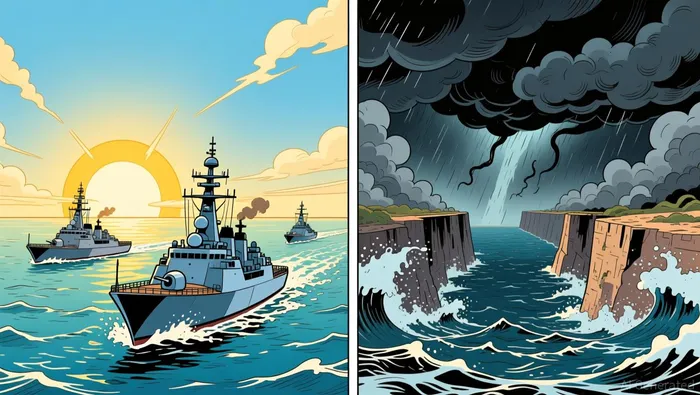
This sets up a nuanced tactical setup for the month ahead. The S&P 500 is entering April, a historically strong month that has seen average gains of 1.4%. This seasonal tailwind provides a supportive framework, allowing the index to potentially "chop along" as the geopolitical limbo persists. The market can use this period to digest the conflicting signals-lower oil prices providing operational relief, the Strait blockade introducing structural risk, and inflation data refusing to fully normalize. For institutional portfolios, this suggests a focus on quality and liquidity. The rotation into energy is likely to be selective, favoring integrated majors with strong balance sheets over pure-play producers exposed to the blockade's uncertainty. Financials may see flows into the most resilient lenders, but the sector as a whole faces a wait-and-see stance until the inflation trajectory and the Strait's status become clearer. The bottom line is that the risk de-rating is real, but it is not yet a full reset.
Catalysts and Risks: The Path to Sustained De-rating
The market's recent de-rating is a bet on a diplomatic resolution, but its sustainability hinges on a narrow window of near-term events. The fragile April 7 truce, which has provided a temporary ceasefire, expires next week. Its extension would be the clearest validation of the de-rating thesis, signaling that both sides are committed to a negotiated path. Without it, the market's optimism risks a swift reversal as the conflict re-escalates.
The immediate next phase is defined by the US "best and final" offer and Iran's response. With US Vice President JD Vance having stated that the ball now sits in the Iranian court, the onus is on Tehran to adjust its position if there are to be more talks. A lack of engagement or a rejection of the US terms significantly increases the risk of military escalation, which would instantly reprice the geopolitical risk premium. The core sticking point remains Iran's nuclear program, where deep divisions on substance and style have already derailed high-level talks exposed deep divisions on core issues.
Institutional investors must also monitor for any shift in the operational reality of the conflict. The US blockade of the Strait of Hormuz, which has effectively shut down the critical waterway, is a persistent structural risk. Any change in enforcement-whether a relaxation or an expansion-would directly impact energy markets and global trade flows. Similarly, a shift in rhetoric from Tehran, moving from defiance to a more conciliatory tone, could signal a pivot in the risk calculus. For now, the blockade remains in place, with the US vowing to eliminate any Iranian "fast-attack" ships near the blockade any Iranian "fast-attack" ships that went near the blockade would be eliminated.
The bottom line for portfolio positioning is one of conditional optimism. The market has priced in a deal, but the path is fraught with binary outcomes. The coming week is a critical catalyst window; the expiration of the truce and the response to the US offer will determine whether the de-rating becomes a sustained reset or a temporary reprieve. Until then, the risk premium remains partially priced in, leaving portfolios exposed to a sharp repricing if diplomatic momentum stalls.