

The market's immediate reaction to the collapse of high-level Iran-US talks was telling. Just before the weekend's failed negotiations, oil prices had been pressured by hopes for a diplomatic resolution that could reopen the Strait of Hormuz. Yet, with the talks ending without a deal, the market's response was not a surge but a consolidation. The price of Brent crude oil stood at $97.78 per barrel earlier today, a gain of about $31 from the same point last year. This steady stance, even after the geopolitical shock, confirms a fundamental shift in the market's logic.
The underlying supply shock has now fully eclipsed the demand narrative. The closure of the Strait of Hormuz, a critical chokepoint for global oil flows, has created a permanent new baseline for prices. As the International Energy Agency noted, this conflict has triggered the "largest supply disruption in the history of the global oil market". The initial panic that pushed Brent past $120 per barrel in March has given way to a recalibration, but to a higher plateau. The market has priced in the reality that this is not a temporary blockade but a sustained constraint.
This sets up a new equilibrium where the Strait's closure is the central supply constraint. The failed talks removed a near-term catalyst for a price drop, but they also removed any illusion that the supply shock is easily reversible. The price is steady not because the crisis has passed, but because it has been fully absorbed into the price. For now, the macro cycle is defined by this elevated baseline, where any further geopolitical escalation or logistical disruption would push prices higher, while a credible diplomatic breakthrough remains the only force capable of bringing them down.
The Macro Cycle Shift: From Surplus to Deficit
The supply shock has not just moved prices higher; it has flipped the entire global oil market cycle. The fundamental forecast has reversed course. Just months ago, analysts predicted a comfortable 1.63 million bpd surplus for 2026, driven by planned OPEC+ output increases and strong non-OPEC production. That view has been erased. The latest consensus now sees the market averaging a 750,000 bpd deficit this year, a massive swing that redefines the economic backdrop.
This isn't a minor adjustment. The disruption is the largest in history, with the International Energy Agency characterizing it as such. The conflict has effectively stalled flows through the Strait of Hormuz, a critical artery for about a fifth of global oil consumption. The immediate impact is staggering: analysts estimate a production loss of 2.13 million bpd across the entire year. The market's steepest deficit is expected in the second quarter, averaging around 3 million bpd, before a partial recovery later in the year. Yet the long-term footprint is what sets a new floor. ANZ warns that up to 2 million bpd of capacity may be permanently lost, a permanent reduction in global supply that will anchor prices at a higher level for years.
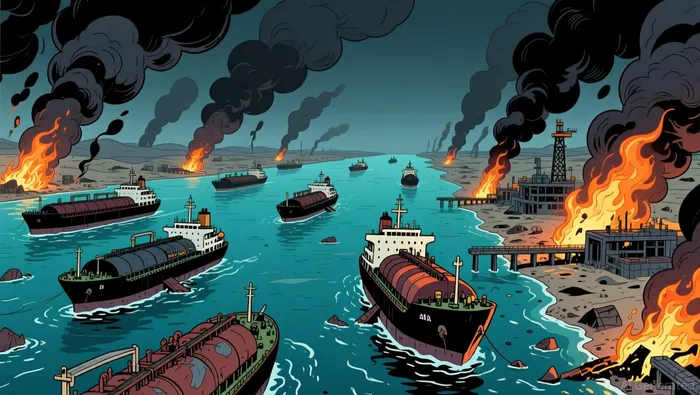
The economic consequences ripple far beyond the oil patch. This supply shock is a direct contributor to higher inflation, complicating central bank policy. The European Central Bank, for instance, has already postponed its planned interest rate reductions due to the inflationary pressures from supply shortages. The same dynamic is playing out globally, as the crisis echoes the 1970s with its risks of stagflation. For investors, this means the macro cycle is now defined by tighter supply and elevated price volatility, not the oversupply that once promised lower costs and easier monetary policy. The market has entered a new, more constrained phase.
Market Positioning and Risk Appetite
The market's focus has decisively shifted from diplomatic headlines to the physical supply ceiling defined by the Strait of Hormuz closure. With the geopolitical shock absorbed, investor behavior is now calibrated to the new reality: a permanent reduction in global supply. The probability of the Strait remaining closed is expected to decline steadily beyond the second quarter, providing a forward-looking supply ceiling. This creates a clear, if uncertain, timeline for the market's next major inflection point.
Risk appetite is now more sensitive to the pace of Iran's facility repairs than to the broader conflict. Early signs point to a gradual recovery. A senior Iranian oil official stated that repair work had begun and that part of the Lavan refinery is expected to resume operations within about 10 days, with other units coming back online gradually. The goal is to restore most damaged refining and distribution facilities to 70–80% of their pre-attack capacity within one to two months. This timeline is critical. It sets a near-term horizon for the market to assess whether the supply deficit will narrow as flows through the Strait begin to normalize.
This dynamic introduces a new layer of volatility. The market is no longer pricing in a static, maximum disruption. Instead, it is pricing in a declining probability of closure over time, which interacts with the physical recovery of infrastructure. The initial shock of a 20% supply loss has been priced in, but the path to a partial resolution is now the key variable. Any delay in the repair schedule could sustain the deficit and pressure prices higher, while a faster-than-expected recovery would provide a tangible ceiling for the rally. For now, the steady price reflects this recalibration, as investors wait for the first tangible signs of the Strait's reopening.
Forward Catalysts and Key Risks
The path forward hinges on two interlinked variables: the physical recovery of infrastructure and the fragile political situation. The primary catalyst for a narrowing deficit is the reopening timeline for the Strait of Hormuz. Analysts expect the probability of closure to decline steadily after the second quarter, providing a forward-looking ceiling for the supply shock. The key near-term signal will be the progress of repair work in Iran. A senior Iranian oil official stated that repair work had begun and that part of the Lavan refinery is expected to resume operations within about 10 days, with other units coming back online gradually. The goal is to restore most damaged facilities to 70–80% of their pre-attack capacity within one to two months. This timeline is critical; any delay would sustain the deficit and pressure prices higher, while a faster-than-expected recovery would provide a tangible ceiling for the rally.
Yet a major risk looms over this recovery: further conflict spillover into the Gulf. The current ceasefire is fragile and temporary. The ongoing military conflict between Iran and the United States and Israel has already raised concerns about a major disruption of global oil supplies. Attacks have targeted oil infrastructure in neighboring countries, including Saudi Arabia, Kuwait, and the United Arab Emirates. More broadly, the conflict prompted the closure of the Strait of Hormuz, through which most oil produced in the Persian Gulf is exported. The ultimate concern has been attacks on oil shipping in the Strait causing unsustainable losses or shipwrecks closing the shipping lanes. This dynamic means that the market's next major inflection point is not just about Iran's repair schedule, but also about whether the broader conflict escalates again. A new wave of strikes could threaten other key supply routes, potentially widening the deficit and reigniting the price surge that began in March.
The bottom line is that the market is now in a waiting game. The steady price reflects a recalibration to a higher baseline, but the cycle's next phase is defined by uncertainty. Investors must watch for two things: the first tangible signs of the Strait's reopening, which will be signaled by Iran's repair progress, and any new diplomatic initiatives or escalations that could alter the risk of a prolonged supply shock. For now, the fragile status quo anchors the market, but the catalysts for change are both physical and political.