

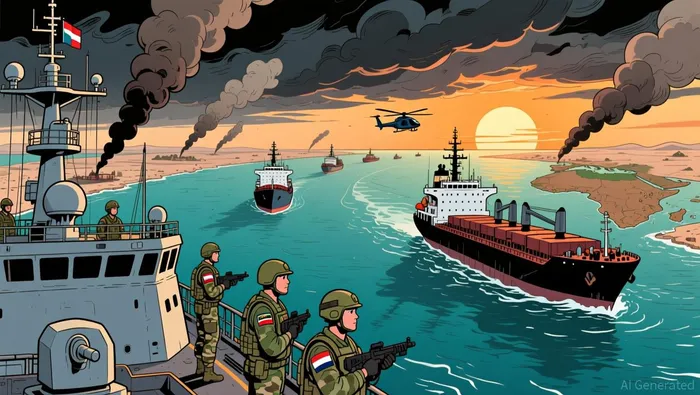
The question of whether traffic can return to normal by July 31 is less a calendar check and more a test of a deep geopolitical deadlock. The crisis is a direct outcome of the 2026 Iran war, with the U.S. and Israel initiating a campaign to reopen the strait after Iran's closure. Yet the fundamental issue remains unresolved. Iran's core demand is the lifting of the U.S. naval blockade of its ports, which it views as a violation of the ceasefire. In turn, the U.S. and its allies see the blockade as a necessary pressure tool. This creates a standoff where each side's condition is the other's non-starter.
Prediction markets reflect deep skepticism about a near-term resolution. Bettors on Kalshi assign only a 59% chance that normal traffic flows through the strait by July 1. That probability falls to 42% for June 1 and stands at 61% for August 1. The market's baseline is one of prolonged disruption, not a swift fix. This skepticism is grounded in the stalemate: a fragile ceasefire is due to run out, and recent days have seen Iran reverse its reopening and fire on ships attempting to pass, escalating the tension anew.
The bottom line is that the July 31 deadline is a calendar artifact against a macro conflict. The U.S. campaign to reopen the strait is ongoing, but Iran's control of the chokepoint remains absolute. The market odds suggest that until the core demands-lifting the blockade versus securing nuclear concessions-are addressed, the strait will remain a zone of high risk and low traffic. Normal flows by July 31 are a possibility, but they would require a breakthrough that current evidence does not support.
Current Reality: A Market-Driven "New Normal"
The market has already decided. The vast majority of shippers have chosen to avoid the Strait of Hormuz entirely, opting for longer, more expensive routes around Africa. This is not a temporary pause; it is a structural shift in global shipping behavior. The result is a new, lower baseline for traffic through the chokepoint, making a return to pre-crisis "normal" levels a significant structural challenge.
Iran has formalized its authority to cement this new reality. The country has created the Persian Gulf Strait Authority and is demanding a "Vessel Information Declaration" from all transiting ships. This move is a direct attempt to normalize its control over the waterway, turning a wartime tactic into a permanent regulatory framework. Yet, the market's response has been clear: compliance is not a given. The authority's rules are issued in defiance of U.S. warnings, and the vast majority of ship owners have opted not to take the risk of sending their vessels through in defiance of Iran's demands.
This adaptation has created a new, lower baseline for shipping flows. The market's definition of "normal" has been recalibrated. Prediction markets now define normal traffic as a 7-day moving average crossing 60 based on data from IMF PortWatch. As of late April, traders saw the most likely reopening by July 1, but by early May, that probability had fallen. The current odds point to a late-summer or early-autumn reopening, with a 57% chance traffic returns to normal by September 1. This shift in market expectations underscores that the new normal is not just about a few ships navigating a dangerous strait, but about a fundamental re-routing of global trade flows.
The bottom line is that the strait's closure has already forced a costly rerouting of commerce. The market's choice to pay higher freight costs and longer transit times to avoid the chokepoint demonstrates a deep-seated risk aversion. Until Iran's core demands are met or the U.S. blockade is lifted, this avoidance behavior is likely to persist, locking in a new, lower baseline for traffic. The July 31 deadline is therefore not just a calendar check, but a test of whether the market's new, expensive equilibrium can be reversed.
Investment Implications: Commodity Cycles and Price Signals
The Strait of Hormuz crisis is no longer just a geopolitical headline; it is a live macroeconomic shock that is reshaping commodity cycles and price signals. The conflict has triggered a global fuel crisis, with Brent crude trading above $100 per barrel. This price level is a direct function of the strait's closure, as it represents the chokepoint for a fifth of traded oil. The market's persistent risk premium is now a structural feature, not a temporary spike.
This prolonged disruption acts as a persistent inflationary pressure. Elevated energy prices feed through the global economy, supporting higher real interest rates as central banks grapple with the inflationary impulse. A stronger U.S. dollar, often a byproduct of such inflationary shocks and safe-haven flows, then becomes a headwind for risk assets and industrial commodities priced in dollars. The investment trade-off is clear: while energy prices are supported, the broader growth outlook faces pressure, creating a challenging environment for cyclical sectors.
The primary catalyst for a sustained price correction and a return to a more balanced commodity cycle is a broader geopolitical de-escalation. This is not about a technical reopening of the strait, but a resolution to the underlying conflict. As U.S. Secretary of State Marco Rubio has stated, any deal must definitively prevent Iran from sprinting towards a nuclear weapon. The Iranian proposal to end its chokehold in exchange for lifting the blockade and ending the war is a clear signal, but it is also a non-starter for the U.S. on nuclear terms. Until this core issue is addressed, the strait will remain a source of volatility.
For investors, the current setup suggests a bifurcated commodity market. Energy prices are supported by the physical supply constraint, while industrial metals and agricultural commodities face a growth headwind from higher real rates and a stronger dollar. The prediction markets' low odds for a near-term reopening-just a 57% chance traffic returns to normal by September 1-anchor this view. A prolonged closure locks in this dynamic, making a synchronized global commodity rally unlikely. The path to a new equilibrium runs through a geopolitical deal, not a calendar deadline.
Catalysts and Risks: What to Watch for the July 31 Thesis
The thesis for a July 31 reopening hinges on a narrow window of diplomatic and operational progress. The immediate catalyst is the fragile ceasefire, which is due to expire soon. Any escalation or failure to renew it will likely push reopening probabilities further out, as seen in the recent reversal of Iran's reopening and attacks on ships. The market's definition of "normal" is the seven-day moving average of transit calls through the strait based on IMF PortWatch data. This metric is the hard benchmark; a sustained climb above the 60 threshold is the only clear signal that traffic is returning to its pre-crisis baseline.
Watch for shifts in the core conditions for resolution. Iran's proposal to end its chokehold in exchange for lifting the U.S. blockade and ending the war is a clear signal, but U.S. Secretary of State Marco Rubio has ruled out any deal that does not definitively prevent Iran from sprinting towards a nuclear weapon. Monitor U.S. and Iranian rhetoric on these non-negotiable points. A breakthrough would require a diplomatic pivot from both sides, which the current evidence does not support. The prediction markets reflect this reality, with odds of a July 1 reopening at just 59% and falling to 42% for June 1.
The bottom line is that the July 31 timeline is a high-stakes test of a fragile process. The market has already adapted to a new, lower baseline of traffic. For the thesis to hold, the ceasefire must be extended, Iran must maintain its opening posture, and the U.S. must signal a willingness to address the blockade condition. Until then, the risk of further escalation and a prolonged closure remains elevated, locking in the higher energy prices and structural rerouting that define the new commodity cycle.