

NEC, Japan's system integrator giant, announced a strategic partnership with Anthropic in April to build secure AI solutions for Japanese enterprise - with a clear emphasis on the financial sector. NEC is Anthropic's first Japan-based global partner.
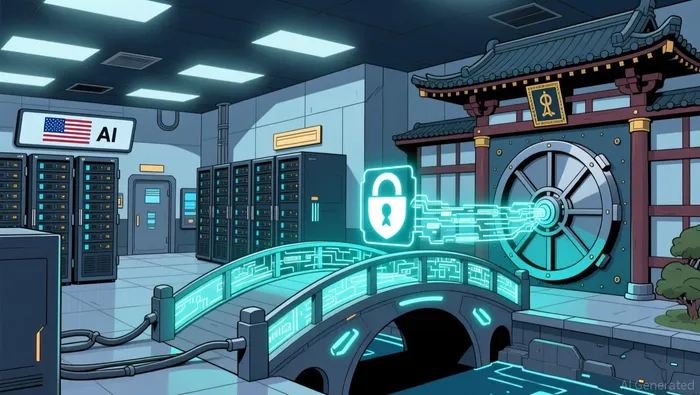
The headline reads like a typical enterprise AI deal. A Japanese IT services company plugs into a frontier model, then resells it to banks and municipalities. But the real story isn't the partnership itself - it's what NEC is quietly positioning itself to become: the gatekeeper between foreign AI capability and Japanese financial infrastructure.
I think that distinction matters more than the press release lets on.
The system integrator plays a role no model company can
If you're not familiar with Japan's IT landscape, NEC isn't just a tech vendor. It's what industry calls a "SIer" - a system integrator that sits between technology providers and the institutions that actually run the country. NEC builds and manages IT infrastructure for banks, government agencies, and critical utilities. If you work at Mizuho or the Ministry of Finance and need to modernize your core systems, NEC is almost certainly in the room.
Anthropic can build Claude. It cannot walk into a Japanese bank's regulated environment and say "deploy this." Banks don't buy AI models directly; they buy the relationship, the liability framework, the Japanese compliance layer, the service-level agreements that go with it. NEC is that layer.
This isn't unusual for Japan, but it is structurally important. Whoever becomes the trusted intermediation layer between frontier AI and regulated institutions effectively controls the pace and shape of adoption. In crypto, I've written about how the party that sits between the protocol and the user - exchanges, custodians, on/off-ramps - ends up with more leverage than the protocol designers themselves. The same dynamic is playing out here.
Why finance is the center of gravity
The partnership specifically targets the financial, manufacturing, and municipal sectors. Of those, finance is where the structural stakes are highest.
Japan's enterprise AI adoption is accelerating from a low base - 43.4% of companies now use generative AI, up from 25.8% in 2024. But financial institutions move differently from the rest of the economy. They're bound by data localization norms, strict privacy requirements, and a supervisory apparatus that hasn't caught up with the technology. NEC's mid-term management plan for 2030 explicitly names enhanced capabilities in "AI operations, security governance, and operational control" - language that's really about reassuring regulators.
The implication is straightforward. NEC isn't selling Claude to Japanese banks. It's selling confidence that Claude can live inside a bank's compliance perimeter. That's a more valuable product than the model itself, and one that Anthropic - a US company with no Japanese regulatory footprint - simply can't build alone.
The sovereignty question
Here's where the story widens, if you want it to.
"Sovereign AI" - the idea that nations should maintain ownership and governance over their own AI infrastructure - has become a live policy concept in 2026. Japan is one of the countries most actively wrestling with this tension. On one side, US firms like Anthropic offer the best models. On the other, there's genuine concern about where data flows, who controls the underlying technology, and what happens if geopolitical conditions change.
NEC's deal with Anthropic doesn't solve that tension - it navigates it. NEC gets first-mover access to Claude, deploys it to its own 30,000 employees, and uses that internal deployment as a proof-of-concept for financial clients. Anthropic gets Japanese market access through a trusted local partner rather than building from scratch. The Japanese government gets the appearance of control because the technology is being deployed through a domestic institution, not a foreign cloud.
Compare this to Europe, where the approach has been more regulatory and slower. The EU's strategy has been to set rules - the AI Act, data governance frameworks - and let market participants comply. Japan's approach, at least in this case, seems to be to pick a champion integrator and let them build the bridge. It's a different flavor of sovereignty, but it's sovereignty nonetheless.
What to watch
I'm less interested in whether Japanese banks actually adopt Claude through NEC than in what happens if they do. If NEC becomes the default path for regulated Japanese institutions to access frontier AI models, it consolidates a lot of influence in one company - a company that already manages critical national infrastructure.
The question going forward is whether other model providers try to replicate this arrangement, or whether NEC leverages its position to become the exclusive gatekeeper. If multiple US AI firms partner with different Japanese system integrators, the market stays competitive. If NEC's first-mover advantage and relationship capital create a natural monopoly in the intermediation layer, that's a more concentrated power structure than most investors are currently pricing in.
In the stablecoin world, I've seen how the intermediation layer - the companies that sit between digital money and the user - ends up shaping the system more than the protocols themselves. I'd keep an eye on whether Japan's AI infrastructure follows the same pattern.