

Headlines are saying Japan's Q1 capital expenditure stalled because the Iran war knocked the stuffing out of business confidence. The data says otherwise. Japan's economy grew at an annualized 2.1% pace in the first quarter - above expectations - with private capital expenditure expanding 0.3% from the prior quarter and gross fixed capital formation up 1.5% year-over-year. That's not a stall. It's a normalization after Q4 2025's 6.5% spike. And the Tankan index for large Japanese manufacturers actually rose to 17 in Q1, up from 15 the prior quarter.
The fear narrative got built in April and May, after Q1 was already in the books. That timing gap matters because it means the market is conflating post-period sentiment with period results.
Now let's talk about what the Iran situation actually delivered for oil investors, because that's where the real story lives. The United States and Israel launched attacks on Iran in late February 2026. A temporary ceasefire followed on April 8, opening the Strait of Hormuz to commercial shipping. Then things unraveled again - the ceasefire was reportedly violated from day one, the U.S. Navy blockaded Iranian ports, reports surfaced of Iranian mines in the Strait, and Brent crude surged above $114 a barrel on April 30, hitting a four-year peak.
That peak didn't last. A tentative new ceasefire agreement sent oil plummeting. By the end of May, Brent had fallen roughly 20% to around $91 - the lowest level in about six weeks. A single day in late May saw crude swing from $114 down to $96 on social media reports of ceasefire talks. The Strait of Hormuz never fully closed. It was threatened, it was tense, but the oil kept flowing.
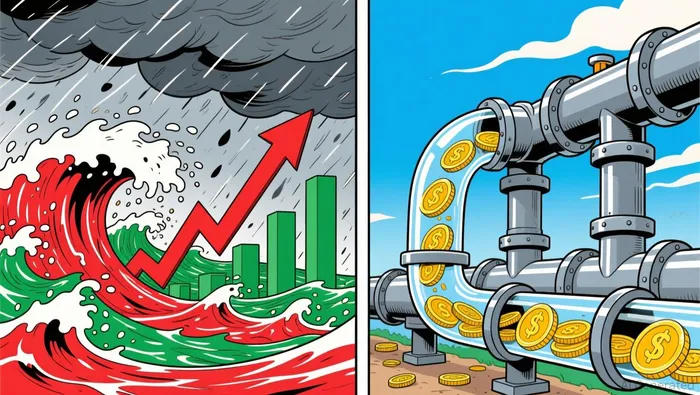
Here's what that whipsaw means for the kind of investor who thinks in cash flows rather than headlines. Fee-based midstream operators - the pipeline and logistics companies whose revenue comes from tolls and transport contracts rather than commodity price exposure - just ran through the ultimate stress test. When oil spiked above $114, volume through contracted systems surged and margins held because fees are fixed. When oil crashed 20% in a week, those same cash flows didn't drop by 20%. The fee-based model is explicitly designed to insulate you from exactly this kind of headline-driven whiplash.
Commodity-exposed players had a different ride. E&P companies riding the $114 price tag saw paper profits and stock pops. Then watched both evaporate as the ceasefire bid took hold. That's the asymmetry. On the way up, commodity exposure looks like genius. On the way down, it looks like luck you can't bank.
Even if the Iran ceasefire holds and oil stabilizes around $90, the fee-based argument doesn't weaken - it strengthens. At those levels, U.S. shale remains profitable, throughput stays strong, and the contracted revenue stream that midstream companies are built on keeps generating predictable cash. At $114, the same companies generate the same contracted cash but get bonus volume. The downside is capped by contract structure. The upside is a free option on throughput growth.
The April collapse in Japanese manufacturer sentiment - an 11-point drop in the Reuters Tankan to +7, the largest monthly fall since early 2023 - tells the real story. That's when the oil price spike actually hit Japanese industry, a nation that imports nearly all its crude. But Q1 GDP doesn't reflect April panic. It reflects what companies were doing in January through March, when oil was elevated but the full Strait of Hormuz crisis hadn't ignited.
All things considered, the lesson from this episode is the one I keep returning to: when geopolitics creates a violent spike-and-retrace in oil, the companies that matter are the ones whose cash flows don't care which direction the commodity moves. Fee-based midstream operators just proved it again. For investors positioning around Middle East risk that refuses to fully disappear, that predictability premium is the only hedge that doesn't require guessing whether the ceasefire lasts.
I'd rate fee-based midstream names a Strong Buy in this environment. The market rewarded the spike and is now repricing the relief - but the cash flow underneath hasn't changed.