

The headline reads like routine government-central bank dialogue. A spokesperson says Japan's government "expects the BOJ to conduct appropriate monetary policy" - and the market files it away as normal policy coordination.
It's not normal. It's fiscal dominance in its earliest public stage.
I don't think investors are paying enough attention to what's happening in Japan. This is the clearest live example of the regime shift I've been tracking for years: a world where central banks can't normalize monetary policy because government debt is too large to ignore. Japan is simply the first to make it explicit.
The constraint isn't political. It's arithmetic.
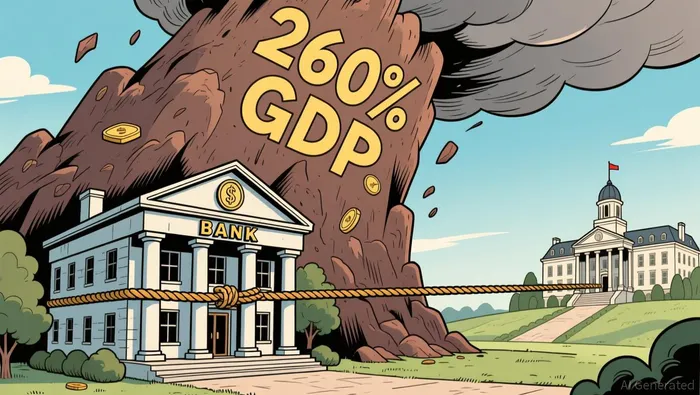
Japan's government debt is roughly 260% of GDP - the highest among advanced economies. At these levels, every percentage point that bond yields rise costs approximately 2.5% of GDP in additional annual deficit spending. That number alone explains why Prime Minister Takaichi's government isn't simply letting the BOJ do whatever it wants.
The BOJ raised its policy rate from zero in January 2025 and has moved it to 0.75%. A June 16 hike to 1.0% is now widely expected - nearly two-thirds of economists surveyed by Reuters see it coming. But how far beyond 1% the BOJ can push before the government pulls the brakes is the real question.
The bond market already knows this tension exists. The 10-year Japanese government bond yield hit 2.8% on May 17 - the highest level in 29 years. The 40-year JGB breached 4% for the first time in history in February 2026. These aren't abstract moves. They're the market testing how much pain the Japanese government can actually absorb.
What "coordination" really means
When Prime Minister Takaichi met with BOJ Governor Ueda in late May, the language was carefully chosen. Takaichi said she "hoped the BOJ conducts appropriate policy mindful of the fact the government is taking steps to cushion the blow". Ueda said they would "maintain dialogue."
That sounds cooperative. It's actually a warning shot.
In the old regime, central bank independence was sacred. The BOJ set rates based on inflation, and the government accepted the consequences. In a fiscal dominance regime, that separation breaks down because the government simply can't afford the consequences anymore. The BOJ can hike rates if inflation demands it, but only as long as the government doesn't go broke servicing its debt.
This matters because it tells us something fundamental about the macro environment we're entering. If the world's third-largest economy can't normalize monetary policy freely, the assumption that central banks will always fight inflation aggressively - regardless of cost - is weakening.
The triangular pressure no one else can resolve
Here's where it gets sharper. US Treasury Secretary Scott Bessent went to Tokyo in mid-May and publicly urged the BOJ to raise rates to strengthen the yen, which trades around 159-160 to the dollar - near its weakest levels in decades. A stronger yen would reduce imported inflation and ease global trade imbalances the US is trying to fix.
But then Bessent added a line that most headlines missed: "BOJ Governor Ueda can deliver if Tokyo grants freedom on rates".
Bessent, of all people, was admitting that the BOJ doesn't have freedom. The US Treasury wants Japan to hike, but even Washington acknowledges the Japanese government is the constraint - not the central bank itself.
This triangular dynamic - US wanting BOJ action, Japanese government fearing fiscal consequences, BOJ caught in the middle - is going to play out repeatedly. The June 16 rate decision will be the first stress test. After that, the question becomes whether the BOJ can lay out a clear path for further normalization, as markets are asking, or whether the government's fiscal constraint forces it to stop.
What this regime shift means for portfolio construction
I believe inflation is likely to remain more persistent than the market wants to admit. Japan's situation is the most visible signal of why. When the world's major central banks are constrained by their own government's debt burdens, the old 2% inflation target becomes less of a binding commitment and more of a hope. Structural forces - deglobalization, demographics, energy transition, and yes, fiscal dominance - push costs up while limiting the tools available to fight them.
This doesn't mean selling equities. It means being selective about which equities you own.
The companies that survive and compound in this environment share specific characteristics. They need pricing power - the ability to raise prices without losing customers - because if they can't pass inflation through, their real earnings and their dividends both shrink. They need balance-sheet strength because higher rates for longer penalize leveraged businesses. And they need to belong to the real economy: energy, industrials, defense, logistics, infrastructure - sectors that provide things the economy cannot function without, regardless of the macro backdrop.
That is where the opportunity starts. While the market debates whether the BOJ hikes or whether the yen finds a floor, the real question for income investors is simpler: which companies can grow their dividends when inflation refuses to go away?
The equity yield curve still works - but only if you pick the right side
The sweet spot hasn't changed. Moderate yields of 2-4% with dividend growth of 8-15% compound faster over time than high yields with no growth. The difference now is that pricing power is the single most important filter. A company trading at a 5% yield means nothing if it can't raise prices.
The real entry opportunity comes when these quality businesses are temporarily out of favor and cyclical weakness inflates their yields - which is exactly when you should be looking, not when the market is cheering.
The framework for the income-growth sleeve is clear: look for the balance sheet that doesn't buckle, the pricing power that compounds through inflation, and the payout profile that can survive a full cycle - including one where central banks can't quite normalize because the government won't let them.
I don't need the BOJ to stop hiking or the yen to crash for this framework to hold. From an income and risk/reward point of view, the appeal is the same: durable payouts, valuations that don't assume inflation disappears, and enough pricing power to protect purchasing power when the regime shifts permanently.
Japan's "coordination" headline will fade from the wires by tomorrow. The constraint it reveals won't.