

The headline says Japan's composite PMI hit a five-month low in May. The natural reflex is to file that under "global manufacturing weakening" and start worrying about cyclicals.
The natural reflex is wrong.
The more useful question is not whether one Asian economy ticked lower. The more useful question is which parts of the real economy are still pulling the chain, and which are starting to drag - because the answer determines whether you own industrials with conviction or sit on the sidelines waiting for a signal that may be months away.
What the Japan print actually says
The S&P Global Japan composite PMI - which combines manufacturing and services into one number - fell to 52.2 in May from 53.0 in April. That is the lowest reading in five months. Still above the 50-point expansion-contraction line, but slower.
Here's what most market commentary misses: the weakness is not in factories. Japan's manufacturing PMI hit 55.1 in April, the strongest reading in over four years, up sharply from 51.6 in March. Factories were accelerating.
The drag came from the services sector, where growth slowed into the low-51s. The composite is weighted toward services, so a softer services reading drags the combined number even when manufacturing is running hot.
That distinction matters. Manufacturing PMI is a leading indicator of export demand, capital goods orders, and global supply-chain activity. Services PMI reflects domestic consumption, tourism, and local demand. Japan's services are feeling the weight of a weak yen making imports expensive and domestic demand softening. That's an internal Japan problem, not a signal that global factory demand is collapsing.
The real divergence
While Japan's composite edges lower, US manufacturing is telling a different story entirely.
The ISM Manufacturing PMI held at 52.7 in April - unchanged from March and the highest reading since August 2022. The S&P Global US Manufacturing PMI climbed to 54.0 in April, the strongest since the spring of 2022. US factories are not slowing; they're expanding at a pace not seen in years.
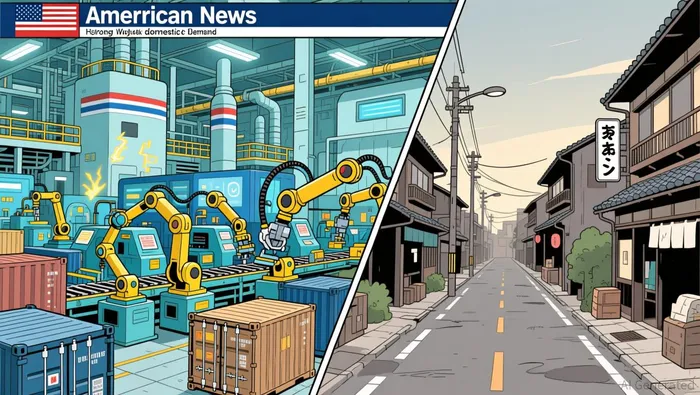
This is the divergence that shapes the trade. Global manufacturing is not in a synchronized downturn. Demand is splitting: strong in US production, softening in Japanese domestic services, with Chinese and European data muddying the middle. If you're watching leading indicators to time entries into real-economy cyclicals, the signal is not "sell everything." The signal is "be selective about which factories you back."
I don't think investors are being paid to panic about a Japan composite PMI number that's being dragged by services weakness, not factory weakness. The better question is whether US manufacturing strength can sustain the pricing power that makes industrial dividend growers worth holding.
What the BOJ is doing complicates the picture
The Bank of Japan held rates at 0.75% in April but raised its inflation forecast. Markets are now pricing a rate hike to 1.0% at the June 15-16 meeting, with a second hike potentially coming by year-end. The BOJ sees inflation risk tilted to the upside - partly from geopolitical pressures, partly from structural wage dynamics - and is willing to tighten even as domestic activity softens.
This matters for two reasons. First, it confirms that the BOJ believes inflation is not a solved problem in Japan, which lends credibility to the broader thesis that central banks may increasingly tolerate above-target inflation when growth, debt, and supply constraints push in that direction. Second, a stronger yen from rate hikes could further pressure Japanese exporters, which is why domestic services are already softening - import prices are elevated, and consumer purchasing power is being squeezed.
For an income-focused investor watching from outside Japan, the takeaway is not to short Japanese equities. The takeaway is to understand that the macro regime Japan is entering - tighter monetary policy alongside softening domestic demand - is one where export-oriented manufacturers with pricing power can still thrive, while domestic consumer-facing businesses face a harder road.
What this means for the portfolio
The equity yield curve approach teaches you to buy quality manufacturers when they're out of favor and selling them when the consensus is euphoric. Right now, the US industrial complex is not out of favor. PMI is strong, and the market knows it. That means valuations in US industrials likely already reflect a decent amount of optimism.
But here's where the opportunity hides: European and Asian manufacturers that supply the US supply chain are where the real-economy demand is flowing. Companies that sell capital equipment, components, and materials into US factories - particularly those with pricing power from oligopolistic positioning or mission-critical products - are where the order books should be filling fastest. Those are the businesses that benefit from reshoring trends, defense spending, and infrastructure build-outs, all while US PMI remains at multi-year highs.
The Japan slowdown is not the global signal. The US PMI strength is. And the question for any dividend growth portfolio is not whether to own cyclicals - it's whether you own the right ones. The ones whose customers are ordering more, whose pricing power holds through inflation, and whose balance sheets can fund growing payouts without begging the market for more equity.
Leading indicators tell you where the economy is heading. Right now, they say US manufacturing is expanding, Japanese domestic demand is softening, and the global picture is fragmented. In a fragmented world, conviction matters more than diversification. Know exactly which factories are building, which supply chains are filling, and which dividend growers are positioned to benefit - then own those with enough weight that the compounding actually matters.
I believe the divergence between US manufacturing strength and peripheral slowdown is going to widen, not narrow. The policy responses will be asymmetric, the currency moves will compound the effects, and the companies with pricing power in the right geographic lanes will compound their dividends while the consensus chases the wrong leading indicators.