

When you go to a financial data site and see 'JavaScript is disabled in your browser. Please enable JavaScript to use all features,' you probably treat it the way you treat any minor tech glitch: you scroll past it, or enable the thing, or move on.
But that message has stopped being a technical error. It's become the standard way of saying 'this content costs money.'
AInvest has been calling it out directly, noting that the 'JavaScript is disabled' error now symbolizes something less technical and more structural: institutional speed in processing information creates baked-in advantages that retail investors simply can't match. The message isn't about your browser settings. It's about who gets to see what, and when.
Here's the mechanism, stripped down. Modern financial websites don't serve their data as plain HTML anymore. They serve a blank page and use JavaScript - a scripting language that runs in your browser - to fetch and display the actual content. If JavaScript doesn't run, you see nothing. That design gives the site operator total control over who gets the data, how it's formatted, and whether it's machine-readable.
In the old model, financial data was scraped from HTML tables. You could pull it into a spreadsheet, build a model, and compare companies across the board. In the new model, the data exists only inside a rendered web page, behind authentication walls, behind paywalls, behind rate limits. The 'JavaScript is disabled' message is just the version that appears when you try the honest approach - reading the raw source - and the site refuses to play.
The question isn't whether free financial data is dying. It already is. The question is whether anyone outside the paying class will be able to invest with anything approaching equal information.
You can see this happening in practice. Yahoo Finance, which served as the backbone of free market data for retail investors and independent developers for decades, now charges approximately $500 a year for a Premium membership just to download historical data. Five hundred dollars. Not $5. Not $50. A full five hundred, which is an intentional price for anyone who isn't a professional or an institution with a budget.
That's not a rounding error in the cost of investing. It's a design choice. And the choice is the same one that 'JavaScript is disabled' enforces: the data is here, but you need to clear a gate to see it.
The broader context is worth a moment. AInvest describes the message as the browser-level equivalent of 'you need to authenticate and pay to see this'. The same firm calls it a tollbooth rather than an error. The framing matters because it shifts the question from 'how do I fix my browser?' to 'who is this gate designed to keep out?'
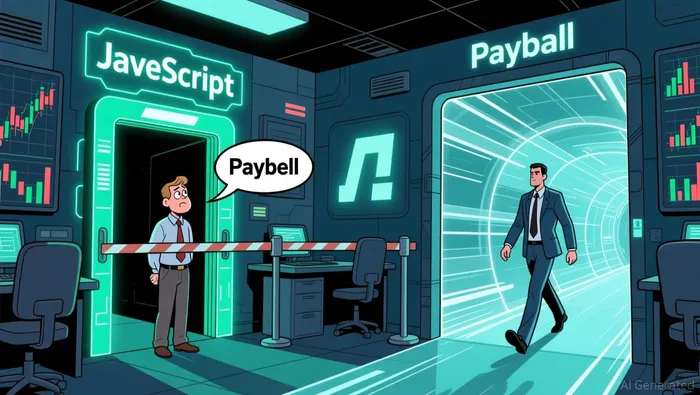
The answer isn't malicious. It's just business. Financial data platforms have realized that free access was an enormous subsidy to retail investors and independent analysts. If you build a product that aggregates data, you might as well monetize it. That incentive is rational at the company level.
But at the market level, it changes something structural. Information inequality is not a new phenomenon - institutions have always had faster feeds, better terminals, and more analysts. What's new is the degree to which even basic data - the kind you used to get for free on any browser - is now systematically behind a cost barrier. The Bloomberg Terminal costs around $24,000 a year. Yahoo Finance's premium tier is $500. That's still a gap of almost fifty-to-one. And below Yahoo, there's a whole layer of free-but-rendered sites where you can look but can't systematically analyze.
I suspect the real question here isn't about data pricing at all. It's about whether this shift matters for outcomes.
Most people think the answer is no. They assume that even with worse data access, retail investors can make good decisions because the market is efficient enough that basic information doesn't create an edge. And there's truth to that - you don't need real-time data to understand whether a company's business model works.
But here's where it gets more interesting. The advantage isn't about knowing the right thing. It's about knowing it first. If institutional investors process earnings reports faster because they have machine-readable data flowing into automated systems, and retail investors are reading rendered web pages on delayed feeds, then price discovery itself skews. The market incorporates institutional information before retail information arrives. That's not fraud. It's just latency. And latency, over thousands of trades, compounds into a structural edge.
The way to think about this is not as a conspiracy. It's as an incentive. Every financial data platform that puts its content behind JavaScript rendering is making the rational choice to monetize access. No single company is trying to disadvantage retail investors. But the aggregate effect - across dozens of platforms, all making the same rational choice - is to make systematic, independent analysis significantly harder for anyone who doesn't pay.
Here's the test I'd apply. If you're a retail investor, try this: pick a stock you own and try to pull its last ten quarters of earnings data into a spreadsheet without paying anything. Not looking at it - pulling it, in a format you can compute with. If that takes more than twenty minutes or requires a subscription, you're already behind the paywall. And the paywall isn't your browser. It's the design.
The deeper question is whether this matters enough to change how you invest. My guess is it matters more than most people think. Not because you're going to lose money - but because the kinds of analysis you can do for free are now fundamentally different from the kinds of analysis that run at scale. If you can't build models, you can't test hypotheses at the speed the market rewards. And if you can't test hypotheses fast, you're making decisions from a smaller sample of ideas than the people who pay for access.
That doesn't mean the game is rigged. It means the cost of playing it honestly has gone up. And the cost is hidden behind a message that looks like your own fault.