

Jensen Huang said it in three words during a March interview with Lex Fridman: "extremely likely, and in my mind, inevitable." He was responding to a straightforward question - can Nvidia become a $10 trillion company?
Huang is not wrong about the long-term direction. He is, however, the CEO of the company in question, which means his job is to project inevitability. The actual question for investors is different: whether the path from Nvidia's current $4.5 trillion market cap to $10 trillion happens fast enough, and reliably enough, to make holding today the best use of your capital.
The evidence for growth is real - and already in the price
Nvidia's Q1 FY2027 numbers, released May 20, show a company still growing at a pace that looks nearly impossible to compete with. Revenue hit $82 billion, up 85% year over year. Earnings per share came in at $1.87, beating the $1.77 consensus. Data center networking - the infrastructure that connects GPU clusters together - posted a record $14.8 billion, up 199% year over year and 35% sequentially.
That 35% sequential jump in networking revenue is the detail I find most revealing. It tells you the hyperscalers aren't just buying more GPUs - they're buying bigger, denser racks and the networking fabric to tie them together. That pattern only emerges when customers are scaling past pilot deployments into sustained production workloads.
Management's own words reinforce this. Huang told investors on the Q4 FY2026 call that the company expects "sequential revenue growth throughout calendar 2026, exceeding what was included in the $500 billion" order pipeline. The $500 billion figure was the combined 2025-2026 order book Huang cited back in October 2025. If Q1's $82 billion run-rate annualizes to roughly $328 billion for just this quarter alone, that pipeline is being consumed at a pace that would have looked extraordinary six months ago.
The architecture transition that changes everything
Here is what the market is still processing, and it matters more than the headline growth rate: the AI compute paradigm has already shifted from training to inference.
Huang made the shift explicit himself: "Inference equals revenues now." Data center inference revenue is now roughly 40% of Nvidia's total - up from a small fraction just two years ago when training dominated almost entirely. Jensen Huang declared AI demand "sky high" in February as Blackwell GPUs sold out, with Nvidia requesting a 50% increase in 3nm wafers from TSMC.
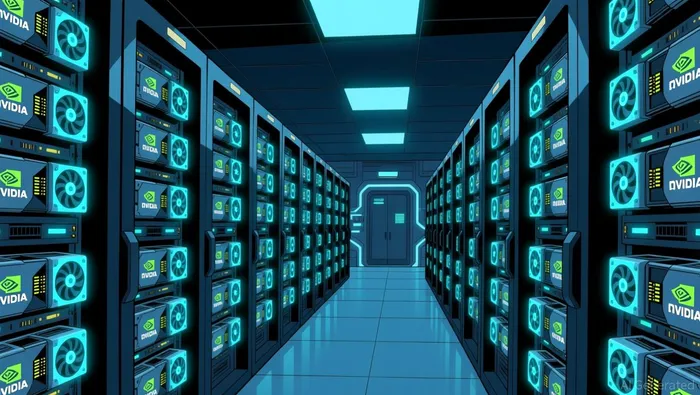
This transition is the structural frame for everything that follows. Training is a burst - you train a model once or twice, and the hardware demand is intense but temporary. Inference is continuous - every query, every user interaction, every API call runs on inference hardware that sits idle between requests but must always be available. Industry observers expect the inference chip market to become an order of magnitude larger than training in dollar terms.
The CUDA moat that made Nvidia's 80% AI accelerator market share so durable - a moat built on years of developer lock-in for training workflows - faces more friction in inference. Inference rewards efficiency, low latency, and cost per token. It rewards running models you didn't train. This is where custom silicon from Google, Amazon, and Microsoft matters more, and where AMD's MI300X finds a larger wedge. Nvidia doesn't need a monopoly to grow - but the nature of that growth is changing from a training fortress to an inference race.
The supply chain tells a different part of the story
TSMC's CoWoS packaging capacity - the bottleneck for advanced GPU production - is sold out through 2025 and into 2026. TSMC is expanding, projecting roughly 120,000 monthly wafer output capacity, but the constraint remains the binding factor on how fast Nvidia can actually ship.
This is the supply signal I watch most carefully. When demand is "sky high" and the only constraint is how fast fabs can build, you're in a supply-constrained seller's market. That sounds bullish - and it is, for revenue visibility. But it also means every sequential surge in supply commitments carries leverage risk. Nvidia has bet enormous capital on the Blackwell-to-Rubin transition, and if the inference demand ramp slows or hyperscalers pull back on capex timing, that inventory and supply commitment pile becomes a downside risk, not just an opportunity.
Put plainly: demand is not the issue. The issue is whether the supply commitments Nvidia is locking in are proportionate to the inference demand that actually materializes - and whether the market is correctly pricing the timing risk.
The product roadmap is the real bet
At GTC 2026, Nvidia unfolded a roadmap that goes beyond GPUs. The Vera CPU - purpose-built for agentic AI and reinforcement learning - was launched with claims of 2x efficiency and 50% faster performance than traditional CPUs. The Vera Rubin VR200 superchip delivers 50 PFLOPS of FP4 compute and a 3.3x throughput jump over the B300. Nvidia believes lifetime sales of its major chip systems will reach $1 trillion.
The Vera Rubin is the architectural generation gap Huang needs to keep the moat intact. If the 3.3x throughput improvement holds, it means the next migration wave - from Blackwell to Rubin - looks economically mandatory for customers, not optional. That is what extends growth even as the market matures.
But the Vera CPU is where the software-layer value migration starts to matter. Nvidia has been a hardware company that builds software moats. The Vera CPU is an attempt to own the CPU-GPU fabric for agentic workloads - the workloads that will drive the next wave of enterprise AI adoption. If that lands, it moves Nvidia from accelerator vendor to full-stack compute platform. That is the hardware-to-software value migration that changes what the market assigns to the multiple.
The $10 trillion math - and why timing is the real risk
Here is the arithmetic. At a $4.5 trillion market cap, Nvidia needs to roughly double to reach $10 trillion. The company's FY2026 revenue was $215.9 billion. If it grows at 65% for another year - the FY2026 pace - that's roughly $356 billion. At the current gross margin rate of approximately 75%, that generates enormous operating cash flow. Even without multiple expansion, the cash flow trajectory can carry a large fraction of that gap.
But much of that $10 trillion return is likely back-half weighted, in the 2028-2030 window when Rubin volume scales, the Vera Rubin superchip transitions, and inference infrastructure builds out across enterprise deployments. The next 12-18 months are about Blackwell Ultra ramping and the Vera CPU finding product-market fit - important, but not $5 trillion of new market cap important.
Where the capital goes
The debate is not whether Nvidia remains the dominant force in AI compute. It isn't. The debate is whether the return profile from here - roughly 120% upside to that $10 trillion target, but back-half weighted - is better than what can be found elsewhere in the AI trade.
I believe Nvidia deserves a core allocation in any AI portfolio. The supply chain signals, the product roadmap cadence, and the inference transition all point to a company on the right side of the compute paradigm shift. But a core allocation and a maxed-out position are not the same thing.