

When JPMorgan, Mastercard, and Ripple settled a tokenized U.S. Treasury redemption on the XRP Ledger in under 5 seconds last week, the crypto press reached for the familiar phrase: institutional adoption.
But the headline "JPM touched XRP" - as one account put it - gets the plumbing wrong in a way that actually reveals something more interesting about where settlement design is heading.
The asset didn't do anything. The ledger did.
This is the first distinction that matters. The XRP token - the one that trades at about $1.40, roughly 60 percent below its July 2025 peak - played no mechanical role in the pilot. What moved was Ondo Finance's OUSG, a tokenized short-term U.S. Treasury product, settling on the XRP Ledger. The corresponding dollar payment flowed from JPMorgan to Ripple's bank in Singapore through traditional banking rails.
The XRP Ledger is a public blockchain. Ondo's tokenized Treasury asset moved across it in real time. The dollar side settled offchain. This is a delivery-versus-payment structure: the asset and the cash move in coordinated fashion, not simultaneously on the same rail.
JPMorgan had already tested this architecture once before, in 2025, using Chainlink. The new pilot adds Mastercard into the chain and completes a full redemption cycle. The under-five-second settlement time is notable not because it's magic but because it demonstrates that a public ledger can serve as a coordination layer between onchain assets and traditional bank settlement - which is exactly what tokenized finance needs to work at scale.
Why this matters: the question for institutional tokenized markets has never been whether blockchains are fast enough. It's whether banks can connect their offchain dollar rails to onchain asset movement without creating legal or operational risk. This pilot suggests they can, at least in controlled conditions.
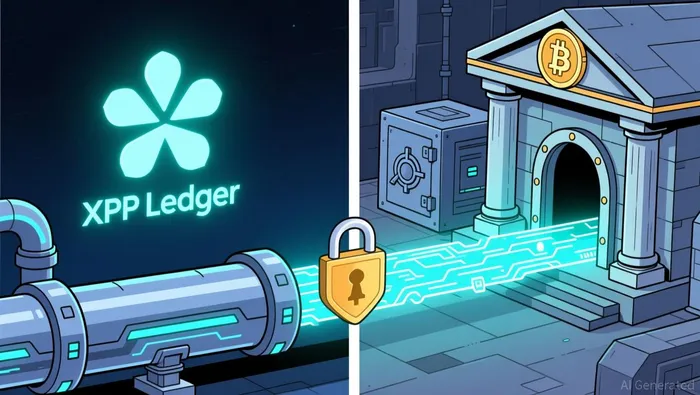
Ripple's stablecoin, not XRP, is the payments product
Ripple has spent years positioning XRP as the bridge currency for cross-border payments - the idea being that dollars convert to XRP, cross a ledger, then convert back to local currency, all in seconds, without pre-funded correspondent accounts. That was the original on-demand liquidity story.
The current architecture looks different. Ripple's own stablecoin, RLUSD, crossed $1.6 billion in market capitalization by April and has expanded to Ethereum Layer 2 networks via Wormhole. It's the Swiss-regulated AMINA Bank that's the first European institution offering end-to-end payments using RLUSD. The stablecoin, not the native token, is becoming Ripple's payments product.
This isn't unusual. The broader market moved toward regulated stablecoins for settlement for the same reasons: predictable reserve backing, clearer regulatory category, and no need for counterparties to absorb volatility risk in the bridge asset itself. XRP's role as an on-demand liquidity medium has quietly given ground to dollar-pegged instruments.
Who's telling the story matters
Here's the part that's worth sitting with. Evernorth Holdings, a Ripple-backed company that has accumulated approximately 400 million XRP and recently filed a Form S-4 registration statement with the SEC (the penultimate step before an IPO modeled on the MicroStrategy Bitcoin treasury playbook), is the loudest voice framing the JPMorgan pilot as evidence of XRP's "actual story."
Their incentive structure is transparent. Evernorth needs a utility narrative to support the thesis that XRP is more than a speculative asset holding on a corporate balance sheet. The S-4 filing means they're preparing to raise capital from public markets to buy even more XRP. The story that institutional settlement runs on the XRP Ledger is valuable to their thesis, even if the XRP token itself didn't facilitate the settlement.
That's not dishonest. It's just constituency politics in crypto form. When an XRP treasury company champions XRP infrastructure, we should read the framing for what it reveals about who benefits from which narrative - not assume the narrative and the mechanics are the same thing.
What the pilot actually proves
Set aside the branding layer for a moment. The structural move here is that a major bank, a global card network, a tokenized asset issuer, and a public blockchain all cooperated to move a real financial instrument - not a synthetic test token, but an actual tokenized Treasury - across jurisdictions in seconds. That's a narrow but real proof point.
JPMorgan's blockchain unit has been running tokenized Treasury experiments for over a year. The progression from internal tests to multi-party pilots involving Mastercard and a public ledger suggests the bank is working through how tokenized settlement layers will sit alongside, not replace, its existing infrastructure. This is how big institutions actually modernize: slowly, incrementally, and in partnership with companies that carry their own incentive to make it work.
The unresolved question is scale. A single redemption between known counterparties is architecture validation, not production evidence. The real test comes when these rails carry routine volume - when a fund manager redeems OUSG tokens and expects the dollars to arrive through a path that doesn't look materially different from the way they'd settle a traditional Treasury fund. Until then, we have a strong proof of concept with an unproven migration path.
Where this leaves us
XRP is trading roughly where it has been all month, well below its 2025 highs, despite a string of institutional pilot announcements. The disconnect between infrastructure news and token price is one more reason to resist the reflex that every partnership moves the underlying asset. The XRP Ledger's utility as a settlement layer is not automatically convertible into XRP demand.
What seems more durable is the shift toward regulated stablecoins - RLUSD included - as the actual settlement currency for cross-border and tokenized flows, with public ledgers serving as the coordination layer. That's the structural transition underneath the headlines.
The question worth tracking isn't whether XRP will benefit. It's whether the institutions that built these pilots will treat the XRP Ledger as a permanent settlement option or as one test among many. If the architecture migrates to other chains - or to bank-private ledgers - the proof point dissolves into a footnote. If it sticks, the XRP Ledger earns a place in institutional plumbing that has nothing to do with the token that shares its name.
Either way, the story Evernorth wants to tell and the story the plumbing actually tell are not the same one. I'm more interested in what the rails reveal than in who profits from the narrative.