

Kalshi's first week points to real U.S. demand
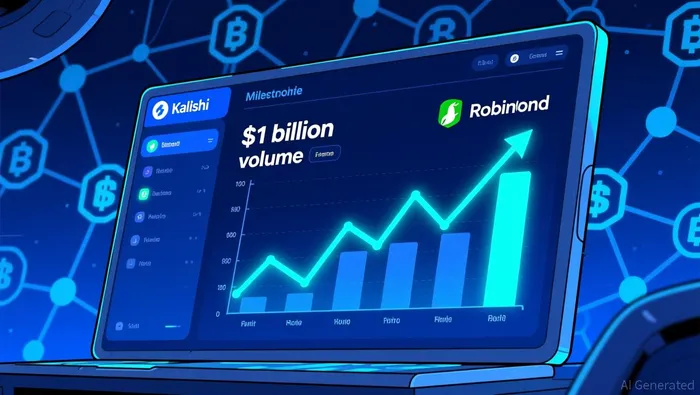
Kalshi's perpetual futures crossed $1 billion in trading volume within a week after launching Monday, June 9. The product also saw more than $100 million in trading volumes in 24 hours. For a new derivatives product on a U.S. platform, that is a notable opening.
The speed of adoption is the clearer signal
The more important takeaway is how quickly that volume arrived. Kalshi's event-contracts business took 40 months to reach the same cumulative figure. Perpetuals are a different product, but the comparison still suggests that traders were ready to move into Kalshi's newer derivatives offering faster than they did into its original market.
A large market finally has an onshore route
The broader opportunity helps explain why the launch matters. Offshore perpetuals saw over $90 trillion in 2025 annual volume, and before Kalshi there wasn't a way to trade the contracts in the U.S. Kalshi became the first company in American history to offer perpetuals under CFTC supervision, giving U.S. traders a regulated venue for an asset class that was previously inaccessible at home.
That does not guarantee durability, but it does show that demand for regulated crypto perpetuals exists and responded immediately.
Why perpetual futures could keep flow after the launch burst
No expiration makes the product simpler
Perpetual futures remove the expiry decision that can fragment traditional futures activity. There is no fixed expiration date, so traders do not have to keep rolling from one dated contract into the next. That makes the product easier to use for both speculation and hedging, because the main call is direction rather than roll timing.
Funding is what keeps the contract anchored
The tradeoff is funding. Kalshi's perpetuals use funding payments keeping the perpetual contract price aligned with the market. That mechanism matters because it gives the contract a way to stay tied to prevailing sentiment without relying on expiry dates.
Why starting with crypto makes sense
Starting with crypto perpetuals also fits the product. Active traders already use perps continuously, so Kalshi is targeting a market where that trading style is familiar. The broader point is scale: offshore perpetuals grew from $28 trillion in annual volume in 2023 to more than $90 trillion in 2025. If Kalshi can capture even a meaningful share of that behavior onshore, the category could matter well beyond the launch window.
The real risk is distribution, not demand
The bigger question is not whether Kalshi can attract one week of flow. It is whether that flow sticks when distribution channels start to compete with the platform itself.
Competition arrived at the same time as the milestone
Kalshi's launch week also saw Robinhood's Rothera Exchange went live and begin routing World Cup contracts away from Kalshi, while the brokerage expanded its own perpetuals offering. That creates a real near-term risk: even if demand is genuine, the most important distribution pipe could become harder to rely on.
Volume is not the same as retention
Product demand and platform loyalty are different problems. Kalshi may be proving that U.S. traders want regulated perpetuals, but that does not automatically mean they will keep trading them through a third-party channel if that channel starts feeding activity elsewhere. The key test is whether Kalshi can turn early interest into repeat usage on its own venue.
What to watch next
Investors should watch for a few signals in the sessions ahead:
- Volume persistence: does trading stay active after the launch halo fades?
- Distribution behavior: does Robinhood keep moving contracts and flow toward its own exchange?
- Liquidity quality: does the market continue to fill cleanly without the initial burst?
- Product breadth: does new derivatives demand strengthen Kalshi's platform overall, or simply expose its reliance on outside channels?
If those signals improve together, the $1 billion week will look like the start of a durable onshore liquidity market. If not, it may be best read as strong demand for the product, but weaker loyalty for the platform.