

Why is KG stock moving today? The answer lies in a violent, unconfirmed breakout that defies normal market logic. Kestrel Group (: KG) has surged nearly 60% in pre-market trading, jumping from a previous close of $11.78 to a current price of $18.84. While the price action screams momentum, the volume tells a starkly different story. With pre-market trading activity significantly below the 20-day average, this move looks less like a sustained institutional accumulation and more like a liquidity-driven spike. For traders, this creates a high-stakes scenario where the validity of the breakout is entirely dependent on what happens when the bell rings.
The technical structure of this move is extreme. Price has decoupled from its recent consolidation zone, breaking well above the 20-day high of $12.25 and the 60-day high of $12.28. The stock is now trading massively extended above its 20-day moving average ($11.46) and 50-day moving average ($11.12). This distance suggests severe overextension and a high risk of mean reversion. The Average True Range (ATR) is $0.82, yet the current single-session move is $7.06, indicating that volatility has spiked far beyond normal expectations. Crucially, the momentum signal from the RSI at 47.4 is misleading; it appears neutral only because the price spike happened too quickly for the indicator to fully adjust. The move is price-driven, not volume-driven, which is a classic warning sign in micro-cap trading.
Why is the volume gap critical for this setup?
The core tension in the KG setup is the disparity between price and participation. Pre-market volume is estimated at roughly 30% of the 20-day average, with a relative volume metric of just 0.69. In a stock of this size, such thin liquidity means that a small number of orders can push the price up significantly without any real underlying demand. This creates a fragile foundation. If buying pressure dries up once regular trading hours begin, the lack of institutional follow-through could lead to a rapid reversal.
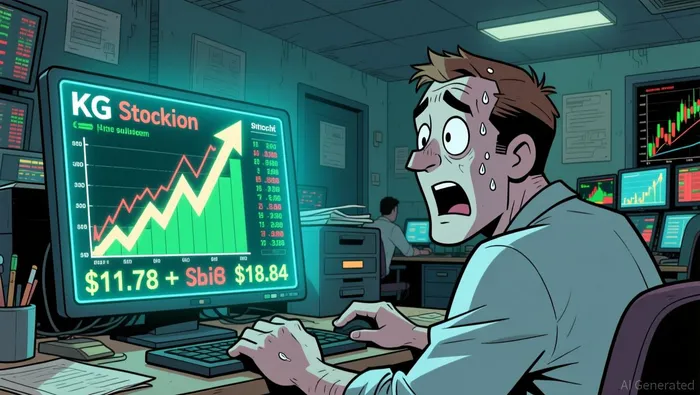
The broader market context does not help this case. Risk-off sentiment is prevailing across major indices, with S&P 500, Nasdaq, and Dow futures showing negative sentiment ahead of the session. A negative macro backdrop typically penalizes speculative micro-cap rallies, increasing the probability that this isolated rally lacks staying power. Without a clear news catalyst or sector-wide tailwind to anchor the move, the rally appears idiosyncratic. This makes it more susceptible to a "gap and trap" reversal, where early buyers are trapped as the price grinds lower to find genuine liquidity.
What is the trade structure and what to watch next?
The most credible trade idea from here is a conditional breakout follow or a rejection play, depending on the first 15 minutes of regular trading. The setup is two-way but leans toward caution. The primary scenario is a failure or fakeout, with a probability of 38%, driven by the lack of volume confirmation. The invalidation level for this bearish bias is a sustained hold above $19.00. If the stock fails to hold above $18.00 on any significant volume, or if volume remains below 50% of the 20-day average after one hour, the case for a reversion to the $12.25-$15.00 gap becomes stronger.
Traders should watch the $19.00 psychological resistance level as the key battleground. A breakout above $19.00 accompanied by a volume surge exceeding 100k shares in the first hour would invalidate the weak thesis and turn this into a strong momentum follow-through trade. Conversely, a drop below $18.00 would signal that the pre-market buyers are exiting, likely leading to a pullback toward the $15.00 psychological support. The nearest support at $18.00 is critical; a break below this level would increase the weight of the reversal scenario significantly.
The bottom line is that this move is unconfirmed and high-risk. The absence of a clear news catalyst, combined with thin liquidity and a negative macro backdrop, suggests that the rally may not be sustainable. Investors should avoid chasing the price at open. Instead, wait for volume to confirm the direction. If the stock cannot hold the $19.00 level with heavy participation, the path of least resistance is likely lower. Understanding these KG support and resistance levels is essential for navigating the volatility that will likely define the opening session.