

Kia is positioning itself for the steepest part of the EV adoption S-curve. The numbers tell a clear story: the company targets 1.26 million annual EV sales by 2030, capturing 4.3% of the global EV market in the updated Plan S strategy. That is not a cautious bet-it is a volume play that signals confidence the industry is accelerating through the inflection point where adoption rate explodes.
The strategic stakes are straightforward. If Kia is right about the S-curve trajectory, the next four years represent exponential growth opportunity. If the adoption wave stalls or shifts, those targets become costly overcapacity. This is where infrastructure plays win-the companies building capacity ahead of the curve capture market share when demand goes vertical.
Kia's electrified lineup spans the full adoption spectrum. The brand offers EV, PHEV, and HEV paths simultaneously, targeting different cohorts at different stages of the curve by 2026. The compact EV4 delivers 200+ miles of range at an accessible price point for early mainstream adopters, while the three-row EV9 SUV targets families ready for premium electric capability with over 300 miles of range. This multi-pronged approach lets Kia capture early adopters, the early majority, and the pragmatic hybrid buyers all at once-maximizing exposure to the steepest part of the adoption curve.
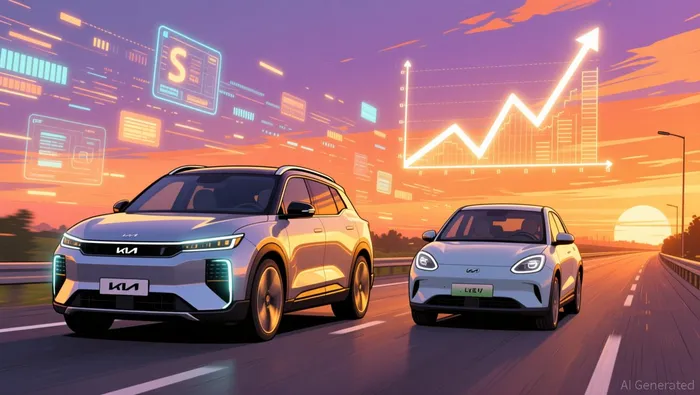
Adding to the strategy, industry speculation centers on the Vision Meta Turismo concept potentially entering production at the April 2026 Investor Day as a potential halo vehicle. A premium EV halo could accelerate brand perception in the high-margin segment where European incumbents dominate-critical for lifting Kia's position on the S-curve beyond volume into value.
For investors, the question is whether Kia's volume targets reflect genuine S-curve positioning or wishful thinking. The lineup breadth and manufacturing expansion (17% capacity growth by 2030) suggest the company is betting real capital on exponential adoption with KRW 42 trillion in planned investment. That is the behavior of a player who believes the curve is bending upward-and who wants to be positioned to capture the surge.
Manufacturing as Competitive Moat: The Capacity Expansion Story
Kia is building the physical infrastructure for exponential EV scaling-and doing so with a geographic focus that maximizes margin potential. The numbers reveal a deliberate, infrastructure-layer play: global production capacity will expand from 3.63 million units in 2025 to 4.25 million by 2030, a 17% increase that targets the steepest part of the adoption curve with capacity growth concentrated in Europe and North America. These are Kia's highest-margin markets-where customers pay premium prices for EVs and where the S-curve inflection is most pronounced. By anchoring capacity where margins are thickest, Kia isn't just adding volume; it's positioning production where every incremental unit contributes most to profitability.
The capital commitment behind this expansion signals conviction. Kia plans to invest KRW 42 trillion from 2025 to 2029, with KRW 19 trillion specifically allocated to future business capabilities-including EV platforms, batteries, and autonomous driving infrastructure KRW 42 trillion investment from 2025-2029. That's not incremental CAPEX; that's a foundational bet on the technological rails that will carry the company through the next decade. For investors tracking S-curve positioning, this is the signal that matters: Kia is building the factory floor of the future before demand goes vertical.
The PBV (Purpose-Built Vehicle) strategy adds another infrastructure layer. Kia targets 250,000 PBV sales by 2030, with the PV5 launching in 2025, the PV7 arriving in 2027, and the PV9 following in 2029 PV5 launching in 2025, PV7 in 2027, PV9 in 2029. This mirrors how tech infrastructure players expand into adjacent markets-building a platform (the PBV lineup) that can be adapted across use cases while capturing new customer segments. It's a diversification bet that treats vehicle platforms as modular infrastructure, not just product cycles.
The strategic implication is clear: Kia is treating manufacturing capacity as a competitive moat, not a cost center. The 17% capacity expansion, the KRW 42 trillion investment, and the PBV diversification all point to a company positioning itself to capture volume when the adoption curve goes vertical. For investors, the question isn't whether Kia can build the capacity-it's whether the market is pricing in the optionality that this infrastructure creates. The answer will depend on whether the S-curve delivers. But one thing is certain: when demand accelerates, Kia will have the rails ready.
Financial Architecture: Can the Numbers Support Exponential Growth?
Kia's financial targets reveal a bold proposition: the company aims to hit KRW 170 trillion in revenue with over 10% operating profit margin by 2030 while investing KRW 42 trillion. That's the financial architecture for an S-curve play-massive top-line expansion paired with margin discipline that typically only comes at scale. But here's the tension: the 2025 guidance already projects KRW 112 trillion in revenue with an 11% operating margin on 3.22 million units. Kia is targeting its own margin goal three years before the deadline. Either the company has already cracked the EV economics code, or these targets reflect the kind of optimistic planning that breaks down under capital intensity.
The 2025 numbers are striking. An 11% operating margin at 3.2 million units places Kia near its 2030 margin target while still in the early phase of EV adoption-before the volume inflection that should theoretically drive down costs. This suggests either exceptional pricing power, favorable cost positioning, or both. For investors tracking S-curve economics, the question becomes sustainability: can Kia maintain these margins while funding KRW 42 trillion in investment, or will the capital demands of the EV transition compress returns?
The Tasman pickup truck adds a strategic lever. Targeting 80,000 units annually in North America with a six percent market share goal, the Tasman represents a bet on the EV pickup segment-a high-margin category where Tesla's Cybertruck has validated demand. Pickups command premium pricing and carry stronger margins than mainstream SUVs and sedans. By anchoring a presence in this segment, Kia isn't just adding volume; it's positioning for the margin structure that supports exponential growth. The follow-on EV pickup for North America signals the company sees this as a platform play, not a niche experiment.
The execution risk is real. Reaching KRW 170 trillion in revenue requires sustaining premium pricing while achieving scale economies on EV platforms that are still maturing. The 17% capacity expansion to 4.25 million units by 2030 must translate into utilization that supports the margin target. If EV adoption stalls or competition intensifies, the gap between target and reality becomes a profitability gap. But if the S-curve delivers-and the 2025 guidance suggests Kia believes it will-then the financial architecture is designed to capture the upside. The numbers say yes, they can support it. The question is whether the market agrees.
Catalysts and Risks: What Could Accelerate or Derivel the Thesis
The April 2026 CEO Investor Day is the next critical inflection point for Kia's S-curve thesis. The event will likely confirm production timelines for the EV7 and EV8, potentially revealing a production version of the Vision Meta Turismo concept as a potential halo vehicle. For investors tracking the adoption curve, this matters: the EV7/EV8 would fill the critical mid-size and performance segments where Tesla and European incumbents hold sway. A confirmed production roadmap signals Kia is moving beyond concept hype into executable capacity planning-the kind of signal that precedes order books filling up.
But the S-curve is not linear. Two material risks could bend the trajectory downward.
The first is US policy uncertainty. North America represents a significant portion of Kia's 2030 capacity expansion with capacity growth concentrated in Europe and North America. Tariff escalation or EV policy reversals could disrupt the very markets where Kia is building production footprint. The Tasman pickup targets 80,000 units annually in North America with a six percent market share goal targeting global Tasman sales of 80,000 units per year-a bet that assumes stable trade conditions. If policy shifts, that capacity sits idle while competitors with different geographic exposure absorb market share.
The second risk is more fundamental to EV economics: battery raw material cost volatility. Kia's 10%+ operating margin target aims to achieve KRW 170 tln in revenue, over 10% operating profit margin by 2030 depends on securing lithium and nickel supply chains at scale. Without long-term supply agreements, cost spikes flow directly into margins. The KRW 42 trillion investment includes KRW 19 trillion for future business capabilities including KRW 19 tln for future business-but that capital can't fully insulate against commodity price turbulence. Investors should watch for supply chain announcements; the margin thesis lives or dies on this variable.
Here's the upside catalyst that deserves more attention: India. Kia's target of 43% market share in India by 2030 represents an underappreciated S-curve play in one of the world's fastest-growing automotive markets expansion of volume EV lineup. India's EV adoption is still in the early majority phase-the steepest part of the curve. If Kia captures meaningful share there, it gains a second exponential growth engine separate from the mature markets where competition is intensifying.
The net effect is a clear framework: April 2026 provides the near-term catalyst, US policy and battery costs represent the key execution risks, and India offers asymmetric upside. For investors, the question is whether the market is pricing in the optionality-or whether the thesis depends entirely on flawless execution across all three dimensions.