

A funny thing has happened to markets. The closing bell still exists, technically, but more and more of the interesting price discovery is happening somewhere else on crypto rails, in metals inventories, in the weird hours when traditional finance is asleep and the degenerates are very much not. And once you notice that, the silver story stops looking like a precious-metals niche and starts looking like the same story in different clothing.
Crypto Built a Weekend Macro Market
Here's the thing nobody wanted to admit until recently: when something blows up on a weekend, there's only one market open. And it's not the CME.
Back in early March, U.S.-Israel strikes hit Iranian targets on a Friday night. Traditional commodity markets were dark. Hyperliquid a decentralized exchange most macro traders had never touched became the only live feed for what oil was actually worth. WTI perpetual swaps jumped roughly 5% to $70.60/barrel. Silver perps were up 2%. Gold up 1.3%. These weren't some illiquid signals either, silver and gold perpetual contracts on Hyperliquid clocked a combined $400 million in 24-hour volume that weekend.
What happened next is the part worth watching. JPMorgan's Nikolaos Panigirtzoglou published a note tracking Hyperliquid's WTI contract specifically the CL-USDC perp. Daily volume peaked around $1.7 billion in mid-March, with open interest hitting roughly $300 million. That made it Hyperliquid's third-most traded product, behind only bitcoin and ether. A crude oil futures contract. On a crypto exchange.
And TradFi is scrambling to respond. CME is launching 24/7 crypto futures trading on May 29. Nasdaq is pushing toward 23-hour weekday equity trading, targeting H2 2026. Wintermute one of the biggest crypto market makers just rolled out a 24/7 crude oil CFD product accepting both fiat and crypto as collateral. This isn't fringe anymore; this is Wintermute reading the same JPMorgan note everyone else is reading and deciding to get there first. If the venue that trades through the weekend becomes the place people check first, then liquidity starts to follow.
Silver's Paper Problem
The World Silver Survey the definitive annual report from Metals Focus and the Silver Institute, published this Tuesday says this will be the sixth consecutive year of structural deficit. Forecast shortfall for 2026: 46.3 million ounces. And since 2021, the market has drawn down 762 million troy ounces of above-ground inventory to cover the gap.
Philip Newman, managing director of Metals Focus, put it plainly: "The conditions are certainly there for another squeeze. I don't think it is necessarily all behind us." The key difference from gold: there's no central bank backstop. When the gold market seizes, the BIS can intervene, swap lines open, something happens. Silver has no such institutional parachute which is exactly what makes the January data so striking. In the first two weeks of that month, 33.45 million ounces were physically withdrawn from COMEX for delivery. About 26% of registered inventory. Gone. In seven days.
The thing most people are treating as a silver story is actually a market structure story. The gold-silver ratio is sitting around 60:1 right now. It spiked hard when the Iran conflict started exactly when you'd expect safe-haven flows to favor gold. But silver has a dual identity that gold doesn't: it's a monetary asset and an industrial input for solar, EVs, and AI data center infrastructure simultaneously. China's January export restrictions on refined silver tightened the physical supply screw further. When the ceasefire extends and rates start to ease, all of those industrial demand bids come back at once against a market that's been drawing down inventory for six straight years.
Chart of the Week: The Silver Free-Float Mirage
London vault silver looks looser than it did last fall. The deficit says otherwise.
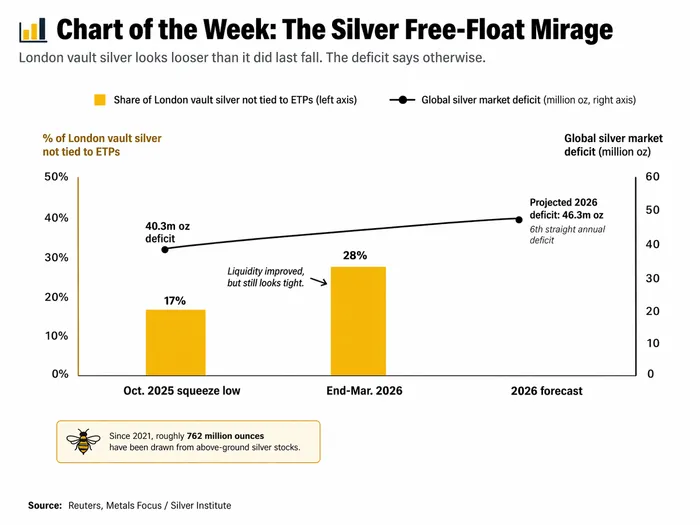
Silver looks less squeezed than it did last fall. That's true. The share of London vault silver not tied to ETPs has climbed from 17% at the October 2025 low to 28% by the end of March 2026. Great. More breathing room. But the market is still projected to run a 46.3 million ounce deficit this year.
The Hive Mind
On Reddit, you can actually watch the story mutate in real time. Weekend trading threads now casually reference Hyperliquid's oil and Nasdaq prints as a live signal while traditional markets are shut, and silver chatter still tends to default to squeeze mechanics, leveraged ETFs, and where the "real" price supposedly lives. Retail is noticing that market structure itself has become tradable.
The Thread
Two stories, one theme: the scarce thing isn't always the commodity. Sometimes it's the hour. Sometimes it's the float. Sometimes it's just the venue willing to stay open while everyone else is pretending price can wait until morning. If markets are increasingly defined by where liquidity is actually available not where it's supposed to be what other "side shows" are about to become the main event?