

Kodiak AI delivered a striking Q1 2026 earnings beat that demands attention-but the path to sustainability remains fraught. The company posted an EPS of $0.10 versus an expected loss of -$0.18, a 155.56% surprise that signals operational inflection EPS of $0.10 versus expected -$0.18. Revenue climbed 74% quarter-over-quarter to $1.8 million, driven by expansion in the Driver as a Service segment 74% quarter-over-quarter revenue growth. These are the numbers a hedge fund analyst wants to see in a growth story-but the underlying cash trajectory tells a more nuanced tale.
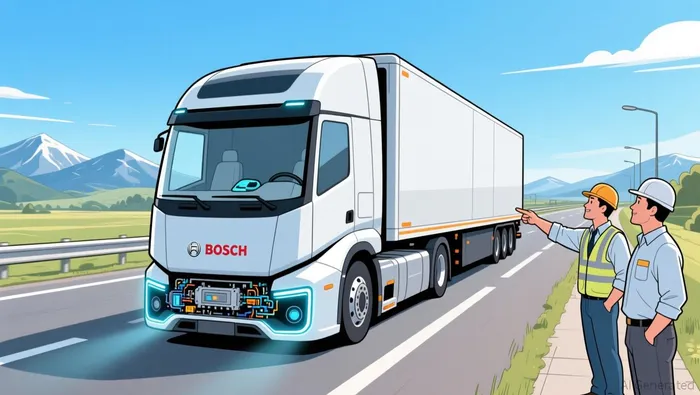
The operational metrics support the revenue acceleration. Kodiak now operates 28 fully-driverless trucks, and cumulative paid driverless hours reached 23,500-a 120% increase over Q4 2025 23,500 hours of paid driverless operations, 120% increase. This scale-up in real-world deployments is the core thesis for the Driver as a Service model, and the momentum is tangible. The Bosch hardware integration further validates the production-grade trajectory Bosch supplying and integrating critical hardware.
Yet the cash burn reality is unforgiving. While Q1 showed positive net income of $26.49 million, this reflects accounting adjustments and one-time items-not sustainable operating cash generation. The trailing twelve months ending December 31, 2025 show earnings of -$585.5 million TTM earnings of -$585.5M. Free cash flow for Q1 was -$35 million, albeit better than expected free cash flow: Negative $35M. At this burn rate, the question isn't whether the technology works-it's whether capital deployment outpaces cash consumption fast enough to reach profitability before funding runs dry.
The $100 million PIPE financing extends liquidity into Q2 FY2027, but it also underscores the capital intensity of the path forward $100 million private placement. For a risk-adjusted portfolio allocation, the key metric isn't the EPS beat-it's the cash burn trajectory relative to the 2029 profitability target. Without explicit 2029 projections in the evidence, we cannot quantify the gap. What we can assess is whether the current operational velocity-23,500 driverless hours and 28 trucks-suggests a credible path to unit economics improvement. The answer remains uncertain, and the drawdown risk from here is material.
$100M PIPE Financing: Capital Runway and Dilution Analysis
The $100 million PIPE financing closes a critical funding gap-but the warrant structure creates a material overhang that demands precise quantification.
Kodiak AI closed the private placement with an affiliate of Ares Management Corporation and several new institutional investors, raising $100 million in gross proceeds through a combination of common stock and warrants roughly US$100 million private placement. Combined with the $90.2 million in cash and marketable securities the company held at Q1 end, total liquidity now approaches $190 million-extending runway into Q2 of FY2027 Ended Q1 with $90.2 million in cash.
At the current burn rate, this capital base provides approximately five to six quarters of operating runway.
The Q1 free cash flow outflow was $35 million, though this improved from prior quarters Free Cash Flow (Non-GAAP) of negative $35.0 million. The trailing twelve-month operating cash consumption remains severe-Kodiak used $29.5 million in cash from operations in Q1 alone Q1 Net cash used in operating activities of $29.5 million. Even with the PIPE proceeds, the company will need to demonstrate accelerating unit economics improvement before the capital runs dry in early 2027.
Here lies the critical tension: the Ares affiliation validates the investment thesis at the institutional level, but the warrant structure creates a structural overhang that will pressure the share price upon exercise.
The effective dilution from this transaction likely falls in the 15-25% range, depending on warrant exercise timing and pricing shares and warrants private placement. For a company already trading on high expectations, this level of dilution is material-it means existing shareholders immediately cede meaningful ownership percentage in exchange for runway. The warrant overhang is the key risk metric: when these warrants exercise, they will introduce supply pressure at whatever price level is set, potentially capping upside even if operational metrics continue improving.
From a portfolio construction standpoint, the PIPE solves the near-term funding risk but compounds the ownership dilution risk. The question for risk-adjusted returns is whether the extended runway materially increases the probability of reaching the 2029 profitability target-or whether it simply delays the capital raise that would have occurred anyway. Without explicit 2029 cash flow projections in the evidence, we cannot quantify whether this financing closes the gap between current burn and the capital required to reach profitability.
What we can assess is the operational velocity: 28 driverless trucks, 23,500 cumulative driverless hours, and a 120% quarter-over-quarter increase in paid operations 23,500 hours of Cumulative Hours of Paid Driverless Operations, representing a 120% increase. If this trajectory sustains, the unit economics improvement could justify the dilution. If not, the warrant overhang becomes a genuine headwind.
The Ares endorsement carries weight-but in a capital-intensive path to profitability, the math ultimately dominates the narrative.
Bosch Hardware Integration: Commercial Viability and Production Timeline
The Bosch partnership represents the most significant hardware validation Kodiak has secured to date-but the production timeline determines whether this translates to meaningful revenue contribution within the investment horizon.
Bosch is supplying and integrating critical hardware into Kodiak's SensorPods, specifically cameras and actuation components Bosch supplying and integrating critical hardware. This is not a theoretical collaboration: early prototype integrations are already underway, tying the capital raise and earnings rebound to progress on the core platform that underpins future Driver as a Service deployments early prototype integrations already underway.
The deployed base provides the foundation: 28 customer-owned driverless vehicles are currently operational, accumulating over 23,500 hours of paid driverless operations-a 120% increase quarter-over-quarter 28 Customer-Owned Driverless Vehicles. This scale of deployment is the testing ground for the Bosch-integrated hardware, and the momentum is measurable.
The timeline, however, is the critical metric. Kodiak has targeted a long-haul driverless launch for late 2026, with production-grade, high-volume driverless trucking system expected by 2027-2028 production-grade, high-volume driverless trucking system. This timeline determines when revenue contribution becomes material. The 2029 revenue projection of $208.2 million requires 133% yearly revenue growth $208.2 million in revenue and $11.0 million in earnings by 2029-a trajectory that depends entirely on hitting these hardware milestones on schedule.
From a risk-adjusted perspective, the Bosch integration reduces technology execution risk but introduces timeline risk. If the hardware integration proceeds as planned, the 28-truck fleet becomes a proving ground for production-grade SensorPods, potentially accelerating customer wins across freight, industrial, and defense verticals. If delays materialize, the 2029 profitability target becomes increasingly untenable given the current burn rate.
The partnership validates the hardware thesis-but in a capital-intensive path to profitability, the calendar matters more than the collaboration. The question for portfolio allocation is whether the 2027-2028 production timeline aligns with the capital runway provided by the PIPE financing. Without explicit 2029 cash flow projections in the evidence, we cannot quantify whether the timeline and funding intersect at a profitable operating point.
What we can assess is that the Bosch integration is the most tangible hardware execution Kodiak has demonstrated. The 28 deployed vehicles, 23,500 driverless hours, and early prototype integration progress suggest this is not a paper partnership. The production timeline remains the key determinant of whether this translates to risk-adjusted returns or remains a long-dated call option on