

Summary
- The Bank of Korea will hold its key rate at 2.5% for the seventh consecutive meeting on May 28 - a decision everyone expects. What nobody is pricing correctly is that two of the world's most important AI infrastructure companies trade at single-digit price-to-earnings.
- Samsung Electronics and SK Hynix - the top two high-bandwidth memory suppliers to Nvidia - delivered record first-quarter earnings in 2026. The market still treats them as cyclical Korean export plays, not AI oligopoly suppliers.
- The KOSPI trades at roughly 9 times forward earnings. The U.S. semiconductor industry average sits near 49 times. The gap is not about quality; it's about narrative.
- I rate both Samsung and SK Hynix as Buys, but I favor Samsung for its explicit commitment to return 50% of free cash flow to shareholders. SK Hynix's 0.19% dividend yield is a mark against it for income-oriented investors.
- A weakening Korean won adds currency headwind for U.S. investors, but the AI-driven memory supercycle is a multi-year structural demand shift, not a cyclical upturn that reverses when central banks change their tune.
I always keep an eye out for false narratives that disguise structural bargains as mundane calendar events. The South Korean central bank's upcoming rate decision on May 28 is one of those moments. The Bank of Korea will hold at 2.5% for a seventh straight meeting - nobody expects otherwise, and nobody who doesn't trade won futures should care. The consensus headline is about monetary policy. The real story is about two semiconductor companies that power the world's most important supply chain bottleneck, and that the market is mispricing by at least a factor of five.
Here's what most analysts are missing: Samsung Electronics and SK Hynix sit inside what I call the AI infrastructure oligopoly. These two companies, both headquartered in Seoul, control the vast majority of high-bandwidth memory production - the specialized chip that sits directly next to Nvidia's GPUs and without which its AI data centers simply don't function. SK Hynix holds roughly 60% of the HBM market; Samsung controls about 20%. Together, they are the primary memory suppliers to Nvidia's next-generation Rubin chips. Micron is a distant third.
That supply position is structural, not cyclical. The HBM4 shortage is expected to worsen in the second half of 2026, according to SK Hynix's own guidance. Samsung is close to finalizing a deal to supply over 30% of Nvidia's HBM4. These are not recovery dynamics; they are structural capacity constraints feeding multi-year hyperscaler capex plans. Comparisons to previous memory cycles are not only unjustifiable and irrational; in my opinion, they are irresponsible.
Now look at the earnings. SK Hynix posted a record $35.55 billion in revenue for Q1 2026 - a 200% year-over-year surge. Samsung's Q4 2025 revenues hit $65.6 billion, up 24% year-over-year, with profits that tripled. DRAM prices are projected to rise another 30% in 2026. And yet, consensus P/E multiples for Korean semiconductor stocks sit in single digits. Goldman Sachs reported that Korean semiconductor stocks trade at single-digit forward P/Es while 2026 earnings growth has been revised up to 23%. The Seeking Alpha analysis putting the KOSPI at 9x earnings against 300% expected EPS growth isn't a contrarian take - it's arithmetic.
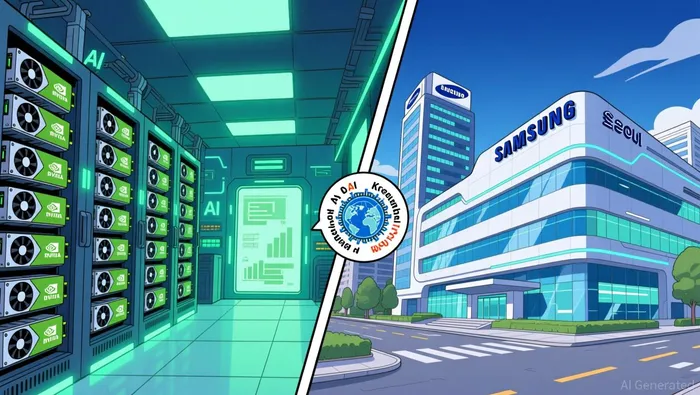
Meanwhile the KOSPI has broken 7,000 for the first time, and Korean stocks are up 75% already in 2026. The index has gained more than any major market this year, but the multiple expansion hasn't caught up to the earnings explosion. The market is pricing a cyclical recovery, not an AI oligopoly. That disconnect is the investment opportunity.
Of the two, I favor Samsung Electronics for three reasons.
First, capital allocation discipline. Samsung has committed to returning 50% of its free cash flow to shareholders, with an annual regular dividend of 9.8 trillion won. That is a dividend growth over buybacks commitment - the kind of structural cash-return framework I trust because it's harder to reverse than a one-time buyback authorization. Samsung's next dividend is set for an ex-date of May 28 (ironically the same day as the BOK decision), at 37,200 won per share. The yield is modest but growing, and the mechanism is institutionalized.
Second, the HBM4 inflection. Samsung has been caught in second place in the current HBM generation - SK Hynix's early Nvidia certification gave it an outsized market share. But HBM4 is the reset. Samsung is expected to capture 30% of Nvidia's HBM4 orders, meaning its revenue trajectory will step up materially in the second half of 2026. That being the case, the current multiple is pricing the old order, not the new one.
Third, balance sheet breadth. Samsung is a conglomerate with foundry, display, and mobile businesses alongside memory. That diversification is a double-edged sword - foundry losses have been a drag - but it means Samsung isn't a pure-play memory cycle bet. When memory prices eventually normalize (they will, eventually), Samsung's other segments provide a floor that SK Hynix doesn't have.
SK Hynix is still a Buy, but with a different risk profile. It is the pure-play HBM leader, and as such it has the most direct AI revenue leverage. However, its dividend yield sits at roughly 0.19%, which is negligible. For investors who prioritize income alongside growth, that's a structural weakness. SK Hynix's management has been reinvesting almost all cash flow into capacity expansion, which is the right strategic move for maintaining its lead, but it's a mark against the stock from a dividend-first framework.
The counterargument worth stating: the Korean won has weakened about 3% over the past month, sitting near 1,517 to the dollar. For U.S. investors, currency headwinds are real. A BOK rate hike from Q3 - as the consensus expects - would strengthen the won and improve translated earnings. But if the BOK delays or skips tightening because inflation cools, the currency drags on. That's a tactical risk, not a structural one. The AI memory demand shift runs through 2027 and beyond; the won's trajectory is a quarterly variable.
The bigger risk is the old cyclical reflex. If memory prices peak and begin falling before HBM4 volume ramps, the narrative will pivot overnight and these multiples will get repriced as "cyclical" once more. I accept that risk. But the HBM shortage, not DRAM inventory, is the current pricing driver, and the shortage has no reason to end in 2026.
That being the case, I rate Samsung Electronics as a Buy - its 50% FCF return policy, HBM4 inflection, and single-digit multiple combination make it the most mispriced AI infrastructure name I can find. I rate SK Hynix as a Buy as well, with the caveat that its near-zero dividend yield makes it a growth-only bet better suited for investors who don't need income. Both are positioned to benefit from the structural HBM shortage combined with Nvidia's multi-year capex expansion. The Bank of Korea's rate decision on May 28 is irrelevant to either thesis.