

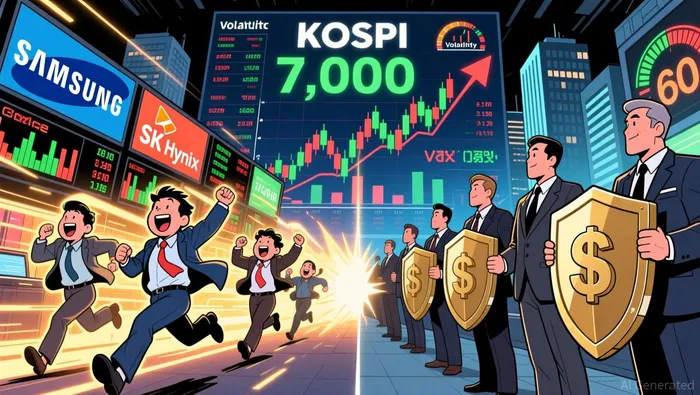
South Korea's stock market crossed 7,000 for the first time this week. The headlines call it an AI chip rally. But look at who's buying and who's selling, and you see a different story.
Retail investors net purchased approximately 37 trillion won while foreign investors net sold 41.7 trillion won. The retail money concentrated on just two stocks: Samsung Electronics attracted 12.5 trillion won and SK hynix drew 4.4 trillion won. Meanwhile, sophisticated money is building record short positions-stock lending balances hit 175 trillion won, the highest since data collection began.
The way to understand this isn't to ask whether AI chips are important. They probably are. The question is whether a market milestone driven by two stocks represents a real category formation or just an early version of something that might not last.
I suspect what we're seeing is less about AI chips as a new category and more about how concentrated bets can create the illusion of broad market health. South Korea overtook the UK to become the world's eighth-largest stock market by listed value. But that comparison needs context. The UK market is weighted toward banks, energy, consumer staples-sectors that don't offer the same AI hardware exposure. Investors are paying more for Korea's listed companies because they want that specific exposure, not because the whole market transformed.
The most revealing detail isn't the 7,000 number itself. It's the volatility gauge. The VKospi hit 60.10, up 7.57 percent from the previous session. A market hitting record highs while its fear indicator also hits records suggests something is off. It's like everyone celebrating a rocket launch while the engineers are quietly checking the escape pods.
What makes this interesting is the asymmetry. Retail investors are pouring money in based on the AI narrative. Foreign institutions are selling. And the smart money is building hedges through record CFD balances of 3.9 trillion won-leveraged bets that settle only the price difference without actual ownership. They're not saying the AI story is wrong. They're saying the concentration creates fragility.
The obvious comparison is to previous tech rallies. But those usually had broader participation. Here, Samsung closed at 232,500 won (up 5.44%) and SK hynix at 1,447,000 won (up 12.52%) on the day before the milestone. Two stocks doing well doesn't make a category. It makes a bet.
Brokerages are already raising targets-Shinhan Securities projects 8,600, JPMorgan eyes 8,500. But these forecasts depend on what they call "diffusion into non-semiconductor sectors." Translation: the rally needs to spread beyond two companies to be sustainable. So far, it hasn't.
The real test isn't whether Samsung and SK hynix keep rising. They might. The test is whether other Korean companies start benefiting from the same tailwinds. If the AI chip boom is a real category shift, you'd expect to see suppliers, toolmakers, and adjacent industries rising too. Instead, you see concentration.
This isn't to say the AI story is wrong. Memory chips are important for AI infrastructure. But markets have a way of taking true stories and stretching them until they break. The KOSPI at 7,000 tells us investors believe the AI chip story. The record short positions and foreign selling tell us some of the smartest money is hedging against how that story gets priced.
What's left is a question: Is this the beginning of a new category, or just an early, concentrated version of something that needs to broaden to survive? The answer probably depends less on AI demand and more on whether two companies can carry an entire market indefinitely.