

President Lee Jae-myung marked his first anniversary in office on June 4. The headline number is hard to argue with: the KOSPI hit an all-time high of 8,880 this week, up roughly 220% over the past 12 months. By that measure, the market looks like a roaring endorsement of the administration's economic vision.
Except the rally doesn't actually endorse much of anything except two companies.
Samsung Electronics and SK Hynix now account for 50.71% of the KOSPI's total market capitalization, up from 38.3% as recently as March. Half an index. Two names. One story: the AI-driven memory chip boom, specifically the high-bandwidth memory chips these two firms supply for Nvidia's data center GPUs. Everything else is dressing.
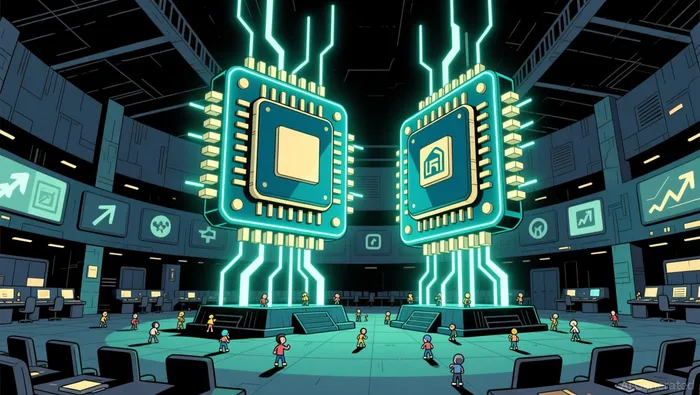
The question isn't whether Lee wants new growth engines. The question is whether the market already decided it only needs two.
The export data tells the same narrow story. South Korea's exports jumped 53.2% year-over-year in May to a record $87.75 billion. Semiconductor exports alone surged 169.4% to $37.16 billion, driven by a memory chip cycle that has barely paused since the AI infrastructure buildout accelerated. SK Hynix broke the $1 trillion market cap barrier in late May. Samsung has been riding the same wave.
Meanwhile the broader economy grew 1.7% quarter-over-quarter in the first quarter of 2026. The government is forecasting 2% annual GDP growth for the full year - a modest pickup from last year's 1.5%, and nothing resembling the explosive move in equity prices. Household debt remains elevated at roughly 89% of GDP. Domestic consumption remains the weak link, which is why Lee's budget proposal pivots toward startups, venture capital, and a ₩7.45 trillion ($5.3 billion) National Growth Fund aimed at AI deep tech and early-stage companies.
That's the tension. The administration's diversification agenda - $11.3 billion in SME and startup funding, €18.6 billion in semiconductor support packages, a push toward a "National Startup Era" - is designed to build growth engines beyond the traditional heavyweights. But the market isn't betting on diversification. It's concentrating.
And that concentration is exactly what cracks under pressure. On June 4, the KOSPI dropped 5.5% in a single session as Samsung and SK Hynix each sank more than 6%, and foreign investors sold $10 billion worth of Korean stocks. Breadth concerns mounted fast. When half your index is two stocks that move together, you don't have a diversified rally. You have a leveraged bet on a semiconductor cycle.
The forward P/E tells part of the story. SK Hynix traded at roughly 6.79x forward earnings in mid-May, just ahead of Samsung's 6.77x. Both are cheap by historical standards for companies in a demand supercycle, but cheap valuations in a cyclical business are the kind of numbers that look attractive until the cycle turns. SK Hynix's trailing P/E sits closer to 38x - the gap between forward and trailing multiples is the market pricing in sustained demand growth that, if it slows, compresses both.
So what does this mean for the investment decision? The rally is real. The factor stack that drove it - exploding memory chip demand, record exports, AI infrastructure spending showing no sign of deceleration - is still intact for now. But a 50% index weight in two correlated names is not a diversification thesis. It's a concentration risk that no amount of government startup funding offsets.
If you own the KOSPI through an index fund or broad Korean equity position, you already own a heavy semiconductor allocation whether you intended to or not. The "new growth engines" Lee is promising - startups, venture, deep tech - represent a rounding error in the current index weighting. They won't show up as portfolio diversification until their market caps stop being measured in millions and start being measured in billions.
The practical move depends on your view of the memory cycle. If you believe AI-driven HBM demand sustains through 2027 and beyond, the concentration is a feature, not a bug - and you should hold or add to direct Samsung and SK Hynix positions. If you believe the cycle will soften, or that foreign capital distribution will become a headwind, then a KOSPI position is effectively a concentrated semiconductor long with no hedge. In that case, sizing matters more than conviction, and the barbell approach - pairing growth exposure with something that doesn't move in lockstep with memory chips - is the structural answer, not more hope for diversification.
Lee's first year produced a spectacular stock market. It just wasn't the diversified economy his rhetoric describes. The market found its growth engines. There are only two of them. Know what you're actually holding.