

Goldman Sachs recently lifted its KOSPI target to 12,000, upgraded South Korea to Buy, and called the mid-June correction "scary" but temporary. The thesis: Korean earnings growth of 320% in 2026 supports a 40% further gain.
That analysis treats the KOSPI as a diversified basket. It is not. Samsung Electronics and SK Hynix together account for over 50% of the KOSPI's market capitalization. The index has effectively become a levered play on two semiconductor companies that are on completely different structural trajectories. Treating them as one Korea bet is the error.
The concentration is the story
As of late May 2026, Samsung and SK Hynix combined exceeded 50.71% of KOSPI market capitalization, up from roughly 36% a year earlier. Their combined operating profit share of the Kospi 200 index reached 56% - already surpassing their weight. For comparison, TSMC accounts for over 40% of the Taiex, but at least TSMC is a single foundry franchise. The KOSPI has bifurcated around two companies running different business models toward different outcomes.
The June 5 sell-off - when the KOSPI plunged approximately 5%, with SK Hynix down 9.92% and Samsung down 6.4% - was not a Korea-specific event. It was a Broadcom contagion. Broadcom's AI chip guidance disappointed despite strong Q2 revenue, the Nasdaq sold off, and the KOSPI followed because the KOSPI is, at this point, a semiconductor index.
This means the "Korea rebound" call reduces to a question about whether AI memory stocks re-rate higher. But even that question is too broad, because the two Korean giants tell different stories.
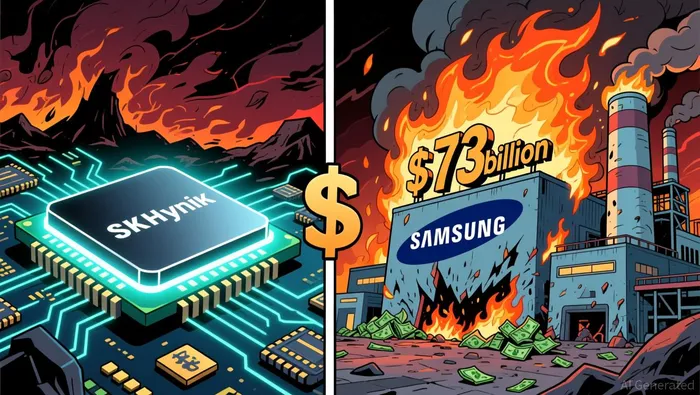
SK Hynix: the constrained-supply beneficiary
SK Hynix is the company Goldman's earnings growth number actually describes. The company posted record Q1 2026 revenue of KRW 52.6 trillion - up 198% year-over-year - with operating profit of KRW 37.6 trillion, representing a 71% operating margin. The market cap topped $1 trillion in May. The stock has jumped roughly six-fold since the start of 2025.
This is not a demand surge story. The DRAM market is being driven by constrained supply. HBM - the high-bandwidth memory variant used in AI accelerators - remains tightly controlled by three players: SK Hynix, Micron, and Samsung. TrendForce data puts SK Hynix at approximately 70% of HBM market share by Q1 2026, up from 57% in Q3 2025. Conventional DRAM ASP (average selling price) is projected to climb 54% to $1.06 in 2026, while HBM ASP is also rising. The company is benefiting from both HBM dominance and the HBM-to-conventional capacity displacement that occurs when fabs prioritize the higher-margin product.
SK Hynix's structural advantage is straightforward: when supply is constrained and pricing power exists, the player with the most installed capacity and the strongest customer relationships - particularly with Nvidia - captures the margin expansion. That is SK Hynix.
Samsung: the capex spender still catching up
Samsung tells a different story. The company posted Q1 2026 operating profit of KRW 57.2 trillion - a 756% year-over-year surge, yes, but from a deeply negative base. AI memory contributed 94% of total chip segment profit, which is both impressive and revealing: Samsung's non-AI memory and foundry segments remain structural drains.
The HBM market share problem is severe. TrendForce estimates put Samsung at roughly 22% of the HBM market, behind Micron's 21% in earlier quarters and far behind SK Hynix's 57-70% range. Samsung's HBM3E chips lack Nvidia certification, which has limited deployment. The company announced record semiconductor investment of KRW 110 trillion (approximately $73 billion) for 2026, and has begun HBM4 sample shipments in an attempt to close the gap.
The foundry division adds a second drag. Samsung Foundry is recovering from multi-year losses - utilization exceeded 80% in Q1 2026, but the segment remains a cost center relative to the memory business. The company is simultaneously spending $73 billion on semiconductor expansion while its foundry loses money and its HBM market share trails by more than a factor of two. That is not a capital efficiency story. It is a capital reallocation story, and the re-rating Goldman expects assumes the spending pays off on a timeline the market may not tolerate.
Two companies, one index, one target
Goldman's KOSPI target of 12,000 implies a roughly 40% gain from current levels. That mathematics works if both giants re-rate higher in tandem. But the structural gap between them means the KOSPI has become a volatility vehicle for two diverging outcomes rather than a Korea growth story.
SK Hynix is a supply-side winner in a constrained market where pricing power flows to the dominant producer. Samsung is a capex-intensive challenger spending at record levels to close a gap it created by misreading the HBM transition. The broader KOSPI - the non-semiconductor half that still exists - is too small to offset whichever way this bet resolves.
The Broadcom sell-off on June 5 showed how the concentration risk works in reverse: when AI sentiment cools, the KOSPI is the first to fall because it is not diversified. The same concentration will drive the rebound if sentiment recovers, but that is a sentiment play, not a structural one.
Investor Takeaway
The key issue is not whether the KOSPI rebounds from the Broadcom-triggered correction. The more important question is whether your Korea exposure is concentrated in SK Hynix - where constrained HBM supply and dominant market share support a structural pricing-power thesis - or Samsung - where record capex spending must close a widening HBM market share gap against a competitor that is already winning.
Goldman's 320% earnings growth forecast averages them together. The investor who buys the KOSPI index is averaging them too. If supply discipline holds and HBM ASP continues rising, the divergence between these two companies will widen, not narrow. The index will not capture that distinction.
The structural signal is clear: treat the KOSPI not as a Korea market play but as a binary semiconductor bet. If you believe in the supply-constrained memory cycle, SK Hynix is the direct expression of that thesis. Samsung requires a separate judgment call on whether $73 billion in annual capex can close a gap that has existed for two years. Those are not the same position. They should not be held as one.