

The headline you'll see today is that layer-2 networks are being forced to adapt after Ethereum's latest upgrades. That framing makes it sound like an emergency. It isn't. It's an outcome.
What has actually happened is quieter and more structural: Ethereum's own scaling design has been systematically compressing the revenue that layer-2 networks collect from users. As the network makes it cheaper to post data, the economic moat that separated one rollup from another evaporates. What you're left with is consolidation - and it's already happening.
The plumbing underneath
To understand why, you need to know one mechanism: blobs. When the Dencun upgrade introduced blobs in March 2024, it created a cheaper lane for layer-2 networks to post their transaction data back to Ethereum's main chain. Think of it as a bulk-shipping lane versus the express checkout. L2 transaction fees, which used to run $0.50 to $3, dropped to a penny or two.
That was supposed to be the good news for users. And it was. But the design had an unintended structural consequence: it turned L2 differentiation into a race to the bottom on price.
Ethereum kept turning the crank. The Pectra upgrade in May 2025 doubled blob capacity. Then the Fusaka upgrade in December 2025 introduced PeerDAS (a data-availability upgrade that distributes storage work across more nodes) and two scheduled blob-parameter increases. By January 2026, Ethereum was targeting 14 blobs per block, with a maximum of 21 - a 2.3× increase in L2 data space over the pre-Fusaka baseline.
The result: data availability costs for most rollups dropped another 40–90% within the first month. L2 transaction costs are now consistently under a penny. For the user, it's frictionless. For the layer-2 operator, it's an accounting problem.
What revenue collapse looks like
In 2025, the total revenue for Ethereum's layer-2 networks fell 53% to roughly $129 million, according to data from Growthepie. Ethereum's own mainnet fee burns collapsed around 99% over the same period. The network sacrificed its own revenue stream to subsidize growth on the rollups - a deliberate design choice by the Ethereum core developers, who view L2 activity as the measure of the ecosystem's health.
But that choice has a second-order effect. When the cost of posting data becomes nearly irrelevant, what differentiates one L2 from another? Not much. If users can transact for a fraction of a cent on any of them, the tiebreaker becomes which network has the deepest liquidity, the most developer tooling, and the strongest brand.
The answer, already written into the on-chain data, is Base, Arbitrum, and Optimism. Those three process roughly 90% of all layer-2 transactions. Base alone accounts for more than 60%.
Smaller rollups that launched without a major backer - a coinbase balance sheet, a venture consortium, or a sticky application - are finding themselves structurally squeezed. Not because their technology is worse. Because the upgrade path Ethereum chose made data costs irrelevant, and data costs were one of the few things that let a new network compete.
The centralization you can't fork away
Here's the part that gets pushed aside when people talk about L2 "scaling success": every major Ethereum layer-2 still runs a centralized sequencer in 2026.
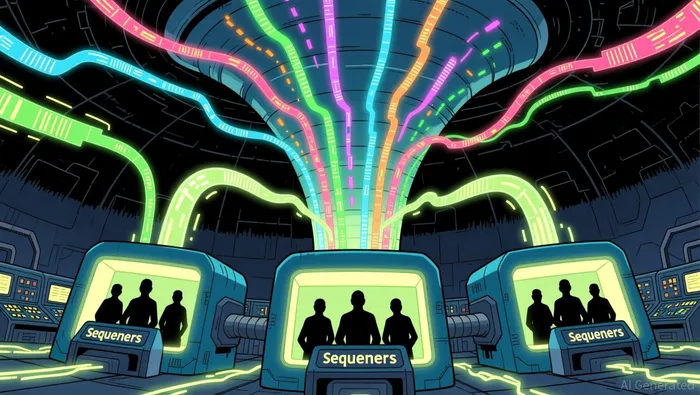
A sequencer is the service that orders and batches transactions before posting them to Ethereum. It's the intermediary. The original promise of layer-2 architecture was that sequencers would eventually decentralize - that control would diffuse across many operators, the way Ethereum's validators did after the Merge. That rollout is still promised for 2026 alongside native interoperability features, but it hasn't materialized.
The practical consequence is that transaction ordering - who gets processed first, who gets front-run, whether transactions can be halted during outages - sits with a small number of operators. When Linea froze user funds in 2024 and Base went down in February 2025, the lesson wasn't lost. But it didn't change the architecture.
Consolidation and centralization are compounding each other. As activity concentrates on three networks, those three sequencers control a bigger slice of Ethereum's transaction flow. That gives them more data, more revenue to reinvest, and more political cover to keep sequencing centralized "for performance" - a story that's hard to challenge when the alternative is a decentralized sequencer that runs slower and costs more.
Why the adaptation frame misses the point
The market tends to cover this story as a technical adaptation challenge: which L2 will pivot fastest, which will find a new revenue model, which will die. That's the wrong question. It treats the outcome as if it's still open.
The outcome is already visible. What's changing isn't whether layer-2s survive. It's who gets to sit between the user and Ethereum's settlement layer. Ethereum's scaling architecture was designed to make that position cheap and easy to build. In practice, it made it cheap and easy for incumbents to consolidate.
If you're watching this story as an investor, the thing to track isn't L2 token price or weekly active user charts. It's whether the shared sequencer experiments actually ship, and whether the Superchain's native interoperability launch changes the economic incentives that are driving consolidation. Until those mechanisms arrive - and they're not confirmed yet - the pressure is directional: toward fewer operators, not more.
The real question isn't whether L2s adapt. It's whether Ethereum's scaling success will keep making the layer-2 layer more or less concentrated.