

The filing is clear: on May 2, 2025, a director's options to buy 100,000 shares at $0.015 each lapsed without being exercised. This isn't a purchase. It's a missed opportunity to buy stock at a steep discount, which the director chose not to take.
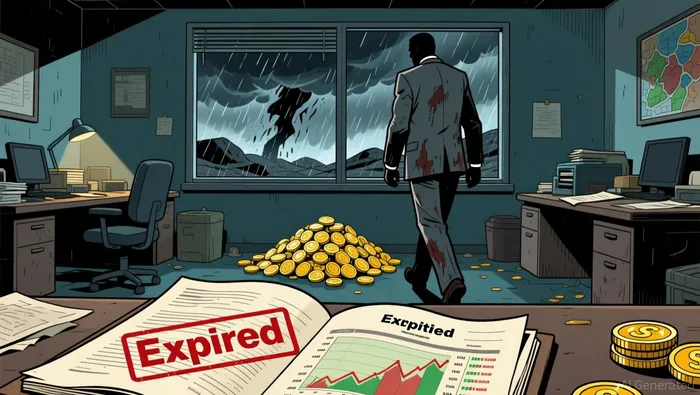
This matters because Legend Mining is an early-stage explorer with no revenue. Its entire business model relies on raising capital to fund exploration, a process that can take years and requires significant investor trust. In this context, a director's decision not to exercise options is a signal. It suggests a lack of skin in the game at a critical juncture.
The company's leadership structure reinforces this point. The CEO and Executive Chairman, Mark Wilson, received a total compensation package of $401,380 AUD last year. Yet, he has not exercised any options during that period. For a company in the risky, capital-intensive exploration phase, this alignment of interest is thin. When the smart money is betting on a future payoff, insiders should be buying in with their own capital. The fact that they are not is a red flag.
The bottom line is that the lapse is a concrete data point. It shows that at least one director saw no reason to commit personal capital at a $0.015 entry point, even as the company's market cap sits around 23.32 million AUD. In a sector where belief in a project's potential is everything, this absence of insider buying speaks volumes.
The Smart Money Check: Who's Really Buying?
The director's lapse is a clear signal, but what about the broader smart money? The data here is frustratingly thin. There is insufficient data to determine if insiders have bought more shares than they have sold in the past three months. That absence of a clear insider buying trend is itself a notable gap. In a company where every dollar of capital raised is critical, the lack of a visible accumulation signal from those who know the project best is a neutral to negative point.
More telling is the complete absence of institutional oversight. Legend Mining is covered by zero analysts. That means no Wall Street research, no consensus estimates, and no institutional research team digging into the numbers. In the absence of that external validation, the only real signal is what insiders do with their own wallets. And right now, the wallet activity is a mystery.
This context helps explain the stock's recent volatility. The share price is up 12.5% today to $0.0090 AUD. But this is a penny stock with minimal liquidity, a classic setup for sharp moves on thin volume. The pop could be driven by any number of factors-rumors, a single large trade, or even a pump-and-dump scheme. Without analyst coverage to provide a steady valuation anchor, the stock is left to drift on sentiment and speculation.
The bottom line is that the smart money isn't talking. There's no 13F filing showing institutional accumulation, and the insider trading data is inconclusive. For a company in Legend Mining's position, that silence is a red flag. When the real money isn't putting skin in the game, it often means they see no clear path to a payoff.
Catalysts and Risks: What to Watch for Smart Money
The path forward for Legend Mining is binary. The company's entire value hinges on one major event: a significant exploration discovery that can attract a partner or raise funds without dilution. Until then, the primary risk is the constant need to raise capital, a process that dilutes existing shareholders and signals a lack of independent value.
The smart money will be watching for two clear signals. First, any future director option exercises or insider purchases would be a stronger signal of alignment. The recent lapse showed a lack of skin in the game. A reversal of that trend would be a concrete step toward proving insiders believe in the project's potential. Second, the company must demonstrate progress toward a partnerable discovery. The stock's recent pop is noise; real traction will come from drill results that confirm a nickel-copper sulfide deposit of commercial scale.
For now, the setup is a classic trap for the unwary. The company is in a high-risk, capital-intensive phase with no revenue and minimal institutional oversight. The CEO's compensation is modest, but his failure to exercise options shows thin skin in the game. The stock's volatility on low volume makes it a prime candidate for pump-and-dump schemes. The only true signal remains what insiders do with their own money. Until they start buying, the smart money should stay on the sidelines.