

Lenovo just posted record full-year revenue of US$83.1 billion, with adjusted net income jumping 42% to $2 billion. One-third of that revenue now comes from AI systems, growing 72% year-over-year, backed by a $15.5 billion order pipeline. The stock trades at roughly 11.93 times forward earnings. That's the disconnect - not between the earnings and the headline, but between what the business has become and how the market still prices it.
Wall Street hasn't moved. It prices Lenovo like a low-margin PC assembler with a server side business, not an AI infrastructure company that's converting real orders at real speed. The narrative is about the top-line record. The story is about what happens when 32% of your revenue is AI and still accelerating.
The AI mix isn't the growth story. It's the earnings story.
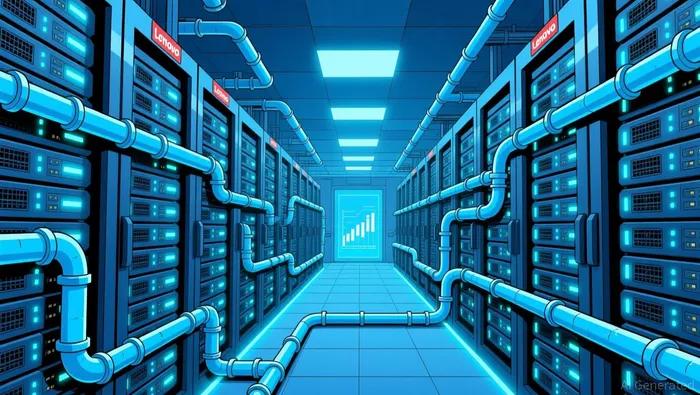
AI-related revenue now accounts for 30% of the Group's total revenue, up 13 percentage points from a year ago. That's not a rounding error. That's a structural shift that's already happened. The Infrastructure Solutions Group - the server and data center division - posted Revenue $5.2 billion, +31% YoY in Q3 alone, with AI infrastructure revenue growing 59%. Neptune liquid-cooling solutions, the cooling technology required for high-density AI racks, grew 300%. Each of those numbers tells the same thing: this isn't a company waiting for AI demand to materialize. It's converting it.
The pipeline proves the demand is contracted, not aspirational.
Lenovo reported a $15.5 billion order pipeline for its AI server business. In the AI infrastructure space, pipeline is the difference between hope and reality. A $15.5B pipeline on roughly $17B of annual ISG revenue means nearly 10 months of demand is already committed. Hyperscalers and cloud providers don't pipe-hole AI server orders. They're under contract. This is the kind of visibility that should compress the discount, not extend it.
The margin dip is a mix effect, not a breakdown.
Gross margin came in at 15.1% versus 15.7% a year earlier in Q3, and analysts flagged surging DRAM costs as a near-term margin risk. That's a real concern. But adjusted net income grew 42% for the fiscal year on $83.1B of revenue. When earnings grow faster than revenue, operating leverage is working. The margin compression is a mix effect - high-revenue, lower-margin AI servers entering the base for the first time at scale. As the AI product mix matures and higher-margin liquid cooling scales, the pressure reverses. The key risk is if DRAM costs stay elevated long enough to structurally hurt ISG margins before the AI mix can offset it. That's worth watching, but it's not the thesis-killer yet.
The valuation doesn't believe the earnings growth it just reported.
Lenovo trades at roughly 12 times forward earnings - below its own PEG Ratio, 1.1x, which means the market is paying roughly fair value for growth, not a premium. Its Enterprise Value/Revenue, 0.3x sits at 0.2x to 0.3x, meaning the entire company costs 20 to 30 cents for every dollar of revenue it generates. For context, Dell faces the same AI server demand cycle and trades at a significantly higher multiple. At 12x forward earnings, Lenovo doesn't price in what happens when AI reaches 40%+ of revenue and the margin mix normalizes. It prices in a company that's already peaked.
What would break the setup
The bear case is specific, not generic. If DRAM and component cost inflation eats ISG margins faster than the AI mix can compensate, the earnings acceleration stalls. If the global AI capex cycle slows and hyperscalers cut server orders, the $15.5B pipeline deflates. Both are real. The stock has already discounted some of the DRAM risk. The capex cycle is the one to monitor through the next two earnings reports - ISG margin prints are the tell.
At 12x forward earnings, the market is pricing Lenovo as if the AI transition has already been accounted for and the growth is behind us. The pipeline, the 72% AI growth rate, and the 42% earnings acceleration say otherwise. Each quarter either confirms the re-rating path or exposes the gap between narrative and execution.