

When the Nasdaq dropped 4.2% last Friday - its worst single-day decline since April 2025 - the market's working explanation was familiar: Broadcom's earnings disappointed, and a surprise-strong jobs report killed hopes for a Fed rate cut. Two days later, South Korea's KOSPI plunged more than 8%, triggering circuit breakers for the third time this year. Bitcoin fell from roughly $67,000 to $59,000 in 48 hours, wiping out over $3 billion in leveraged crypto positions.
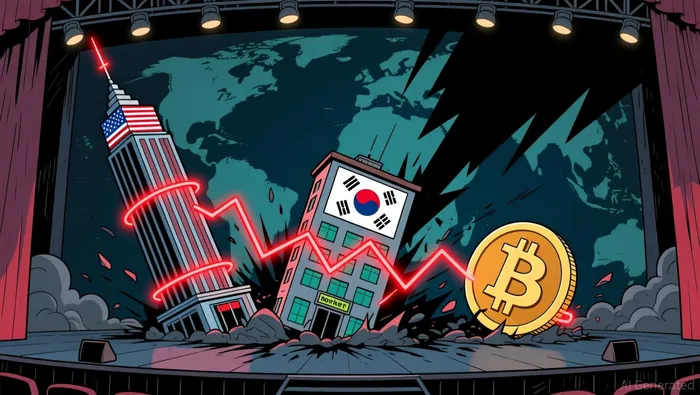
The headline story is an AI bubble popping. But the mechanism isn't valuation skepticism. It's leverage architecture - three different markets that built three different kinds of leverage on the same trade, then blew through each other in sequence.
The catalyst wasn't AI. It was interest-rate math.
Let me start with the trigger, because understanding what started the chain matters more than understanding what the chain destroyed.
The Labor Department reported that May added 172,000 jobs. Economists expected 80,000 to 85,000. That number is roughly double the forecast, which means the labor market is tighter - and inflation risk is higher - than everyone assumed. One analyst told the Los Angeles Times that any hopes of a Fed rate cut had "effectively been eliminated" by the data.
That's the macro layer. When rate-cut expectations vanish, the discount rate used to value long-duration growth stocks rises. AI stocks are the longest-duration trades on Wall Street: the market is pricing in years of future cloud spending and chip demand that hasn't materialized in earnings yet. Raise the discount rate, and those distant cash flows shrink faster than any other part of the market.
Broadcom's earnings were the match. The jobs report was the wind. But neither one would have produced circuit-breaker-level damage without what I think is the real story: how much leverage was stacked on top of the AI trade across three separate financial systems.
Three markets, three leverage structures
The US built leverage through concentrated valuation and options positioning. U.S.-traded chipmakers lost roughly $1.3 trillion in market value in a single session. Nvidia fell 6.2%, Broadcom 7.9%, Micron slid 13.3%. The scale of the drawdown wasn't unusual for overvalued tech - what's worth noting is how many institutional positions were running options strategies that amplifed the downside when volatility spiked.
South Korea built leverage through retail margin debt. This is the part most US-focused coverage ignores. A Bank of Korea report showed that leveraged equity investment by retail Korean investors had topped a record 60 trillion won - roughly $39 billion. That debt was heavily concentrated in Samsung Electronics and SK Hynix, the two chipmakers that anchor the KOSPI. Just weeks earlier, Korea had launched leveraged ETFs tied to those same stocks, designed to pull even more retail money into the AI chip trade. When US chip stocks sold off on Friday, Korean chip stocks had nowhere to go but down. Within three minutes of the KOSPI open on Monday morning, the index had plunged nearly 9%, triggering a circuit breaker - a mandatory trading halt that activates when the index falls 8% or more and stays there for one minute. Trading resumed briefly before halting again. It was the ninth circuit-breaker event in the index's history.
What makes Korea's case structurally interesting is that the Bank of Korea had to make a verbal intervention to prop up the won after the crash. Central banks don't talk down their currency unless the spot move threatens capital-flow stability. The signal here is that the Korean equity rout was close enough to a cross-asset event that the monetary authority felt compelled to act.
Crypto built leverage through perps and futures. Bitcoin's drop from roughly $67,000 to $59,000 over 48 hours in early June triggered over $3 billion in forced liquidations. Most of those positions were leveraged long bets - traders borrowing to buy Bitcoin, expecting the AI-stock rally to carry crypto higher with it. When it didn't, the liquidation cascade was mechanical: margin calls forced sells, sells pushed prices lower, lower prices triggered more margin calls.
I mention the crypto piece not because I think Bitcoin is the center of this story. It's not. But it's evidence that the AI trade had become so dominant a market-wide assumption that even assets with no fundamental link to chip earnings were carrying leverage bets on its continuation. When a jobs report from Washington triggers margin calls in Seoul and liquidations in crypto, the transmission isn't about fundamentals. It's about connected leverage.
What this tells us about the next leg
The immediate question now is whether this is a correction within a trend or the beginning of a structural break in how the market prices AI infrastructure spending. I don't have a clean answer, but I can point to what would tell us which one it is.
If this is just leverage unwinding, it should be fast and shallow. The kind of positions that blew up last week were mostly short-term retail and speculator bets. Those clear out quickly. The question is what happens to the institutional positioning underneath - the pension funds, the index funds, the mutual funds that own Nvidia and Broadcom at scale. Those don't face margin calls. They face a different decision: do they hold through the volatility, or do they rebalance?
If this is structural, it takes longer. It shows up as a sustained rotation out of AI hardware stocks into sectors that actually have current earnings, and as a longer-term repricing of how much the market is willing to pay for revenue that depends on AI adoption staying on track.
The signal to watch is what happens to Korean chip stocks. If Samsung and SK Hynix stabilize and the margin debt resets without a sustained secondary selloff, the leverage cascade was contained. If the Korean market keeps triggering circuit breakers, it means the AI chip trade is more structurally exposed than a single US earnings miss and a hot jobs print.
I'll confess I'm less interested in whether AI is a "bubble" than in what this episode does to how markets price concentration. The AI trade turned into the single largest coordinated bet across multiple asset classes and jurisdictions in my lifetime. That's not inherently a problem - but when the entire trade is built on leverage, the system doesn't correct gently. It snaps.
The question for the next few weeks is whether the snap was the whole event, or the beginning of something wider.