

Leveraged ETFs are one of the fastest ways for traders to make a short-term market bet without using margin directly or trading options. They are simple to buy, easy to sell, and available in many of the market's most popular corners, from the S&P 500 and Nasdaq to semiconductors, gold, oil, and single stocks.
That convenience is exactly why they attract so much attention. But it is also why they are often misunderstood.
A lot of investors see "2x" or "3x" on the label and assume it means the fund will return two or three times the market over any period of time. That is not how these products are designed. Leveraged ETFs are built to target a multiple of a benchmark's daily move, not its long-term return. That daily reset is the key to understanding both why traders use them and why they can get risky fast.
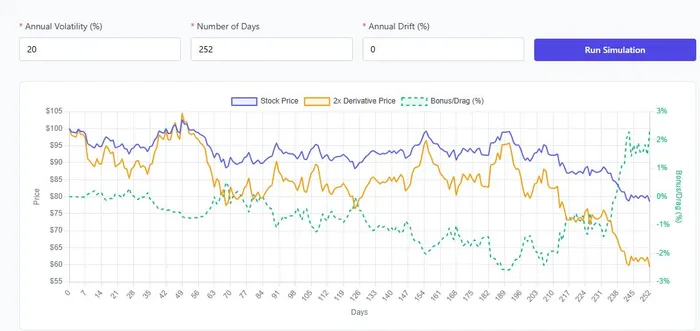
A leveraged ETF is designed to magnify the benchmark's move for a single trading day. Bigger upside also means bigger downside. This tool from Moontower AI shows how Leveraged ETF's behave and show volatility decay in action.
Source: https://www.moontower.ai/tools-and-games/leveraged-etf-simulator
At the most basic level, a leveraged ETF is an exchange-traded fund that aims to deliver a multiple of a benchmark's daily performance. A 2x leveraged ETF aims for about twice the daily move. A 3x leveraged ETF aims for about three times it. There are also inverse leveraged ETFs, which try to move in the opposite direction of the benchmark, often by -2x or -3x for the day.
So if an index rises 1% in a day, a 2x leveraged ETF tied to that index should rise about 2%, before fees and tracking differences. If the index falls 1%, that same fund should lose about 2%.
That sounds straightforward, and for one day, it mostly is.
The problem starts when people assume that one-day math extends neatly over a week, a month, or a year.
Why traders use leveraged ETFs
For active traders, leveraged ETFs can be useful tools.
One common use is for a short-term directional trade. If a trader believes the Nasdaq is about to rally after an inflation report or a Fed meeting, a leveraged ETF can express that view in a simple way. Instead of buying call options or borrowing on margin, the trader can buy a product that already packages the leverage.
Another use is tactical hedging. A trader or investor who expects a rough patch in the market may use an inverse ETF for a short period instead of selling a whole portfolio. That can be especially attractive when someone wants temporary protection without changing long-term holdings.
They also get used around events. Think earnings season, CPI releases, jobs reports, or major geopolitical headlines. In those moments, traders often want tools that can quickly amplify a move without adding the complexity of derivatives.
That is the appeal. Leveraged ETFs are accessible, liquid, and easy to understand at first glance.
The daily reset most investors miss
The most important concept in leveraged ETFs is the daily reset.
These funds are not built to deliver 2x or 3x of a benchmark over time. They are built to target that multiple for one trading day at a time. Then they reset and do it again the next day.
That reset means your return depends not only on where the market ends up, but on the path it takes to get there.
Here is a simple example. Imagine an index starts at 100. On Day 1, it rises 10% to 110. On Day 2, it falls 9.1%, which takes it right back to 100. Over those two days, the index is flat.
Now look at a 2x leveraged ETF tracking that same index. On Day 1, it rises 20%, going from 100 to 120. On Day 2, it loses about 18.2%. That brings it down to roughly 98.2.
The underlying index finished flat, but the leveraged ETF lost money.
That surprises a lot of first-time buyers. But it is not the fund failing. It is the fund doing exactly what it was designed to do: track a daily objective, not a multi-day one.
What volatility drag really means
This is where volatility drag comes in.
Volatility drag sounds technical, but the idea is simple: when prices swing around a lot, compounding starts to work against you. Gains and losses happen from changing base levels, so a sharp drop hurts more than an equal percentage gain helps.
That is true for regular investments too, but leveraged ETFs feel it more because the swings are magnified.
Take a choppy market where an index gains 10% one day, loses 10% the next, then repeats that pattern. The index will slowly erode because a 10% loss from a higher number does more damage than a 10% gain from a lower one can fully repair. A leveraged ETF tied to that same path will usually erode even faster because its daily gains and losses are amplified.
This is why leveraged ETFs often perform best in strong, clean trends and worst in volatile sideways markets. A sustained move can help compounding work in the trader's favor. A whipsaw market can do the opposite.
The real risks to know
The biggest risk with leveraged ETFs is not that they are broken. It is that they are often used for something they were not built for.
They are generally trading tools, not set-it-and-forget-it investments.
A trader using one for a short-term view may be using the product exactly as intended. But an investor buying a 3x fund and assuming it will simply triple the market over six months or a year may end up disappointed, especially if the path is volatile.
There are other risks too. Leveraged ETFs can have higher expense ratios than standard ETFs. They may not track perfectly in fast or disorderly markets. And because they are meant to be actively monitored, they can punish complacency. A position that looks manageable in the morning can feel very different by the close.
The leverage works both ways. A fund that can jump 6% in a good day can also fall 6% just as easily.
That does not make leveraged ETFs bad products. It just means they are specialized products. Like power tools, they can be very effective in the right hands and very costly in the wrong ones.
Bottom line
Leveraged ETFs are designed to magnify daily market moves, not long-term returns. That makes them useful for short-term trading, tactical hedging, and event-driven setups. But it also makes them more complicated than they first appear.
The two ideas every retail investor should understand before buying one are daily reset and volatility drag. Daily reset means performance over time can drift away from the simple 2x or 3x label. Volatility drag means choppy markets can eat away at returns faster than many traders expect.
In a strong trend, leveraged ETFs can be powerful tools. In a volatile sideways market, they can become frustrating very quickly.
Resource links:
SEC / Investor.gov: Updated Investor Bulletin: Leveraged and Inverse ETFs Investor.gov
Investor.gov: Leveraged Investing Strategies – Know the Risks Before Using These Advanced Investment Tools Investor.gov
FINRA: The Lowdown on Leveraged and Inverse Exchange-Traded Products FINRA
FINRA: Non-Traditional ETFs FAQ FINRA
ProShares: Performance and Pricing FAQs https://www.proshares.com/faqs/performance-pricing-faqs
Direxion: Understanding Leveraged & Inverse Exchange Traded Funds Direxion Education