

The macro desk is watching the dollar, tracking CPI prints, and measuring how many basis points Iran tensions move the DXY. That is not where the damage is happening.
The Strait of Hormuz - the narrow chokepoint through which roughly a quarter of the world's oil and gas passes - has been closed to most commercial shipping since March 2026. Brent crude spiked past $120 per barrel before settling back to the $92–$94 range. The market has partially priced that move. What it has not priced is a secondary shock that doesn't show up on any currency chart: the helium crisis, and the multi-year bottleneck it is creating for the world's most advanced semiconductor manufacturing.
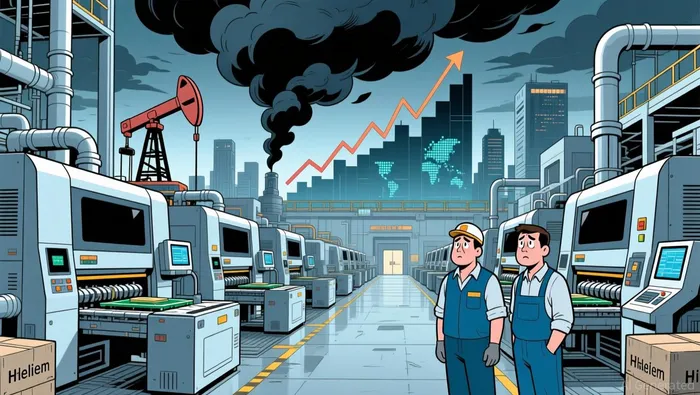
The helium problem nobody is tracking
Qatar's Ras Laffan facility is the world's largest helium production plant. It ships through the Strait of Hormuz. When the strait closed, the pipeline stopped.
Helium is not a dramatic headline material - it doesn't move stock prices overnight the way an oil spike does. But it is the single most critical industrial gas for EUV (extreme ultraviolet) lithography, the process that TSMC, Samsung, and Intel use to manufacture chips at 7nm and below. EUV systems flood the exposure chamber with helium to cool the optics and maintain the ultra-clean environment required for nanometer-scale patterning. Without helium, the machine stops. There is no substitute, no workaround, and no alternative chemistry.
By 2025, advanced logic production - dominated by EUV steps - accounted for an estimated 10–12% of global helium demand. That share is growing every year as foundries build more EUV tools to run 3nm and 2nm processes. With TSMC, Samsung, and Intel all expanding EUV capacity, the structural demand for helium in chipmaking is accelerating at the exact moment supply collapsed.
The recovery timeline is not months. It is years.
Even after the Strait of Hormuz fully reopens - and the US says it could take six months to clear mines that Iran laid - the helium supply damage will not heal quickly. US distributors are already rationing. Industry analysts at WestAir Gases warned in May that recovery will take years, not quarters. The Ras Laffan plant infrastructure has been offline for months, and restarting deep-cryogenic helium extraction after that kind of disruption is not a flip-of-the-switch event.
The market is treating the helium shortage as a supply blip. It is a structural bottleneck for the next generation of AI chips.
Why this matters more than CPI
The macro desk is worried about US inflation hitting 4.2%, which the OECD warned could happen as the Iran war drives energy prices higher. CPI is important. But CPI measures yesterday's damage.
The helium shortage measures tomorrow's production capacity. When helium runs short at an EUV fab - and early April 2026 transit estimates showed existing shipments would sustain Asian operations only through early April - foundries have three choices: throttle production, deprioritize customers, or pay catastrophic premiums for spot helium. Every one of those outcomes ripples through the AI supply chain.
TSMC supplies the vast majority of the world's advanced logic. Samsung and SK Hynix supply three quarters of global HBM memory, which is built on processes that also depend on helium-intensive manufacturing steps. When helium availability becomes the constraint, it doesn't matter whether Nvidia's Rubin architecture is brilliant or AMD's MI450 is ready. It matters whether the foundries can actually run the machines that build them.
The cross-currents are helium availability, data center power costs, and geopolitical escalation; directionally, the supply constraint is the most underappreciated.
The second shock: power costs the macro desk won't see until it's in the numbers
Separate from helium, the Hormuz closure has triggered the biggest energy price surge since Russia's invasion of Ukraine, according to the World Bank's April commodity outlook, which projected a 24% increase in energy prices for the year. That's already reflected in oil. What isn't reflected is the TCO impact on AI data centers.
JLL forecasts the average global data center power cost will rise 6% in 2026 to $11.3 million per megawatt. That number was built before the full extent of the Hormuz crisis unfolded. IEA data from May shows the largest technology companies already exceeded $400 billion in data center capital expenditure in 2025, and their power consumption trajectory puts global data center energy use approaching 1,050 TWh by 2026 - enough to make data centers the world's third-largest electricity consumer if they were a country.
When oil and gas prices surge, the marginal cost of every kilowatt-hour rises - even for data centers running on grid power or long-term contracts, because those contracts get repriced when the underlying commodity index moves. The IEA's own analysis, published May 2026, states plainly: "affordable, reliable and sustainable electricity supply will be a crucial determinant of AI development". That's not a forecast. It's a dependency.
The per-MW framework changes the story. A hyperscaler building a 100MW data center at $11.3M/MW faces $1.13 billion in power acquisition costs alone, before hardware, labor, or construction. If energy prices move another 10% higher on sustained Hormuz disruption, that adds $113 million per facility. Across a portfolio of planned builds, the gap between "build on schedule" and "delay and re-evaluate" narrows fast. The CEO keynote about AI spending being "accelerated" sounds very different when you decompose it into per-megawatt TCO.
What the market is missing
The dollar is steady. CPI is coming. The macro narrative treats Iran tensions as a headline risk that will resolve when it resolves. That is the wrong question.
The real question is: what happens to AI infrastructure deployment when helium availability becomes the hard constraint on leading-edge production, and power costs keep rising? The answer is that the entire AI capex timeline gets slower, more expensive, and more concentrated among customers who can afford the premiums. The supply bottleneck won't show up in CPI until it shows up in GPU prices and data center TCO. By then, the damage is already in the P&L.
Any astute semiconductor investor would have tracked helium supply the moment Ras Laffan went dark. Instead, the market is watching Treasury yields and waiting for an inflation print that will confirm what's already true: energy costs are restructuring the economics of every AI build-out.
The helium shortage won't be resolved by a ceasefire. The infrastructure is damaged, the distributors are rationing, and demand is growing. If you're evaluating the AI infrastructure thesis, the constraint isn't chip design or architecture. It's whether there's enough helium to run the machines that build the chips, and whether the power bill stays small enough to justify the build. Those are engineering questions, not macro ones. The macro desk doesn't have the answer.