

Here's a thing most retail investors never notice: the stock exchange you're watching is not the stock exchange where the action is happening.
That's not a conspiracy theory. It's plumbing. As of mid-2026, dark pools - private venues where large trades execute anonymously, outside public exchanges - handle roughly 40 to 45 percent of all U.S. equity volume. Bloomberg data from January 2025 put the number even higher: a slim majority of all U.S. stock trading, 51.8 percent, was happening in the dark. In 2008, the number was about 15 percent. The shift took less than two decades, and most retail traders didn't notice it happening because they can't see it.
That's what the phrase "JavaScript is disabled" gets at when you strip away the browser warning. You're looking at a page that won't render properly. You click around, and most of what should be there isn't. The structure works fine for everyone else. It just doesn't work for you.
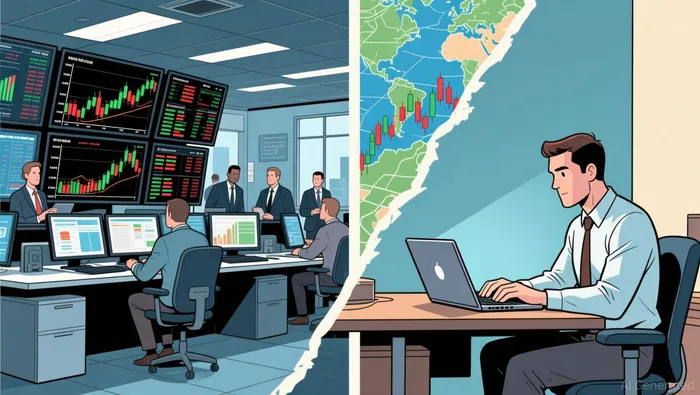
The more interesting question isn't whether this is unfair. It's whether the market is becoming a system where the visible layer - the tape, the level 2 quotes, the public order book - is gradually becoming a shadow of the real price discovery process. Not all of it, obviously. But enough that the part retail investors can observe is no longer the whole story.
Here's how it works. A dark pool lets institutional investors execute large block trades without signaling their intentions to the public market. If a pension fund wants to sell 500,000 shares of a company, doing it on a public exchange would move the price against them as the order gets sliced into pieces and visible to everyone else. A dark pool lets them find a counterparty quietly. That's genuinely useful. It reduces the market impact cost on large trades.
The problem for retail traders is the information asymmetry that comes along with it. When a large block trades in the dark, the price doesn't reflect that trade immediately. The information travels through other channels - institutional analytics, dark pool print delay data, internal firm research - long before it shows up in public prices. Retail investors see the price move and have no idea why.
I suspect this is the version of what people mean when they complain that the market is "rigged." It's not rigged in the sense that someone is cheating. It's rigged in the sense that the system is optimized for a different user than you are. You're not the primary user of the modern equity market. Large institutions are.
There's another layer. Payment for order flow - the practice where brokers sell retail trade orders to market makers in exchange for compensation - created an additional structural conflict. The broker that tells you they're getting you "the best execution" is sometimes optimizing for the rebate they receive, not the price you get. Europe banned this practice under MiFID III rules taking effect in 2026. The U.S. hasn't followed. The conflict of interest remains for American retail investors.
None of this means retail investing is a losing game. It means the terrain has changed in ways that aren't obvious from looking at a chart. The visible market still moves. Prices still reflect information. But the path from information to price now runs through a layer you can't see, at speeds you can't match, and in venues you can't access.
The thing that matters most for how you respond: time horizon. If you're trading on information, you're competing in a system where the best information is processed fastest by people with the fastest infrastructure. No amount of willpower or chart study closes that gap. But if you're investing based on a company's ability to generate cash over years, the dark pool layer doesn't change the underlying business. The plumbing affects price discovery over seconds and minutes, not fundamental value over years and decades.
So the test is simple, but not comforting: look at your trading frequency and be honest about whether you're actually investing or trying to compete on information and speed. If you're doing the latter, you're not wrong about wanting to make money. You're wrong about the playing field.
A good rule of thumb: if your strategy depends on seeing what other people are about to do before they do it, you're the JavaScript-disabled browser in a market that's moved to web3. The page will still look like it works. It just isn't loading the part that matters.