

If your retirement depends on a regular cash stream, the first thing you look at is not NAV direction. You look at what actually hits your bank account. Marlin Global's headline story this week - NAV ticking back up, shares shifting toward a discount, the portfolio anchored by familiar tech heavyweights - sounds like the recovery play income investors love. But if you follow the payout mechanism for 30 seconds, the picture gets more complicated.
Marlin Global is a New Zealand-listed closed-end fund managed by Fisher Funds. It invests in offshore growth companies - mostly the same large-cap global tech and payments names you already know. Microsoft, Apple, NVIDIA, that crowd. The fund pays a quarterly distribution equal to 2% of its average NAV. That is the structural detail that changes everything.
When NAV falls, your payout falls. There is no fixed coupon, no contractual obligation to a set dollar amount, no asset-backed cash flow that runs independently of portfolio value. The distribution is literally a percentage of whatever NAV is. In Q1 2026, NAV dropped 11.5% as the broader tech quality factor reset took its toll. The fund has been down roughly 43% from its highs over the past year. That means the cash you collect each quarter is materially smaller than it was 12 months ago, even though the distribution rate - 2% - has not changed.
As of mid-May 2026, the unaudited NAV sits around $0.8140 per share. The share price has been hovering near $0.83 to $0.84, which means shares have recently traded at a small premium rather than the headline discount the competitor story touts. The yield - roughly 8.8% on an annualized basis - looks attractive on paper, but it is an 8.8% yield on a shrinking base. Think of it like a savings account that pays a steady interest rate while the principal erodes every quarter.
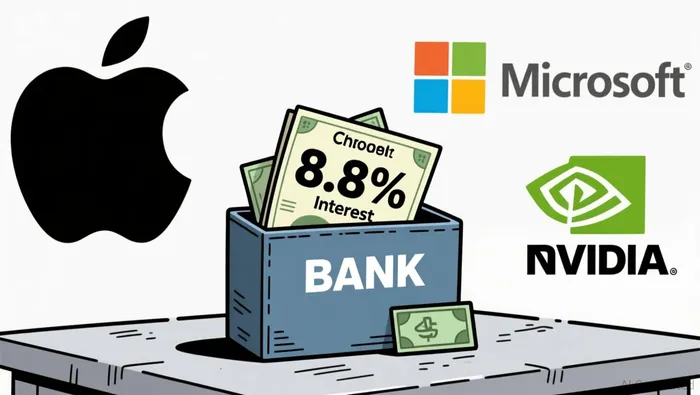
The portfolio composition has not shifted away from its tech concentration. The fund remains tilted toward global technology leaders, which is what drove the NAV gains when the trade worked and the NAV losses when it didn't. Marlin is essentially a leveraged bet on the same names that dominate the NASDAQ 100, wrapped in a distribution structure that rewards you in good quarters and quietly cuts your income when NAV declines.
Here is what the income investor needs to decide: are you buying a diversified income producer, or are you buying concentrated tech exposure with a variable payout on top? Those are different answers to different questions. If you already own Apple, Microsoft, and NVIDIA in your portfolio, Marlin does not add diversification. It adds duplication with a distribution layer that will rise and fall with the exact same volatility.
The 2% NAV-per-quarter policy is simple enough to explain to anyone, which is a virtue. But simplicity is not the same as safety. There is no leverage disclosure to worry about, no borrowing cost squeezing the spread. The fund is not supplementing distributions with return of capital in any formal sense - the payout just scales with NAV. That is cleaner than many structured income products, but it is not a buffer.
I could not find evidence that the board has discussed returning to the higher NAV levels from two years ago, or set a floor on the distribution policy. The warrant issue launched in April 2026 was aimed at strengthening capital flexibility, not at raising the distribution rate. The directors have maintained the 2% policy consistently, but consistency of policy is not the same as durability of income.
So what does this mean for the income investor? If you need reliable cash flow that does not shrink when tech has a bad quarter, Marlin is not the answer. If you want tech exposure with a distribution that reinvests automatically and compounds when the trade works, the lower NAV might offer a better entry point. The income stream is intact - it just tracks whatever NAV does.
We get the appeal of an 8.8% yield headline. But the real question is whether this helps fund a comfortable retirement without forcing you to watch your income decline every time the quality factor resets. For income investors who already own the underlying tech names directly, Marlin is a redundant wrapper. For those seeking the distribution reinvestment mechanic on a position they would hold anyway, the current levels deserve a look - but go in knowing the payout is variable, not guaranteed, and tied to the same volatile assets that caused the NAV to fall in the first place.