

The headline narrative is simple enough. With the U.S.-Iran ceasefire on "life support" and Trump's latest ultimatum cycling through the news, the S&P 500 and Nasdaq barely flinched. Futures stayed flat. Stocks continued toward record closes. The consensus explanation: AI spending is so dominant that nothing else matters. Investors have decided geopolitical risk is background noise.
That explanation gets the mechanism wrong. The market is not ignoring the Iran situation because it is enamored with AI. It is ignoring it because the semiconductor supply chain is structurally constrained in a way that makes short-term macro disruption irrelevant to the companies that control the bottleneck. The recovery is not being driven by a surge in AI unit demand. It is being driven by manufacturers who learned after 2022 to limit capacity, prioritize technology migration over volume, and let pricing do the work.
The memory shortage is the load-bearing evidence.
Micron's stock surged from roughly $448 to a peak of $804 in a single month, with UBS raising its price target to $1,625 and Mizuho calling it $800. The company did not report a breakthrough in consumer demand. It reported what the entire memory industry already knows: AI-driven memory demand continues to outstrip supply, DRAM inventories are lean, and customers are meeting only a fraction of what they need. The Street's reaction was to bid the stock higher. The market's silence on geopolitics followed.
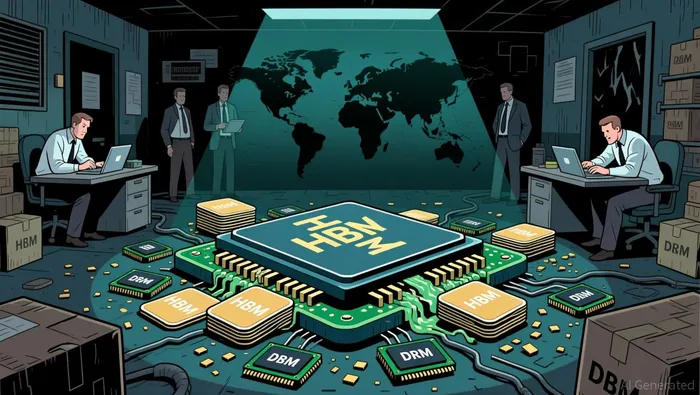
This is not a demand surge. This is a supply deficit. HSBC estimates an 8% HBM supply deficit in 2026. HBM - the high-bandwidth memory that feeds NVIDIA GPUs and custom AI accelerators - is consuming capacity that would otherwise produce standard DRAM for smartphones, PCs, and servers. The result is a cascading shortage: HBM takes wafer output, standard DRAM supply tightens, and ASPs (average selling prices) rise across the board. Samsung DRAM ASP increases are estimated at 84% in this cycle. That is pricing power, not volume growth.
The constraint has migrated up the chain.
This is where the specific names in the headlines matter. Rambus, Monolithic Power Systems, and Zscaler are not "AI stocks" in the vague sense. They sit at physical constraint points in the AI infrastructure buildout.
Rambus designs chips and IP that advance data center connectivity and solve the bottleneck between memory and processing. The company introduced PCIe 7.0 switch IP for scalable AI infrastructure in early May and won the "Semiconductor Product of the Year" designation. In a shortage environment, the company that controls data movement between memory and processor has leverage.
Monolithic Power Systems has surged over 70% in 2026 because AI infrastructure requires power management at every layer of the stack. The company projects 50%+ growth in its enterprise data segment. Power is the new constraint: as AI racks consume megawatts, the companies that deliver regulated voltage at the chip level are capturing the margin.
Zscaler sits at the cybersecurity layer of cloud infrastructure. As hyperscalers build AI data centers and migrate workloads, security architecture is mandatory infrastructure, not an optional add-on. The company's inclusion alongside memory and power names reflects how the AI buildout has become a chain of sequential constraints, each requiring specialized suppliers.
Why the market is not pricing in geopolitical risk.
The Iran situation is real. The ceasefire is fragile. Trump said the Iran ceasefire is on 'life support' and has cycled through threats to strike power plants, blockade the Strait of Hormuz, and negotiate deals that are described as "largely" reached but not finalized. Oil markets move on these headlines. Defense stocks move.
But semiconductor supply chains have a different structure. Allianz noted in March 2026 that AI-related orders benefit from priority access within semiconductor supply chains. The four largest hyperscalers have spent $1.3 trillion on capital spending and R&D since Q4 2022, much of it directed at generative AI infrastructure. Those companies are locked into multi-year supply contracts with memory and equipment manufacturers. The supply constraint is so severe that manufacturers are already turning away non-AI customers to fulfill AI orders.
In this environment, a temporary disruption - shipping delays through Hormuz, short-term logistics friction - does not change the structural math. The constraint is capacity, not logistics. The bottleneck is wafer lines and packaging capacity, not oil prices. Until a geopolitical event directly targets semiconductor manufacturing capacity in Asia, the supply chain is insulated by design.
The sustainability question.
This is where the narrative requires a boundary. The supply-driven pricing power that is currently protecting these stocks from macro noise is not permanent. It lasts only as long as the constraint holds. The variables that change the equation are:
- Whether memory manufacturers use the ASP recovery to rebuild standard DRAM capacity at scale, which would eventually flood the market and compress pricing.
- Whether hyperscaler capex slows, reducing the demand that justifies capacity allocation to HBM over standard products.
- Whether advanced packaging capacity (CoWoS, EMIB) expands fast enough to remove the current bottleneck at the assembly layer.
Each of these would shift the constraint, change who holds pricing power, and re-expose the supply chain to macro risk.
Investor Takeaway
The key issue is not whether the Iran ceasefire holds or whether geopolitical headlines intensify. The more important question is whether memory manufacturers maintain the supply discipline that is currently supporting pricing power. If Samsung, SK Hynix, and Micron resist the temptation to convert today's ASP recovery into tomorrow's oversupply, the current trajectory holds. If they respond like they did in 2021 - bidding for volume with capex that outpaces demand - the pricing power evaporates, and the market's dismissal of macro risk will prove premature. Watch memory capex-to-revenue ratios over the next two earnings cycles. That is the leading indicator.