

Micron and SK Hynix Crossing $1 Trillion Shows How Fast the Memory Trade Has Heated Up
This is no longer a niche semiconductor story. Micron just reached a $1.01 trillion market capitalization, and SK Hynix also crossed the $1 trillion mark. That puts memory at the center of the AI rally, with the market now debating how far the move can go rather than whether demand is real.
The momentum has been concentrated and fast. Micron has climbed in 11 of the last 15 sessions and has more than doubled since the end of March. The Roundhill Memory ETF has amplified the move, finishing its first month up approximately 107% and still up 31% over the past week.
That leaves investors with two readings of the same setup. Bulls see a genuine AI bottleneck with room for earnings to keep rising. Skeptics see a crowded momentum trade that could cool quickly. Either way, the sector's strength is now impossible to ignore.
AI Demand Is Changing the Memory Cycle
AI moved memory into the bottleneck
This rally is not being driven mainly by smartphones or a vague enterprise rebound. Data centers now consume over 50% of DRAM and NAND bit TAM, which makes memory part of the core AI buildout rather than just a downstream consumer-electronics commodity.
The architecture is part of the pressure too. AI training and inference require more memory close to compute, pulling capacity into products such as HBM. Micron has pointed to a $100 billion HBM market by 2028. That does not prove the bull case on its own, but it does help explain why memory is getting renewed attention inside the AI stack.
Supercycle forecasts now extend into 2028
The broader industry view is what makes this rally different from a standard bounce. Analysts and industry watchers argue DRAM and NAND likely to remain in short supply until at least 2028. One I/O Fund analysis goes further, projecting global semiconductor revenue rising 62.7% in 2026, with DRAM revenue expected to nearly double and NAND revenue potentially quadrupling.
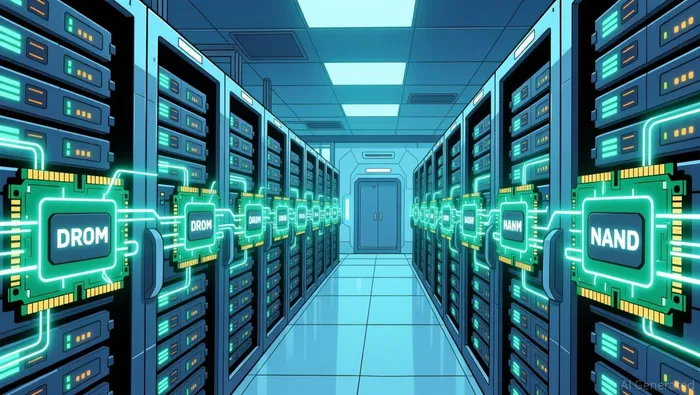
If supply stays tight while AI demand keeps building, the current rally is still tied to fundamentals rather than pure speculation.
Valuation and Targets Still Show How Wide the Debate Is
Micron has rallied roughly 240% over the past year, yet it still trades at 9.9 times forward earnings versus 22 times for the S&P 500 and 25 times for Nvidia. That is why the setup still matters: the stock has already run, but the valuation debate has not settled.
Price targets also show how much room there is for disagreement. UBS has outlined a much more bullish path, while the roughly $640 average target still implies a very different outlook. In other words, this is now a discipline trade as much as an AI narrative trade.
The clearest way investors are playing the move
The most direct exposure remains the core memory group: Micron, SK Hynix, Samsung, Western Digital, SanDisk, and Seagate. In the Roundhill Memory ETF, Micron, SK Hynix, and Samsung making up about 75% of the ETF, which is why the fund has become the clearest proxy for the sector's momentum.
What would keep the thesis intact
- Prices are still rising:Another day another new high for DRAM prices.
- Supply remains constrained: analysts expect DRAM and NAND likely to remain in short supply until at least 2028.
- Demand is broadening: data centers now account for over 50% of DRAM and NAND bit TAM.
What would weaken the thesis
- DRAM prices stop climbing or start to roll over.
- Supply catches up faster than expected, easing the shortage before earnings fully reflect it.
- AI spending slows or shifts away from memory-intensive hardware.
The narrative part of the trade is no longer the hard part. The question now is whether pricing, supply, and earnings can keep supporting a sector that has already repriced so aggressively.