

The $115 million vs. $145 billion problem
Meta launched America's Workforce Academy on Monday with all the ceremony a Silicon Valley press conference can muster: Mike Rowe on stage, Dina Powell McCormick - the former Trump adviser Meta installed as president and vice chairman this January - delivering the corporate citizenship speech about pathways and economic transformation. The announcement has drawn bipartisan praise. A former Trump adviser called it exactly what the economy needs. An ex-Facebook executive said more companies should follow suit.
It is a PR stunt. Not because the program is a fraud, but because $115 million is a rounding error against the real constraint Meta faces: a $125 to $145 billion capital expenditure program for 2026 alone, building data centers at a pace the American construction workforce cannot physically support.
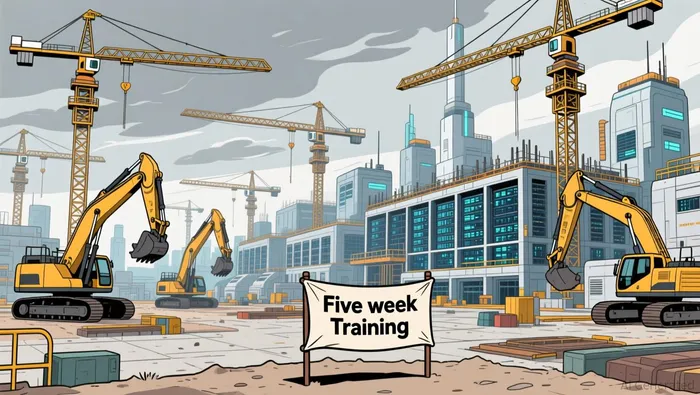
Five weeks is not an apprenticeship
America's Workforce Academy is a five-week training course launching in Louisiana, Ohio, Indiana, and Texas. It covers electricians, plumbers, and welders - the skilled trades needed to build data centers. Every graduate gets a guaranteed job on a Meta partner construction site, and Meta covers all costs. The program is operated in partnership with CBRE and the Associated Builders and Contractors.
Any astute construction manager would have noticed the gap between five weeks and a qualified trade worker immediately. Electrical apprenticeships take four years. Plumbing takes four to five. These are licensed trades that require state certifications, journeyman exams, and years of hands-on work before a worker can operate independently on a critical infrastructure project.
What Meta is actually building is a feeder pipeline for entry-level labor positions - cable pullers, equipment helpers, basic technician roles - dressed up as trade school. That's not nothing. But it is not the equivalent of creating a cohort of licensed electricians or master plumbers. Five weeks can produce helpers, not tradespeople. The national shortage Meta is supposedly solving is measured in 439,000 to 499,000 fully qualified skilled workers, not in people who finished a five-week orientation course.
The scale problem
The numbers tell the real story. Let's decompose the $115 million. Even if every dollar went directly into training costs - and it doesn't, since Meta is also funding program operations, partnerships, and the marketing apparatus around it - the academy would need to train thousands of workers per year across multiple states to meaningfully dent a half-million worker national shortage.
The program launches in four states. Even optimistically, Meta could graduate a few thousand workers per year. Against a shortage measured in hundreds of thousands nationally, that is a drop in an ocean. It is corporate philanthropy at best, and signal-theft at worst.
Now compare the headline of this story with Meta's actual 2026 capex guidance. In April, Meta raised its full-year capital expenditure forecast to between $125 billion and $145 billion - up from its initial guidance of $115–$135 billion and more than double the $72.2 billion it spent in 2025. That capital is going into data center construction, power infrastructure, networking hardware, and custom AI chips.
The $115 million academy is 0.08% of Meta's 2026 capex budget. Less than one-tenth of one percent. If Meta actually believed the skilled labor shortage was the binding constraint on its AI buildout, it wouldn't be spending $115 million on a training program. It would be spending billions on construction firms, workforce development at scale, or acquiring capacity through deals with established industrial partners.
Why the timing matters
Meta announced this program the same month its Q1 earnings showed capex accelerating beyond what Wall Street was prepared for. The stock took a hit. Investors are asking the question that Zuckerberg dodged in every earnings call this year: when does this spending pay off?
The workforce academy announcement arrives at precisely the moment when Meta needs to project control over the AI infrastructure buildout. The message is designed to reassure - we have the capital, we have the workers, we have the plan. The reality is thinner. Construction labor is already cited as a bottleneck by the construction industry, with up to 41% of the current skilled trade workforce expected to retire by 2031. A 60-megawatt data center that runs behind schedule costs millions per day in delayed compute deployment. Half of planned 2026 data center projects have been delayed or cancelled, partly due to labor and infrastructure constraints.
Meta isn't solving the labor shortage. It's performing the solution so the stock doesn't have to price in the delay.
The counterargument, and why it doesn't change the thesis
The charitable reading is that America's Workforce Academy is a down payment - a pilot program Meta will scale if it works. That it's better than nothing, and that even entry-level feeder roles free up experienced tradespeople for more complex tasks. That the guaranteed-job model is a real innovation that could reduce dropout rates in trade careers.
None of those things are false. But none of them make this an infrastructure solution either. A down payment that is 0.08% of the total investment is not a strategy. It's a gesture. And a gesture directed at Dina Powell McCormick's political contacts and Mike Rowe's audience is a gesture with an audience in mind - not an engineering team.
What investors should actually watch
The real question for Meta investors is not whether America's Workforce Academy is a nice idea. It is whether Meta's $145 billion capex program can be deployed on schedule when the construction labor market is structurally short by half a million workers and aging out at record rates.
The cross-currents are clear:
- Capex is accelerating - Meta raised its 2026 forecast upward in April, signaling that the buildout is getting more aggressive, not less. That puts more pressure on the labor bottleneck, not less.
- Labor cannot be trained quickly - Five-week programs produce helpers, not licensed tradespeople. The national pipeline for skilled trades takes years, not weeks.
- Delays are already happening - Industry data shows half of 2026 data center projects are already delayed or cancelled. Meta is not immune. If its data centers slip, the AI compute arrives later, the revenue from AI-driven ad products arrives later, and the capex ROI question gets harder.
- The PR machine is working - As long as the workforce academy story dominates the narrative, the labor bottleneck stays off investors' radar. That is a temporary cover, not a permanent solution.
Directionally, the labor bottleneck is real and Meta knows it. The question is whether Meta's execution can absorb the delays or whether the $145 billion buildout runs into the same physical constraints that are already halting half the industry's planned projects.
You decide which was marketing fluff and which one was analysis.