

Let me start with the conclusion: Meta's new America's Workforce Academy is a feel-good press release designed to distract from the real story - a capital expenditure binge that is destroying free cash flow at a company already trading without any margin of safety.
The program itself is worth noting because it is not. Meta announced a free five-week training partnership with the Associated Builders and Contractors to teach Americans how to install fiber and build data center infrastructure. Graduates get a guaranteed job. A former Trump adviser and an ex-Facebook executive called it praiseworthy. The headline asks if more companies should follow suit.
From a cash-flow perspective, the question should be why Meta needs to train its own workforce at all. The answer: because it is planning to spend between $125 billion and $145 billion this year on capital projects, mostly AI data centers, and it cannot find enough construction workers fast enough. The workforce academy is not corporate citizenship. It is an operational admission that the spending plan is outpacing supply.
Now let's talk about the numbers. Meta generated $115.8 billion in operating cash flow during 2025, which sounds enormous. But free cash flow - the cash left after paying for capital investments - fell to $46.1 billion, down from $54.1 billion in 2024. The company spent more on infrastructure than it had the year before, and there was less cash left over for investors. Revenue grew 22%, but the cash that actually returns to shareholders shrank.
The acceleration is what matters. Capital expenditure as a share of revenue was roughly 15% in 2023, climbed to 21% in 2024, and hit 36-38% in 2025. Q1 2026 capex was $19.84 billion, up 45% year-over-year, with only $12.39 billion in free cash flow that quarter. Meta then raised its full-year 2026 capex forecast from $115 billion to $125-$145 billion and announced a $20-25 billion bond sale to help fund it.
That is the structural problem. Meta is spending a third to a third-and-a-half of every revenue dollar back into infrastructure, and the trend is going the wrong direction. The market understood this. The stock fell roughly 10% after Q1 results when the raised forecast hit. It trades around $585, at approximately 21 times trailing earnings and 18.6 times forward earnings.
Here is why that is not a buying opportunity. A 21 times earnings multiple on a company whose free cash flow is deteriorating because of structural, compounding capex increases offers no margin of safety. Value investing is about buying when price sits below intrinsic value with room for error. Meta's price reflects the assumption that its AI investments will eventually generate enough return to justify spending $140 billion a year. That is a forecast, not a floor. If AI monetization lags, if hardware costs stay elevated, or if competition compresses ad margins, the multiple contracts - and there is nothing below to catch it.
While it's true that Meta's ad business remains powerful and its AI products are advancing, I would argue that cash flow durability matters more than product momentum when evaluating whether a stock is a value play. A company can innovate beautifully and still be a poor investment if the price assumes perfection and the cash flow trajectory is pointing downhill.
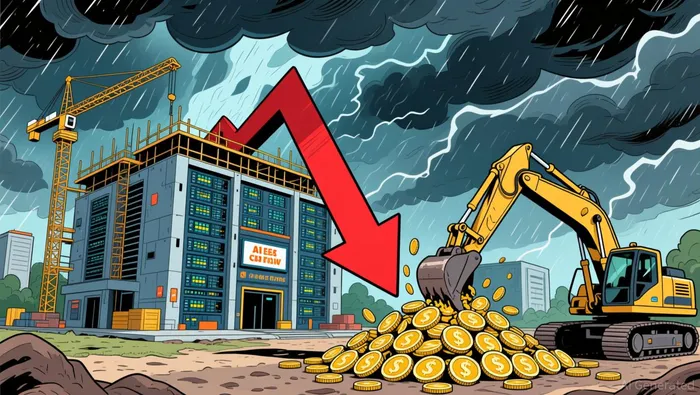
From a balance-sheet perspective, the $20-25 billion bond sale is a signal worth watching. Meta is borrowing to fund its capital program, which means the market for its debt is absorbing the overhang. That is not inherently dangerous - Meta has strong underlying operations - but it confirms that operating cash flow alone is no longer sufficient to cover the spending plan without shrinking free cash flow further.
The workforce academy is real, but it is a rounding error against a $145 billion capex program. It costs a fraction of what data center construction costs and solves a fraction of the supply constraint. The political goodwill it generates does not change the fact that Meta is spending its free cash flow faster every quarter and borrowing to make up the difference.
All things considered, there is no margin of safety here. Meta trades at a multiple that assumes AI delivers, capex stabilizes, and revenue keeps growing in the low-to-mid 20s. It is not a cheap stock. It is not a value stock. Even if Meta's AI strategy works out exactly as planned, the current price leaves little room for execution error - and in value investing, no margin of safety means no position.
There are better opportunities elsewhere that do not require you to be right about the ROI on $140 billion in infrastructure spending.