

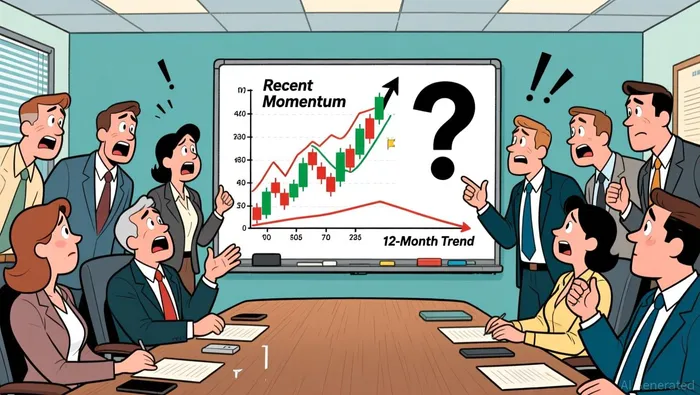
MetLife's stock has erupted in recent weeks, climbing 13.8% in the past month and 5.7% in the past week. Yet step back and look at the longer horizon, and the picture looks dramatically different: the stock remains down 1.1% over the past year and down 6.9% year-to-date. This disconnect-between explosive recent momentum and stubbornly flat longer-term performance-is the hallmark of recency bias in action.
The market is behaving as if the past month matters far more than the past twelve. That's a psychological distortion, not a fundamental revaluation. If investors were weighing all available information equally, a 13% monthly rally would likely be tempered by the knowledge that the stock still trades below its 52-week high and remains in the red for the year. Instead, the recent surge appears to be driving sentiment, with traders chasing momentum rather than reassessing intrinsic value.
The analyst community's enthusiasm only amplifies this effect. With 12 Buy ratings out of 18 analysts and a median price target of $89 implying 14% upside, the consensus is undeniably bullish. The average target sits even higher at $95.27, representing nearly 21% upside from current levels. Yet here's the behavioral tension: these price targets have been relatively stable even as the stock has rallied. The gap between where MetLife trades and where analysts say it's headed hasn't narrowed meaningfully-the stock has simply caught up to the lower end of expectations.
This creates a dangerous feedback loop. Recent buyers, seeing the price climb, interpret the momentum as validation. Analyst ratings provide social proof, triggering herd behavior. Meanwhile, the fundamental question-whether MetLife is actually worth significantly more than it was three months ago-gets drowned out by the noise of short-term price action. The market is pricing in a narrative of renewal, but the numbers suggest that narrative remains unproven.
Recency Bias and Herd Behavior Driving the Rally
The Q4 earnings report delivered exactly what the bull case needed: full-year adjusted earnings of $8.89 per share and an adjusted ROE of 16%-right at the midpoint of management's 15-17% target range. These are solid numbers. But the market's reaction reveals something less rational than a cold calculation of intrinsic value.
When MetLife reported Q4 adjusted earnings of $2.49 per share, that represented a 24% year-over-year jump. The recency bias mechanism is straightforward: recent positive information carries disproportionate weight in human judgment. Investors who bought after the report are responding to the freshness of the good news, not necessarily revaluing the entire stream of future cash flows. The earnings beat is real, but the magnitude of the rally suggests the market is overweighting this single data point relative to everything else-including the fact that the stock still trades below its 52-week high.
The herd behavior component is equally telling. Of 18 analysts covering MetLife, 12 recommend Buy with zero selling ratings. That's a consensus so uniformly bullish it becomes self-reinforcing. When investors see that level of agreement, especially from prominent firms, the natural tendency is to assume the collective wisdom must be correct. This is social proof in action-the psychological shortcut where people look to others' behavior to determine their own, particularly under conditions of uncertainty.
What's notable is that the analyst targets haven't moved dramatically toward the current price. The median target sits at $89, implying 14% upside from here. But that target has been relatively stable even as the stock has rallied. The gap hasn't closed meaningfully-the stock has simply caught up to the lower end of the analyst range. This suggests the price movement is being driven more by the sentiment around the ratings than by revisions to fundamental expectations.
The behavioral tension here is subtle but important. Strong Q4 results justified a positive revaluation. But when you combine recency bias with a wall of Buy ratings, you create a feedback loop: recent buyers see the price climbing and interpret it as validation, new buyers see the analyst consensus and jump in for social proof, and the original fundamental question-whether MetLife is genuinely worth significantly more than it was three months ago-gets drowned out. The numbers show a well-run company meeting its targets. They don't necessarily justify a price that has already captured most of the analyst upside.
Anchoring and Loss Aversion in MetLife Valuation
The analyst price target range for MetLife spans from $75 to $102-a spread of $27 that reveals more about psychological anchoring than fundamental disagreement. At current levels around $78, the stock sits just 3.9% above the low target while sitting 30.6% below the high. This asymmetry is telling: the market has anchored to the conservative end of the range, treating the low target as a psychological floor rather than viewing the entire spectrum as equally plausible.
Anchoring theory predicts that when faced with uncertainty, investors latch onto specific reference points-and analyst price targets provide exactly that. The median target of $89 has remained remarkably stable even as the stock has moved. What's striking is that the current price has essentially caught up to the lower bound of expectations. The market is not pricing in the upside narrative that the high target represents; instead, it's hugging the floor. This explains why the rally, despite its recent intensity, hasn't meaningfully closed the gap to the median target-the anchor holds firm.
But there's a second behavioral force at work: loss aversion. MetLife is down 6.9% year-to-date and remains below its 52-week high. For investors who bought at higher levels, that underwater position creates psychological pain that looms larger than any potential gain. Prospect theory tells us losses hurt roughly twice as much as equivalent gains feel good. So even as the stock rallies, the memory of YTD losses keeps buyers hesitant to push the price toward the high targets. The market is effectively discounting MetLife's fundamental value because the recent past has been unpleasant.
This creates a valuation disconnect. At a P/E of 16.6x, MetLife is not cheap-but it's not absurdly expensive either. The company is generating solid returns, hitting its ROE targets, and delivering earnings growth. Yet the combination of anchoring to conservative price targets and the emotional weight of recent losses prevents the market from fully appreciating that fundamental picture. The stock trades as if the bad past still matters more than the solid present-and as if the optimistic future is less certain than the conservative anchor suggests.
The behavioral tension is clear: rational valuation would weight all information equally, past and future. But human psychology doesn't work that way. The market is pricing MetLife through a lens distorted by where it's been, not where it's going.
Catalysts and Risks to Watch
MetLife now trades near the upper end of its 52-week range, positioning the stock at a critical inflection point. The recent rally has consumed much of the gap between current price and analyst targets, but genuine validation requires something more than momentum alone: either sustained earnings beats that justify higher valuations, or a broader market re-rating of insurance names. The forward picture breaks down into two paths.
On the catalyst side, three developments could sustain the rally. First, volume growth in Group Benefits remains underappreciated-the business added approximately $600 million of new adjusted premiums in 2025, with higher-margin voluntary PFOs rising 10% year over year. If renewal season delivers robust results, particularly in dental where persistency has strengthened, the market may begin pricing in continued expansion. Second, pension risk transfer integration is progressing: the company closed on the PineBridge Investments acquisition, scaling assets under management to $742 billion. Successful integration could unlock fee income that the market hasn't yet fully recognized. Third, interest rate stabilization would remove a key headwind for life insurers. While rates have been volatile, any clear path toward stability would improve the outlook for MetLife's investment income and reduce the discount pressure on legacy book values.
But the risks are equally concrete. The most immediate behavioral risk is a momentum correction. The stock sits just 3.9% above the low end of the analyst target range at $75. If the rally loses steam and sentiment shifts, a move back toward that conservative anchor represents roughly 5% downside. This isn't a fundamental assessment-it's the mechanical result of recency bias reversing. Investors who bought at the top of the recent rally could find themselves quickly underwater if the momentum narrative breaks.
There's also the matter of execution. The company faces a higher direct expense ratio in 2026 due to the PineBridge acquisition, adding 50 basis points to costs. Disability experience has trailed expectations, and Latin America faces a roughly $50 million impact from the Mexico VAT change. These aren't catastrophic, but they're real headwinds that could derail the earnings momentum if they worsen.
The behavioral tension here is clear: the stock has rallied on sentiment and recency, but it now needs fundamentals to catch up. At current levels, the market is pricing in a story of renewal-but that story remains unproven. For the rally to hold, MetLife needs to deliver sustained beats that justify the higher price. For the correction to trigger, it only takes one quarter of disappointment or a broader market shift away from financials. The stock sits at an inflection point where psychology and fundamentals will soon collide.