

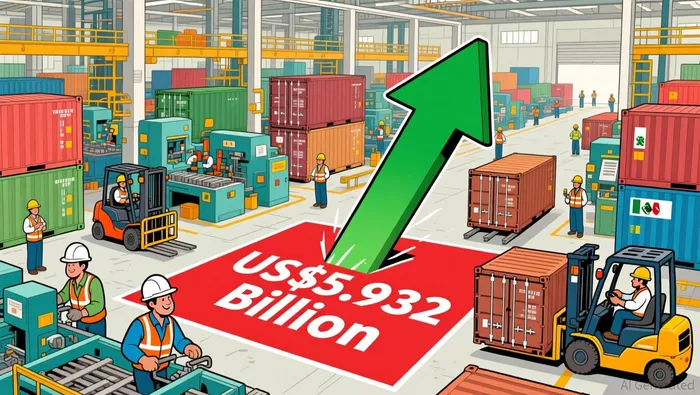
- Mexico's trade balance reversed sharply to a US$5.932 billion surplus, marking a significant deviation from the previous period's deficit and exceeding market expectations.
- The data underscores strong external demand for Mexican exports, providing a critical buffer for an economy facing domestic growth deceleration and sticky inflation.
- While the surplus supports the peso and current account dynamics, it contrasts with forecasts of flatlining GDP, highlighting a divergence between external and internal economic performance.
- Investors are weighing this positive trade data against the Bank of Mexico's likely decision to hold rates steady in May to anchor inflation expectations.
- The divergence between trade strength and domestic stagnation suggests that external sectors remain the primary engine of growth, even as internal demand and policy constraints weigh on the broader economy.
Mexico's latest trade balance data reveals a dramatic turnaround in the country's external sector performance, delivering a surplus that stands in stark contrast to recent historical trends and modest market forecasts. The actual release of a US$5.932 billion surplus not only eclipsed the previous reading of a US$0.463 billion deficit but also significantly surpassed the consensus forecast of a US$0.700 billion surplus. This substantial positive deviation signals that Mexican exports, particularly in manufacturing and nearshoring-linked industries, continue to exhibit robust resilience despite global economic uncertainties. For retail investors and macro analysts, this data point serves as a critical indicator of the external sector's ability to support the national economy, even as domestic growth metrics show signs of stagnation.
What Does The Mexico Trade Balance Data Reveal About Export Strength?
The trade balance, which measures the difference between a country's exports and imports of goods and services, is a key component of the gross domestic product (GDP) and a vital indicator of external competitiveness. Mexico's move from a deficit to a multi-billion dollar surplus suggests a significant acceleration in export volumes or prices relative to import costs. This reversal is often interpreted as a sign of strong global demand for Mexican-produced goods, particularly in sectors such as automotive, aerospace, and consumer electronics, which benefit from the United States-Mexico-Canada Agreement (USMCA) and ongoing nearshoring trends. The magnitude of the surplus, far exceeding the modest forecast, indicates that supply chain reconfiguration efforts are yielding tangible results, with Mexican factories successfully capturing market share from other low-cost manufacturing hubs.
However, the composition of this trade surplus warrants close attention. While the headline number is positive, investors must consider whether the surplus is driven by volume growth or price fluctuations. In an environment where global commodity prices can be volatile, a surge in energy or agricultural exports could artificially inflate the trade balance without reflecting underlying industrial strength. Conversely, a decline in import prices, possibly due to softer global demand for intermediate goods, could also widen the surplus. The fact that the previous period saw a deficit suggests that these dynamics are fluid and sensitive to external shocks. For the Mexican economy, a sustained trade surplus is generally supportive of the current account and provides foreign exchange reserves that can buffer against currency volatility. This is particularly relevant given the country's deep economic integration with the United States, where a significant portion of exports is destined.
Why Are Investors Watching Mexico's Trade Data Amid Growth Concerns?
The release of strong trade balance data arrives at a time when broader economic indicators in Mexico present a more mixed picture. Recent analysis from Scotiabank economists projects that Mexican GDP flatlined in year-over-year terms and contracted on a quarter-over-quarter basis in the first quarter of 2026, marking a sharp deceleration from the fourth quarter of 2025. This divergence between a strong external sector and weak domestic growth creates a complex macroeconomic landscape. It suggests that while Mexican exports are performing well, internal demand and investment may be struggling. This imbalance can have significant implications for monetary policy, as the central bank, Banxico, must balance the need to support growth with the imperative to control inflation.
Inflation remains a key concern for Banxico, with headline inflation holding steady at 4.53% in the first half of April. This persistence is largely driven by non-core components, particularly processed foods and agricultural prices, which have been impacted by adverse weather and logistics disruptions. Core inflation shows slight deceleration in goods, but service price growth remains elevated. The strong trade surplus could potentially complicate Banxico's policy calculus. On one hand, a robust surplus supports the peso, which can help import prices and reduce imported inflation. On the other hand, if the surplus is driven by strong domestic production and demand, it could fuel wage pressures and further inflationary risks. Additionally, external risks from Middle East energy volatility pose a threat to global supply chains and energy prices, which could feed into Mexico's inflation dynamics despite the current trade surplus.
Given these conflicting signals, market expectations for Banxico's next policy move are leaning towards a hold. While some board members have expressed dovish sentiment, favoring a rate cut to 6.50%, the bank is advised to hold policy unchanged in May to prevent inflation expectations from unanchoring. The strong trade data reinforces the need for caution, as it suggests that the economy is not in immediate danger of a severe downturn, but the persistent inflationary pressures require a vigilant stance. Investors are closely monitoring how Banxico interprets this trade data in conjunction with other economic indicators, such as retail sales and industrial production, to gauge the future path of interest rates.
How Does This Data Impact The Peso And Regional Markets?
For currency traders, the Mexico trade balance is a leading indicator for the peso's direction. A significant surplus typically leads to increased demand for the local currency, as exporters convert their foreign earnings into pesos. This increased demand can strengthen the peso against the US dollar, making Mexican assets more attractive to foreign investors. However, the strength of the peso must be weighed against the broader macroeconomic context. If the strong trade balance is accompanied by weak domestic growth and high inflation, the real return on Mexican assets may be eroded. Furthermore, the peso is sensitive to global risk sentiment and US monetary policy. Any shifts in Federal Reserve expectations or global trade tensions could offset the positive impact of the trade surplus.
Regionally, Mexico's trade performance has implications for neighboring countries, particularly those in the Latin American bloc. As Scotiabank's recent report highlights, the region is navigating a packed week of central bank meetings and economic data releases. In Brazil, the central bank is expected to cut rates, while Chile is projected to hold steady. Peru is facing growth slowdowns due to natural gas supply disruptions. Mexico's ability to maintain a trade surplus while managing domestic inflation places it in a unique position relative to its peers. If Mexico can sustain this external strength without exacerbating inflation, it may attract further foreign direct investment, reinforcing its role as a key manufacturing hub in the region. However, the risk of external shocks, such as energy price volatility, remains a constant threat that could quickly alter this favorable outlook.
In conclusion, Mexico's trade balance data provides a compelling narrative of external resilience in the face of domestic challenges. The sharp reversal to a US$5.932 billion surplus highlights the strength of the export sector, driven by nearshoring and global demand. However, this positive development must be contextualized within a broader macroeconomic environment characterized by flatlining GDP, sticky inflation, and uncertain policy paths. Investors should view this data not as a standalone signal of economic health, but as one piece of a complex puzzle. The interplay between external strength and internal weakness will likely dictate Banxico's policy decisions and the peso's trajectory in the coming months. As such, market participants should remain vigilant to subsequent data releases, particularly those related to inflation and domestic growth, to refine their views on Mexico's economic outlook.