

Micron offers HBM scarcity; SanDisk offers contract visibility
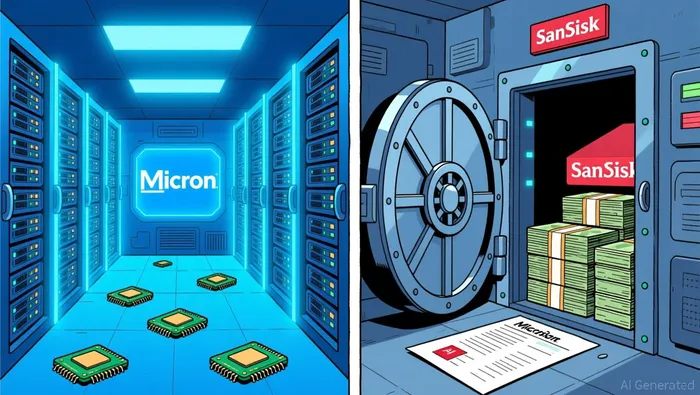
After Micron has gained 154% year to date and SanDisk has surged 493%, neither stock looks like a cheap entry. The choice now is less about which memory name is hotter and more about which edge you trust: Micron's tighter AI-memory bottleneck, or SanDisk's more visible booked demand.
Why Micron is the scarcity play
Micron's case starts with a very tight supply constraint. Its entire 2026 HBM chip supply is already sold out, and that gives it a direct link to one of the most constrained parts of AI memory. Micron also offers DRAM, HBM, and NAND exposure in one company, so investors are not betting on just one product line.
The trade-off is that Micron is still exposed to the broader memory cycle. If HBM stays tight but other segments cool, the overall story becomes less pure.
Why SanDisk is the visibility play
SanDisk makes a different case. Rather than leaning on the broadest product mix, it is backed by $42 billion in multi-year supply agreements and more than $11 billion in financial guarantees. Bulls see a business that may be earning more durable visibility than a typical NAND cycle deserves. Skeptics see a cyclical business that has already been rerated sharply.
Micron's AI mix is improving, but the capex response is the risk
Micron remains the cleaner public way to own HBM scarcity because HBM is closer to the tightest bottleneck in AI memory. Its entire 2026 HBM chip supply is already sold out, and it also gives investors DRAM, HBM, and NAND exposure through one platform.
The bull case: a better earnings mix
The stronger argument is not just that Micron sells HBM, but that AI demand is changing the composition of the business. In fiscal 2025, data center was 56% of sales, up from 35% in FY24, while HBM, high-capacity DIMMs, and low-power server DRAM revenue reached $10 billion. If that mix keeps improving, Micron's upside comes from more than a simple price rebound.
The bear case: new supply can change the story
Micron is also about $200 billion in planned capacity expansion. That shows management expects AI-related demand to stay strong, but it also highlights the classic cycle risk: today's scarcity can turn into tomorrow's pricing pressure if new supply arrives too fast.
SanDisk's edge is the contract book, not just the quarterly spike
SanDisk's appeal is not that it is the biggest NAND player. It is that its latest demand signal looks more like booked infrastructure than another fleeting quarterly chase. In the latest quarter, revenue rose 97% QoQ and 251% YoY, while data center revenue jumped 233% QoQ. The company also signed five long-term agreements with more than $11 billion in guarantees and disclosed a $42 billion backlog under contract tied to multi-year supply agreements.
Why the contract book matters
Bulls argue this is more than a good quarter. It suggests SanDisk may be selling capacity with better visibility than a standard NAND cycle provides. SanDisk is also debt-free, which adds flexibility as the market decides how durable this demand really is.
What the market still needs to prove
The stock has already been re-rated dramatically since the spinoff, so the next question is whether investors keep treating the backlog as a valuation anchor rather than dismissing it as part of a cyclical recovery. That is the thesis to watch between earnings reports.
How to choose between Micron and SanDisk now
The better stock depends on what kind of upside you want. Choose Micron if you want the tighter bottleneck: it offers broader DRAM, HBM, and NAND exposure and sits at the front of the sold-out 2026 HBM allocation. Choose SanDisk if you want a cleaner read on how demand is being booked: it is the name backed by multi-year supply agreements and $11 billion in guarantees.
What would change the comparison
- Micron becomes less compelling if investors stop focusing on sold-out 2026 HBM and start focusing more on planned capacity expansion.
- SanDisk becomes less compelling if investors decide its multi-year supply agreements still do not outweigh the usual NAND cycle discount.
- Both become less attractive if investors rotate toward a more diversified memory and storage ecosystem instead of concentrating on single-stock upside.
For now, the practical decision is simple: own the scarcest AI-memory exposure, or own the cleaner contract book. Just know which evidence would prove you wrong.