

The spring relief on household budgets was real, but short-lived
The spring breathing room was real, but it was narrow. Households on default tariffs saved £117 from April to June, yet Ofgem has already set the next default-tariff level at £1,862 from 1 July 2026. That means the seasonal pressure is about to rise again just as families thought costs might stabilise.
Inflation data now risks looking stale
That timing matters because the latest comforting macro data are already behind the conflict. Official UK inflation was 3% in the year to February, but that reading was collected before the US-Israel war with Iran began, when petrol was at its lowest since June 2021. The oil shock arrived after that snapshot, and pump prices for petrol and diesel have since soared.
The broader cost-pressure signal is already visible
Fuel prices are not staying isolated. Higher transport costs can feed through to food costs, leisure, and other services as firms pass on expenses. Even after the spring reset, bills were still about a third higher than before the war in Ukraine. That leaves households with less room to absorb another leg up in costs.
Why the Iran war can still push up UK bills
Global energy markets transmit the shock fast
The UK does not need to be close to the fighting for budgets to feel it. Energy markets are global, so a Middle East shock can raise what families pay without a direct UK supply cutoff. What matters is whether the disruption moves through crude, refined fuels, gas-linked heating costs, and transport quickly enough to widen beyond a temporary war premium.
The Strait of Hormuz is the key choke point
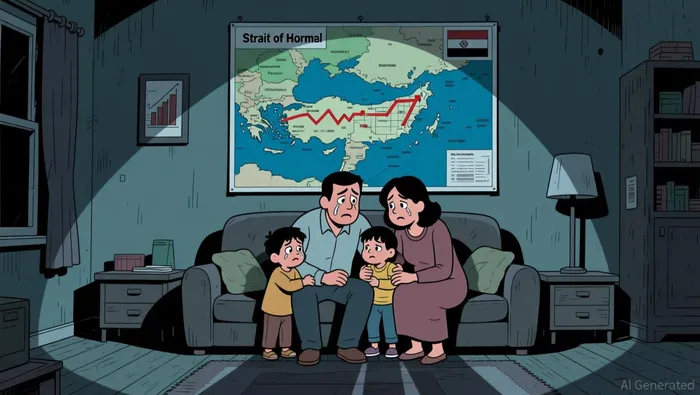
Earlier this year, the closure of the Strait of Hormuz became a major disruption to global oil supplies. Roughly 15% of global oil supply and about 20% of global LNG normally pass through that route. When that artery tightens, markets price scarcity before the effects are fully visible at the pump or on household bills.
The transmission chain is already starting to show up
Recent price moves point in the same direction:
- crude and refined-fuel prices have risen
- UK pump prices have started to climb
- inflation data now need updating because fuel conditions have changed sharply since they were collected
- energy costs remain elevated from the previous shock
That does not prove a second full cost-of-living squeeze, but it does show why the next bill cycle deserves caution rather than complacency.
The market may be anchoring to an outdated baseline
The market's comfort looks less like discipline and more like anchoring. Official UK inflation still read 3% in the year to February, but that snapshot was taken before the war began, when petrol was at its lowest since June 2021. Treating that calm reading as a new baseline ignores the fact that fuel conditions have changed since then.
The base case is still a higher-cost one
The real issue is not only a volatile crude spike. It is that energy costs remain elevated from the last shock. Even after the April reset, household energy prices were still about a third higher than before the war in Ukraine, and the latest cap level applies from 1 July to 30 September 2026. That raises the risk that a fresh supply shock lands on a budget base that was never fully repaired.
What would change the outlook from here
The key question is no longer just geopolitics. It is whether households can absorb the new default-tariff floor of £1,862 from 1 July 2026 before fuel costs spread further into the rest of the basket. Analysts link every $10 increase in oil to roughly 7p a litre of pump pressure, and petrol above 150p a litre is still described as not out of the question if crude stays elevated.
Catalysts and watchpoints
- Watch oil volatility tied to the conflict's progress, since crude prices have risen sharply since the start of the war, although they are volatile.
- Monitor whether the closure of the Strait of Hormuz eases; if it does, the market may be dealing with a temporary premium rather than a sustained shock.
- Track pump prices in real time. Petrol had risen to 137.78p a litre and diesel to 151.81p in recent reporting.
- Look beyond the pump. If transport costs stay high, the next question is whether firms pass them into food costs, leisure, and other services.
What would weaken the tighter view
This call weakens if the conflict narrows quickly, Hormuz traffic recovers, and fuel-price pressure eases before it can spread into wider services and inflation expectations. If that happens, investors can keep treating this as a short-lived war premium. If it does not, household budgets may face a broader squeeze while still carrying the higher energy base left by the Ukraine-war shock.