

The setup is clear. Mistral AI isn't just selling software; it's executing a high-velocity blitz to become the indispensable partner for European enterprise AI. The strategy is simple but powerful: lock in the continent's biggest banks with deep, bank-wide deals, and then leverage that foothold to dominate a massive, underserved market. The path to monetization is direct and urgent.
First, the bank-wide partnerships are the foundation. Mistral has secured multi-year, enterprise-wide pacts with HSBC and BNP Paribas. These aren't narrow pilots. They provide access to Mistral's commercial models across all business lines, from global markets to retail banking. This gives Mistral a direct line into the core operations of Europe's financial giants, embedding its technology into everything from client communications and fraud detection to internal productivity tools. It's a playbook for scaling quickly and generating recurring revenue.
The market opportunity is where the $10B+ TAM comes in. European banks are under intense pressure to adopt AI, but they face a critical bottleneck: data sovereignty and regulation. The EU's strict rules mean banks cannot simply use foreign, cloud-based AI models. They need compliant, on-premise solutions. That creates a massive gap in the market for secure, sovereign AI. Mistral's strategy is a direct response. By partnering with banks like HSBC and BNP Paribas, Mistral is positioning itself as the go-to partner for this exact need. It's not just about having a model; it's about having a model that can be deployed securely within a bank's own infrastructure, meeting regulatory demands head-on.
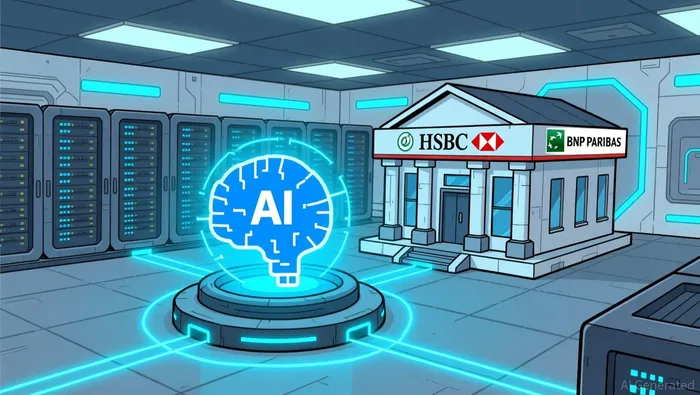
This is the alpha leak. While others chase flashy consumer AI, Mistral is building a moat in the most regulated, high-value sector. Its partnerships with Reply and others further cement this, extending the sovereign AI play into public services and other data-sensitive industries. The signal is loud: European institutions are choosing Mistral because they need AI that works for them, not against them. The strategic blitz is working, and the path to monetization is paved with bank-wide contracts in a market that has no other viable option. Watch this space.
The Financial Engine: How These Deals Translate to Revenue & Scale
The strategic partnerships are the spark, but the financial engine is the predictable, scalable revenue they unlock. This isn't speculative licensing; it's a multi-year commercial play with a clear path to monetization.
First, the deal structure is built for stability. Both the HSBC and BNP Paribas agreements are multi-year partnerships. This provides Mistral with a foundation of recurring revenue, de-risking the model and allowing for long-term planning. The scope is enterprise-wide, meaning Mistral isn't just selling a tool for one department-it's embedding its models across all business lines, from global markets to retail banking. This creates a massive addressable footprint within each bank, setting the stage for significant scaling.
The model's scalability is its secret sauce. Mistral's focus on energy-efficient, open models is critical. Unlike some proprietary systems, these models can be deployed widely across thousands of bank employees and processes without a proportional spike in cost. This allows Mistral to serve a single bank's entire global workforce efficiently, turning a pilot into a continent-wide deployment with minimal marginal expense. The economics are powerful: high initial value, low incremental cost to scale.
Early wins have already de-risked this model. BNP Paribas' journey is a blueprint. It began with a pilot in its Global Markets division that produced strong results. That success directly led to the bank extending the collaboration to its entire Group in February 2024. This progression-from a targeted pilot to a full enterprise agreement-is the exact trajectory Mistral needs to replicate with other banks. It proves the technology works in high-stakes, regulated environments and delivers tangible value, making the next bank's decision easier.
The bottom line is a growth trajectory that mirrors the partnerships themselves. Predictable multi-year contracts provide a revenue runway. The scalable model ensures those contracts can expand rapidly without burning cash. And early wins like BNP Paribas' global markets division show the model is not just theoretical-it's already generating strong results that fuel the next wave of adoption. This is how Mistral turns strategic blitzkrieg into a financial engine. Watch for the next bank to follow the BNP Paribas playbook.
The Competitive Moat: Why This Matters More Than Just a Deal
The real alpha isn't in the headline deals. It's in what those partnerships build underneath: a durable, defensible moat. Mistral is using its bank-wide pacts not just to sell software, but to create a proprietary asset that will be nearly impossible for competitors to replicate.
First, Mistral is building a deep, proprietary dataset of financial workflows and regulatory patterns. By embedding its models into core banking operations, Mistral gains unique, real-world insights into how banks actually work. This isn't theoretical data; it's the messy, complex reality of KYC/AML checks, risk controls, and compliance reporting. The company's own materials highlight this: "Transform general intelligence into specialized financial AI that knows your workflows, regulatory requirements, and risk controls." This proprietary data is the fuel for future model refinement. The more Mistral's AI is used in these high-stakes environments, the smarter and more accurate it becomes, creating a flywheel where adoption begets better performance, which begets more adoption.
Second, this integration creates massive switching costs. Once Mistral's AI is woven into multi-step workflows for onboarding, risk, and compliance, migrating away becomes operationally and financially complex. As the BNP Paribas executive noted, the solution runs "entirely on our own infrastructure-delivering productivity gains... while maintaining the data control and compliance our business requires." That control is a double-edged sword for the bank: it's a regulatory necessity, but it also means the bank's own processes are now dependent on Mistral's specific stack. The cost of retraining staff, revalidating audit trails, and re-engineering workflows is prohibitive, locking the bank in for the life of the multi-year contract.
Finally, partnerships with giants like ALTEN and Accenture extend Mistral's reach, turning it into an ecosystem enabler. These aren't just resellers; they're deployment strategists and integration experts. By combining Mistral's models with ALTEN's deep process knowledge and Accenture's global scale, Mistral can now offer turnkey solutions that are field-tested and secure. This ecosystem approach makes Mistral the default partner for banks looking to deploy AI quickly and compliantly, further cementing its position.
The bottom line is a moat built on data, dependency, and ecosystem dominance. Mistral isn't just selling AI; it's becoming the essential infrastructure for European finance. That's the strategic advantage that will outlast any single deal. Watch for this ecosystem to accelerate, making Mistral the de facto standard for sovereign AI in the region.
The Cybersecurity Alpha: Mistral's Fraud Detection Model
The strategic partnerships with HSBC and BNP Paribas are more than just software deals. They are a direct play on a bank's most critical pain point: security. Mistral's specific, high-value AI model for fraud and AML detection is the key differentiator, providing immediate, quantifiable ROI on a bank's most expensive and high-stakes operations.
Mistral has built a fine-tuned model specifically for this battlefield. The "mistral-7b-fraud2-finetuned Large Language Model" is trained on a variety of synthetically generated fraudulent transcripts. This isn't generic AI; it's a specialized weapon honed on the exact data banks need to fight modern financial crime. For a bank like HSBC, which prioritizes advanced AI capabilities, this model directly addresses a core security workflow, turning complex, manual investigations into automated, high-accuracy processes.
The automation extends far beyond simple flagging. Mistral's solutions are designed to turn entire compliance workflows into efficient, audit-ready operations. The company's materials emphasize "Automate KYC/AML, sanctions screening, and regulatory reporting while maintaining audit-ready trails." This means banks can deploy AI agents that handle multi-step processes-from initial customer onboarding checks to ongoing transaction monitoring-while automatically logging every policy check and decision. This slashes processing time, reduces human error, and creates a bulletproof digital trail for regulators.
This is the alpha leak. While other AI vendors offer general tools, Mistral's fraud detection model is a plug-and-play solution for a bank's most urgent need. It provides immediate ROI by cutting operational costs, accelerating compliance cycles, and strengthening security posture. For a bank adopting Mistral's platform, this model isn't an add-on; it's the foundational use case that justifies the investment. Watch for this to be the first model deployed in every new bank partnership, proving its value and locking in the relationship from day one.
Catalysts & Risks: What to Watch for the Thesis
The bullish thesis is set. Now, let's map the near-term milestones that will confirm it-and the tripwires to avoid.
Catalysts to Watch:
- New Bank Announcements: The next 6-12 months are critical for scaling the model. Look for announcements of new bank partners or, more importantly, the expansion of existing deals. The BNP Paribas playbook is clear: start with a division, prove value, then go enterprise-wide. Watch for news that Mistral is extending its pilot in BNP's Global Markets or other divisions, or that HSBC is rolling out its AI platform to more business lines beyond the initial focus. Each expansion is a direct signal of the model's proven ROI and a step toward hitting that $10B+ TAM.
- Proof Points from Pilots: The early wins are promising, but public metrics on cost savings or efficiency gains will be the ultimate validation. The BNP Paribas pilot in Global Markets produced "strong results," and HSBC's CEO cited "saving employees time." The next catalyst is for Mistral or its bank partners to quantify that. Look for case studies or press releases detailing specific numbers: e.g., "X% reduction in KYC processing time," "Y hours saved per week per employee," or "Z% increase in loan approval speed." These aren't just nice-to-haves; they are the hard evidence that justifies the multi-year contracts and fuels the next wave of adoption.
Risks to Monitor:
- Execution Delays at Giants: Large banks are complex beasts. Integration challenges, internal approval bottlenecks, or slower-than-expected rollout timelines could delay revenue recognition. The partnership with Reply shows Mistral is building an ecosystem to help, but the clock is still ticking on the bank's own deployment. Any slowdown in the pace of pilot-to-production conversion at HSBC or BNP would be a red flag for the growth trajectory.
- Regulatory Shifts: Mistral's entire sovereign AI bet hinges on the current EU regulatory landscape. A major shift-like a sudden relaxation of data sovereignty rules or a new, more restrictive framework-could alter the competitive dynamics. The company's strategy is built on being the compliant, on-premise solution. If the rules change, the unique advantage it's selling could be diminished or redefined overnight.
The bottom line: The thesis is strong, but it's not a done deal